1. Introduction
Specialized discourses have traditionally been regarded as mostly literal and referential. As a result, not much attention has been directed to the figurative nature of many scientific-terminology expressions, and even less attention has been devoted to the non-literalness of a significant number of specialized phraseological units (phraseological units used in languages for specific purposes, henceforth SPUS). Nonetheless, it is not a secret that however literal or referential they may appear, many terms and SPUS have originated through semantic and cognitive mechanisms such as metaphor and metonymy. But, more often than not, those mechanisms pass unnoticed due to the degree of conventionality that figurative PUS and terms usually reach through time and usage. Hence, specialized language is ‘plagued’ with novel and dead metaphors and metonymies that help insiders and laymen form meaning out of very ethereal or abstract concepts. But how does that affect the transmission of science between different languages and cultures? Does the fact that those units have originated through metaphorical and metonymic processes have implications for their translation into other languages?
The present work intends to answer the questions posed above by analyzing a random sample of 78 units (61 in Spanish and 17 in English) selected from a parallel lexicographic database of entries extracted from The Diccionario de Comercio Internacional (Alcaraz & Castro Calvín, 2007) (henceforth DCI). This dictionary was chosen with three criteria in mind:
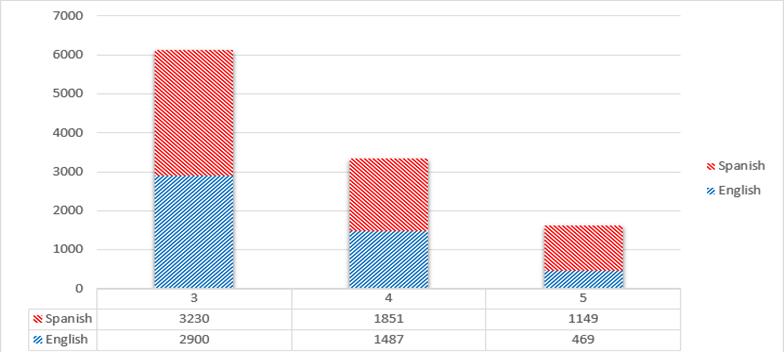
(i) it should be a specialized dictionary (in this case related to commerce and economics), (ii) it should be bilingual (in English and Spanish, to have access to the equivalents of the SPUS), and (iii) its publishing house should be recognized as a lexicographic authority. From the entries of the dictionary, a database was constructed containing 11,086 SPUS [4,856 in English (43.8 %) and 6,230 in Spanish (56.2 %)] in which 715 SPUS [144 in English (20.13 %) and 571 in Spanish (79.86 %)] that included dead metaphors in their word forms were identified. Previous studies (Deignan, 2005; Kövecses, 2002; Tercedor Sánchez, López Rodríguez, Márquez Linares, & Faber, 2012; Warren, 1992) have demonstrated that metaphor is the most common semantic mechanism underlying the generation of new meanings not only in general language but also in specialized discourses. That phenomenon is equally evident in the case of phraseology both in general and specialized languages.
2. Definitions and theoretical notions
Since this phraseological study can be classified as belonging to the area of terminology and its main focus is on semantics, it is necessary to offer some definitions as a starting point before carrying out the analyses intended here. The definitions of language for specific purposes (henceforth LSP) and term will be offered in the terminology section. Later, in the semantics section, a definition of metaphor and dead metaphor will be introduced. Next, in the phraseology section, a definition of specialized phraseological unit will be presented. Finally, to conclude the theory section, a general overview of the concept of equivalence will be offered.
Although this contrastive study is based on the translation techniques proposed by (Molina & Hurtado Albir, 2002), the definitions of the techniques identified in this study will be presented along with their correspondent analysis in section 4.
2.1. Definitions of LSP and term
The aim of offering these definitions is to set the boundaries of this study and to position our object of study within those boundaries. In most cases, notions within the fields of linguistics, applied linguistics, terminology, and translation tend to have an abundance of definitions, and more so since those notions are shared by several disciplines. LSP is not an exception to that.
From a historical perspective, Swales pinpoints the writing of the linguistic sciences and language teaching by Halliday, Strevens, and McIntosh (1968) as the beginning of an agenda towards the consolidation of the study of LSP (Swales, 2000, p. 59). LSP could be broadly defined as:
the teaching and research of language in relation to the communicative needs of speakers of a second language in facing a particular workplace, academic, or professional context. In such contexts language is used for a limited range of communicative events. (Basturkmen & Elder, 2004, p. 672)
Nevertheless, since this study does not pursue a pedagogical or didactic objective, a definition of LSP specific to terminology is needed. For instance, the definition of LSP, put forward by Hoffmann, offers a shared ground for linguistics and terminology when he asserts that:
A specialized language (LSP) is the group of all the linguistic resources that are used in a communication field -delimited by the specialized discipline- to ensure the understanding among the people that work in a certain field. (Hoffmann, 1998, p. 57, our translation)1
Besides his definition of LSP, one of Hoffman’s most remarkable contributions was to put forth the notions of LSP variation in which it is possible to differentiate several types of LSP (horizontal variation) and different types of registries or levels of specialty (vertical variation) (1998, p. 65). The conception of several levels of specialty brings up the question of the notion and the positioning of language for general purposes (henceforth LGP) among them. In this regard, Picht and Draskau state that LGP (from Hoffmann’s point of view) has an “autonomous existence while the existence of LSP is LGP-dependent” (1985, p. 3).
In addition to their comments on Hoffmann’s notions, Picht and Draskau present a more refined definition of LSP that, in turn, will be the one guiding this paper:
LSP is a formalized and codified variety of language, sued for special purposes and in the legitimate context-that is so to say, with the function of communicating information of a specialist nature at any level- at the highest level of complexity, with the aim of informing or initiating other interested parties, in the most economic, precise and unambiguous terms possible (Picht & Draskau, 1985, p. 3)
One definition of term (terminological unit) that encompasses the notion of LSP chosen for this paper is proposed by the Communicative Theory of Terminology and the works by Cabré:
These units (terminological units/terms) are, at the same time, similar and different from the lexical units of a language, denominated as words in lexicology. Their specialized character can be identified in their pragmatic aspects and mode of signification. Their signified is the outcome of a negotiation among experts. This negotiation happens within the specialized discourse through their use that determines the meaning of each unit. (Cabré, 2000, p. 14 our translation)2
After delimiting the notions guiding the present work regarding terminology, it is now necessary to specify the concepts of metaphor and dead metaphor employed here.
2.2. Definition of metaphor and dead metaphor
Although originally studied as a rhetorical figure and a trope, the concept of metaphor has evolved for over 2,300 years since it was first defined. It has gone from being considered a merely ornamental device used for the embellishment of language to being regarded as a cognitive mechanism that has enabled us to understand abstract or complex concepts in terms of physical, closer ones (Johnson, 1987; Lakoff & Johnson, 1980, 1999). This cognitive mechanism, in turn, has allowed us to develop the degree of sophisticated social organization and technology we enjoy -and in some cases endure- today.
Thus, in the first place, metaphor could be simply defined as “the use of language to refer to something other than what it was originally applied to, or what it ‘literally’ means, in order to suggest some resemblance or make a connection between the two things” (Knowles & Moon, 2006, p. 3). Although such definition may appear too schematic, it actually comprises the entirety of the phenomenon both in its linguistic manifestation and in its conceptual dimension. Secondly, it is important to note that metaphors are traditionally studied by using the terms vehicle -which describes the expression or term used explicitly-, topic or tenor -i.e., the contextual meaning (that to which the vehicle refers when used figuratively)-, and grounds -the relationship established between the vehicle and the tenor- (Knowles & Moon, 2006, pp. 9-10).
Additionally, Knowles & Moon (2006, p. 6) also provide a classification of metaphors based on their degree of conventionality -i.e., the degree to which we identify a metaphorical expression as such or, on the opposite end, the degree to which we “forget” the fact that a metaphorical expression is actually metaphorical. For these authors, metaphors can be classified into two groups according to their degree of conventionality, namely: creative or novel, on the one side, and conventional on the other. But Knowles & Moon’s classification is not the only one based on conventionality. In fact, some nine years before their work, Goatly classified metaphors into five different categories metaphorically labeled as: active, tired, sleeping, dead, and dead and buried (Goatly, 1997, p. 30), which, in turn, can be sorted into three main groups, namely: active, inactive, and dead , the characteristics of which are explained in detail in Table 1.
Table 1
Dead, inactive, and active metaphors and their characteristics (Goatly, 1997, p. 32).
For Goatly, one of the main differences among active, inactive, and dead metaphors has to do with how the topic is accessed through the vehicle, i.e., how necessary it is to resort to the original meaning of the vehicle in order to access the topic. Therefore, in the case of active metaphors, it is absolutely necessary to turn to the vehicle’s original meaning in order to establish a similarity connection with the topic, while in the case of dead metaphors, the said process is not necessary, or, in Goatly’s words, “the Topics and Grounds [of dead metaphors] are [rather] inaccessible” (1997, p. 31). Dead metaphors, in turn, are the ones we will focus on in the present study for two main reasons: (i) they are quite frequent in the domain of commerce and economics (ii) they are of interest for translators working in this field. Therefore, in addition to the characteristics of dead metaphors put forth by Goatly (1997) (see Table 1), our working definition of dead metaphor for the present study is: “[metaphors that] are institutionalized as part of the language. Much of the time we hardly notice them at all, and do not think of them as metaphorical when we use or encounter them.” (Knowles & Moon, 2006, p. 6) Consequently, those were the kind of units that were identified, processed, and analyzed for the present study, as it will be explained in detail later in this paper.
Finally, since the units to be analyzed in the present work are phraseological ones, it is necessary to specify what a phraseological unit is. That is the main purpose of the following section.
2.3. Definition of phraseological unit
The study of the representation and indexation of phraseology in both general and specialized lexicographic resources (e.g., dictionaries and databases) has been of interest for several scholars coming from diverse traditions and languages (Alonso Ramos, 2006; Bevilacqua, 2004; Buendía Castro & Faber, 2015; Heid, 2008; Leroyer, 2006; Mel’čuk, 2012; Mellado Blanco, 2008; Moon, 2008; Nuccorini, 2020; Paquot, 2015; Rojas Díaz & Pérez Sánchez, 2019; Siepmann, 2008; Sosiński, 2006; Tschichold, 2008; Veisbergs, 2020). However, the first step in any work on phraseology, according to García-Page, is to define phraseology’s object of study (2008, p. 7). Nevertheless, reaching that definition entails a complex problem regarding the ever-increasing number of definitions and denominations used by phraseology scholars (Bushnaq, 2015, p. 175; Rojas Díaz, 2020, pp. 289-293).
As shown in the works by Rojas Díaz and Pérez Sánchez (2019, p. 376) and Rojas Díaz (2020, p. 295), among others, it is possible to find a common set of characteristics (such as plurilexicality, fixation, and idiomaticity) and even a broad definition of phraseological unit (henceforth PU) in LGP. Nevertheless, SPUS are defined within terminology, and while the lack of consensus regarding the use of a certain definition and denomination is a well-known issue in LGP phraseology, this problem is far from being solved in LSP phraseology.
In this regard, Kjær states that phraseology is, without doubt, an “independent academic discipline within linguistics” (2007, p. 507). However, she asserts that LSP phraseology is an under-explored and non-institutionalized line of research, to the point of considering it a non-coherent research field (Kjær, 2007, p. 507). Nonetheless, during the last two decades, scholars have been studying LSP exhaustively with the goal of offering descriptive and statistical information about the behavior of LSP phraseology both in corpora and in lexicographic resources (Aguado de Cea, 2007; Bevilacqua, 2004; Buendía Castro & Faber, 2015; Fraile Vicente, 2007; Hourani-Martín & Tabares-Plasencia, 2020; Kübler & Pecman, 2012; L’Homme & Bertrand, 2009; Lorente, 2002; Montero Martínez, 2008).
Since the scope of this study does not include the classification of SPUS in subcategories (i.e., idioms, collocations, etc.), our working definition of SPU must be as broad as possible, allowing for the inclusion of all the selected units of analysis. Therefore, an appropriate definition that covers the type of units analyzed in this study is the one provided by Mendez-Cendon (2009), in which the author states that SPUS can be:
[…] recurrent word combinations which occur in specialised language. PUs are characterised by a high frequency of cooccurrence of their constituent elements and the semantic and syntactic connections established between them. These constituent elements are fixed but the pu admits internal variation, for example, the permutation of the elements, or the substitution of one element for another. (Mendez-Cendon, 2009, p. 170)
Now that the most important concepts guiding the present work have been defined, the data, tools, and methods employed in this study will be described in detail.
3. Data, tools, and methods
The motivation for this study derives from previous studies on lexicographic resources in general language (Rojas Díaz, 2020; Rojas Díaz & Pérez Sánchez, 2019). Those studies offered extensive morphosyntactic and semantic information regarding patterns based on part-of-speech (henceforth pos) tags along with detailed information concerning the semantic fields in which each of the word forms of the pus could be categorized. However, those studies did not offer information about LSP phraseology, dead metaphorization, and the translation techniques that underlie SPUS’ equivalents in dictionaries.
As stated in the work by Kübler & Pecman, globalization processes have evidenced the need for LSP lexicographic resources capable of standardizing and describing specific domains by offering definitions (2012, p. 187). In addition, the role of commerce and economics in globalization processes is undeniable. Furthermore, the use of lexicographic resources as a source for the creation of an analysis database guarantees the presence of terminological units coming from different levels of abstraction-as proposed by Hoffmann (1998, pp. 72-73)-and aimed at different users (Kübler & Pecman, 2012, p. 187).
As explained in section 1, the dictionary chosen for this study was the DCI, which is presented as a dictionary aimed at various users, including “field experts and scholars from diverse areas of Economics, International Commerce, and linguistic mediators” (Alcaraz & Castro Calvín, 2007). Besides, the DCI could be categorized as a descriptive, semasiological, and synchronic dictionary. Some other generalities of the DCI are presented in Table 2.
Table 2
General lexicographic information about the DCI
Once the lexicographic resource was chosen, it was decided to create a database for the present study containing all the SPUS included in the dictionary entries composed of three-, four-, and five-word forms. The resulting database consists of 11,086 pus (4,856 in English, and 6,230 in Spanish), as shown in Figure 1.
Most of the phraseological entries in the DCI include a suggested equivalent for the SPU in question, as seen in Figure 2.

The pos tagging was done using TreeTagger (Schmid, 1994), whose tags were slightly modified into more generic categories (i.e., omitting linguistic information, resulting, for instance, in the fusion of common and proper nouns into the category noun).
The semantic annotation in this study was carried out similarly to the one proposed by Rojas Díaz (2020). The UCREL’s Semantic Analysis System (henceforth USAS) was employed to do the semantic annotation of all the word forms in the database. USAS is a pos and semantic tagger that contains semantic tags classified into 232 semantic categories based on 21 discourse fields identified by McArthur (1981) (Archer, Wilson, & Rayson, 2002, p. 2).
This morphosyntactic and semantic information was used to create patterns that, in turn, could be used to extract phraseological-unit candidates from corpora, and to identify possible metonymies and metaphors. The next step was identifying the metaphors and dead metaphors included in the 11,086 SPUS collected, which was done manually. In order to identify these items, it was necessary to go over each one of the 11,086 SPUS collected and to determine whether their component word forms were used literally or figuratively. Next, those units in which one or several of their component word forms were used figuratively were classified according to the semantic relationship established between the literal and the figurative meaning. Thus, figurative word forms were classified as instances of metaphor, metonymy, or metaphtonymy (Goosens, 1990). Subsequently, all the units in which at least one lexical component was a dead metaphor -i.e., those in which “the topic is referred to through a fixed meaning of the vehicle term” (Goatly, 1997, p. 32)- were selected, thus conforming an analysis subset that will be described in detail in section 4.
Besides the analysis of the entries and the equivalents offered by the DCI, the extracted SPUS selected for the study sample (described in section 4) were contrasted with two corpora accessed through Sketch Engine3 in order to identify which of the expressions from the sample were found in the corpora and if the equivalents suggested by the DCI matched those in the corpora.
The two corpora used for this study were the EUR-Lex4 corpus (Baisa, Michelfeit, Medveď, & Jakubíček, 2016) (containing 635,185,136 words in Spanish and 629,722,593 words in English) and the DGT5 corpus (consisting of 57,311,149 words in Spanish and 59,106,576 words in English). The selection of these two corpora was made based on two criteria: (i) they are parallel corpora (Spanish-English / English-Spanish), and (ii) they contain texts related to commerce and economics. Additionally, these two corpora are the two largest parallel corpora preloaded into Sketch Engine.
4. Sample selection, analyses, and results
An analysis subset was extracted from the DCI database (see section 1) in order to analyze the frequency of occurrence of the analysis units in the corpora, the translation techniques used to obtain the equivalents suggested by the dictionary, and to identify the origin of the dead metaphors present in those analysis units. The information regarding the selection criteria applied to the analysis sample is presented in section 4.1.
4.1. Subset and sample selection
As mentioned above, our database contains 11,086 SPUS, 4,856 of which are in English (43.8 %), and 6,230 in Spanish (56.2 %). In total, 2,047 SPUS in the DCI [1,271 in Spanish, and 776 in English] contain some type of metaphor (novel/active, inactive, or dead), and 715 of those SPUS (144 in English, and 571 in Spanish) contain a dead metaphor, which represents 34,9 % of the total number of metaphors identified in the database [44.94 % out of the total number of metaphors in Spanish and 18.75 % out of the total number of metaphors in English]. Some instances of the dead metaphors composing the sample are presented in Table 3.
Table 3
Instances of dead metaphors identified in the database
In all the examples presented in Table 3, as well as in all the SPUS in our sample, it is not necessary to access the original meaning of the word in question to decode its current meaning. In other words, the topic (figurative meaning) of the metaphorical expression corresponds to a conventionalized meaning of the vehicle (word form).
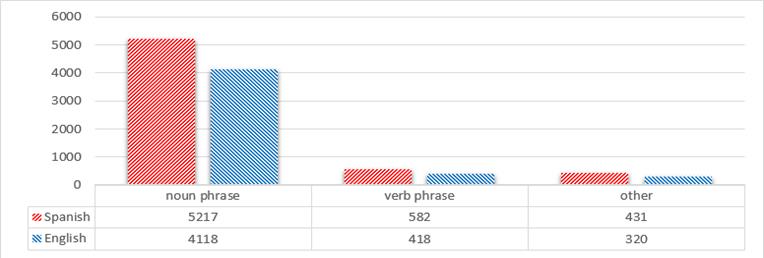
On the other hand, unsurprisingly, after plotting the distribution of the SPUS in the subset by type of phrase, it became apparent that, by far, the most common type of phrase in the database corresponded to the ‘noun phrase’ category (see Figure 3).
Next, the database was filtered by choosing only the ‘noun phrase’ category, resulting in 530 noun SPUS containing dead metaphors (424 in Spanish and 106 in English). As predicted, the distribution of the SPUS according to their word forms was uneven, which needed to be considered when selecting the sample (see Figure 4).
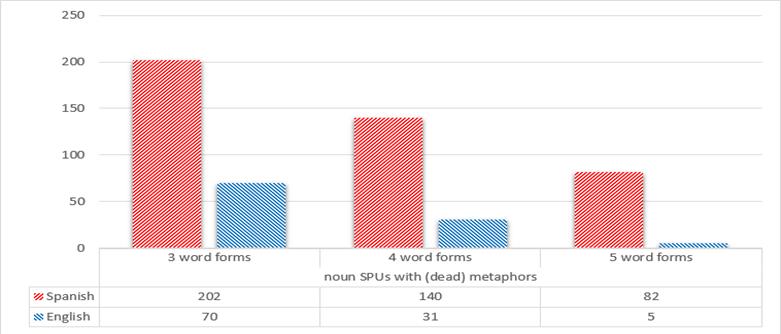
Since the differences in frequencies were notorious not only among the number of word forms but also in terms of the number of dead metaphors identified in both languages, a sample containing 15 % percent of the noun SPUS containing dead metaphors was selected to have a sample size suitable for being analyzed in this paper. Consequently, 78 units (61 in Spanish and 17 in English) were chosen (see Table 4). They were divided according to the number of word forms they contained (30 containing three-word forms in Spanish and 11 in English, 21 containing fourword forms in Spanish and 5 in English, and 10 containing five-word forms in Spanish and 1 in English). This sample was selected randomly out of the 530 SPUS containing dead metaphors in the database.
Table 4
Data sample selected for the analyses
Having selected the data sample for the analyses intended in this study, the first analysis to be carried out was to query the selected corpora (described in section 3, above) for the frequency of occurrence of the units in the sample.
4.2. Analysis in corpora
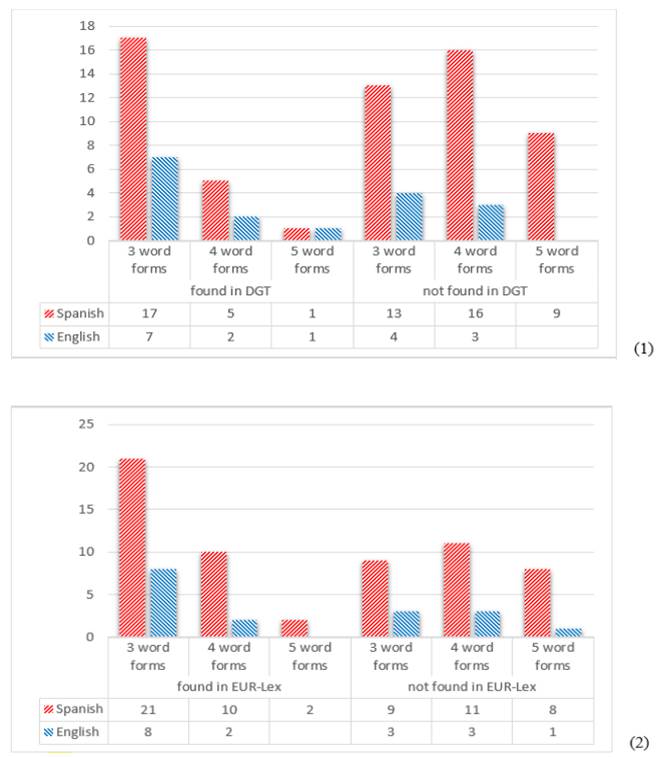
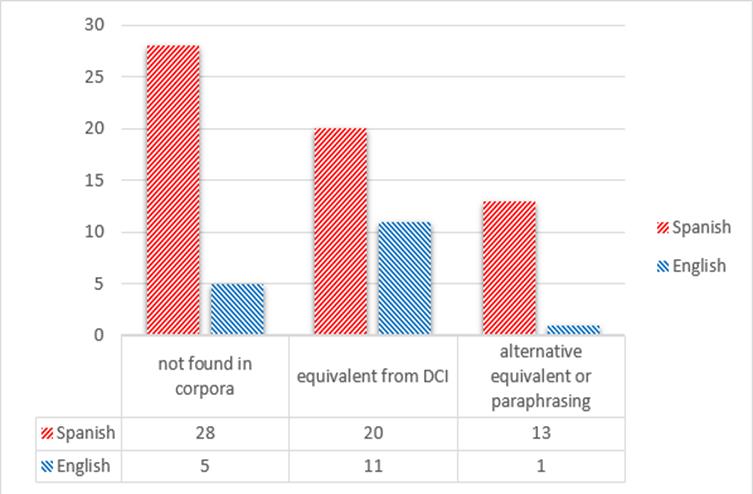
The first query was intended to identify whether the SPUS from the sample were included in the corpora or not. A total of 43 SPUS from our sample (33 in Spanish and 10 in English) were found in the EUR-Lex corpus, while 33 SPUS from our sample (23 in Spanish and 10 in English) were found in the DGT corpus (see Figure 5).
The next step was to look for the SPUS’ equivalents, for which there were two possibilities: either (i) the SPU in question appeared in the queried corpus and the equivalent used in parallel texts matched the one provided by the DCI, or (ii) the SPU appeared in the queried corpus, but its use in the corpus suggested a diverse equivalent or description from the one included in the DCI. 39.74 % of the times, the corpora retrieved the same equivalent proposed by the DCI (20 SPUS in Spanish and 11 in English). An alternative equivalent or paraphrasing was retrieved 17.95 % of the times (13 SPUS in Spanish and 1 in English). In turn, 42.31 % of the SPUS were not found in the corpora (see Figure 6).
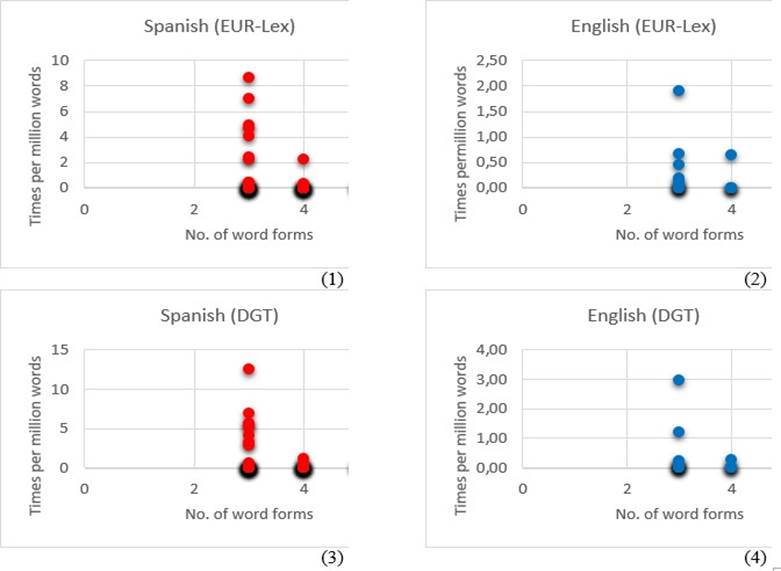
As expected, the frequency of occurrence in the corpora evidenced a negative correlation between the number of word forms and the frequency of SPUS with dead metaphors per million words in the two corpora consulted (see Figure 7).
Figure 7
Negative correlation between frequency and number of word forms in the EUR-Lex corpus in (1) Spanish and (2) English and in the DGT corpus in (3) Spanish and (4) English
By extracting some descriptive statistics, it was possible to find the SPUS from the sample that occurred more frequently in the corpora with their corresponding normalized value of frequency per million words. The results show that the most frequent dead-metaphor SPUS from our sample in Spanish are ‘ciclo de vida’ (life cycle) in the EUR-Lex corpus and ‘acceso al mercado’ (market access) in the DGT corpus, while the most common dead-metaphor SPU from our sample in English is ‘point of entry.’ The frequency values for the top 5 SPUS in each language and corpus are presented in Table 5.
Table 5
Frequency of SPUS in corpora per million words
4.3. Translation techniques in SPU equivalents
As explained above, the second analysis carried out in this study had to do with identifying the translation techniques used to obtain the SPUS’ equivalents suggested by the dictionary. Firstly, it is important to note that Molina and Hurtado Albir (2002, p. 510) present the category ‘established equivalent’ as one type of translation technique. They define this category as: “To use a term or expression recognized (by dictionaries or language in use) as an equivalent in the tl, e.g., to translate the English expression ‘They are as like as two peas as Se parecen como dos gotas de agua’ in Spanish. This corresponds to scfa’s equivalence and literal translation.” However, because this study is based on a lexicographic database, this technique will not be considered for this analysis because, technically, since all the units being analyzed and most of their equivalents are included in the DCI, those equivalents are indeed ‘established equivalents.’ Moreover, the ‘established equivalent’ category also involves other techniques that will be shown in those cases in which the corpora retrieve equivalents offered by the DCI. A graphic representation of the frequencies of occurrence of translation techniques in the sample is presented in Figure 8.
Figure 8
Graphic representation of the translation techniques used from Spanish-English and EnglishSpanish sample units
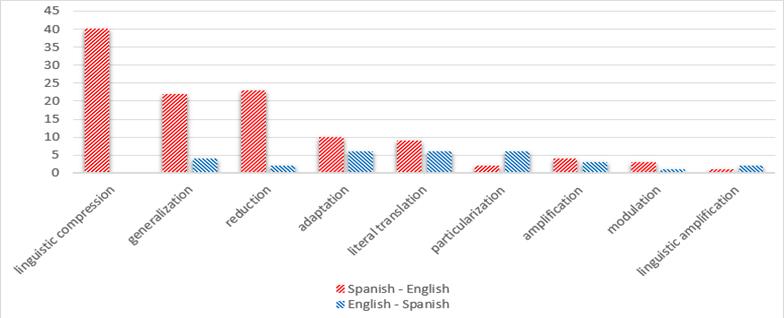
As observed in Figure 8, ‘linguistic compression’ is the most common translation technique employed in the English equivalents of Spanish SPUS. In contrast, in the English-into-Spanish pair, the difference is not as clear. A complete count of the frequencies of the strategies identified is presented in Table 6.
Table 6
Count of translation techniques identified in the sample’s SPU equivalents
As stated in section 2 (above), the classification made by Molina and Hurtado Albir (2002) was chosen for the analysis of translation techniques in this study. Out of that classification, nine translation techniques were identified in the study sample (see Table 5). The definitions of those techniques are presented in Table 7.
Table 7
Classification and definitions of translation techniques found in the sample (based on Molina and Hurtado Albir (2002, pp. 509-511)
As observed in Table 5, the number of translation techniques identified in the study sample exceeds the number of SPUS analyzed. The difference between the number of techniques and that of SPUS resides in that, in some cases, several translation techniques are involved in coining an equivalent and that certain SPUS have more than one equivalent in the dictionary. In the latter case, each one of those equivalents corresponds to a particular translation technique or combination of techniques. Thus, 11 SPUS in the study sample (9 in Spanish and 2 in English) involved more than one translation technique (see Table 8).
Table 8
Examples of SPUS whose equivalents evidence more than one translation technique
As observed in Table 8, some equivalents are the result of the combination of several techniques. Such is the case of the SPU ‘giro en moneda extranjera’ (literally, ‘bank giro in foreign coin’), whose equivalent is ‘foreign money order,’ where a generalization takes place between ‘coin’ and ‘money,’ and linguistic compression is at work as the preposition ‘in’ is omitted in the target language. Likewise, two different translation techniques are at play in the Spanish equivalent of ‘out of date cheque’ (cheque caducado), where the word caducado (expired) implies both a cultural adaptation and a particularization regarding the original expression, i.e., ‘out of date.’
As previously mentioned, the DCI offered more than one equivalent for some of the SPUS. 23 of them were identified in the study sample (19 of which are in Spanish and 4 in English). Some examples are presented in Table 9.
Table 9
Examples of translation techniques identified in SPUS with multiple equivalents
Additionally, some SPUS in the sample evidenced the co-occurrence of both multiple equivalents and multiple translation techniques (see Table 10).
Table 10
Examples of SPUS with multiple equivalents and multiple translation techniques
In general, the analyses performed to the sample selected for this study evidenced that linguistic compression -the most common translation technique employed in the Spanish-to-English linguistic pair-, literal translation, and linguistic amplification are mostly related to the morphosyntactic rules of the languages involved. In other words, the occurrence of these techniques is related to linguistic constraints rather than semantic aspects.
On the other hand, techniques such as generalization, reduction, and, particularly, adaptation, amplification, and modulation have a semantic motivation as they add, reduce, or otherwise modify the semantic elements of the original SPU.
Finally, no clear correlation could be found between the fact that our units of analysis contained dead metaphors and the frequency of occurrence of the translation techniques involved in the formation of SPU equivalents. However, the occurrence of techniques such as adaptation, generalization, or amplification evidence that, in some cases, dead-metaphor SPUS’ equivalents are the result of domestication, paraphrasing, or explanation processes.
Based on the findings made in this study, some conclusions can be drawn, as shown below.
5. Conclusions
The analysis performed here has allowed us to confirm that metaphor is an ever-present phenomenon in the evolution of science, and the fields of commerce and economics are not an exception. Additionally, it has also been found that a significant number of the metaphors used in these domains are so conventionalized that they have become dead or at least inactive ones.
An initial morphosyntactic analysis has evidenced a negative correlation between wordform number and dead metaphors, where the latter are mostly found in three-word SPUS. Additionally, a correlation was also found between dead metaphors and type of phrase, with dead metaphors occurring mostly in noun phrases, and, less frequently, in verb phrases.
As for the equivalents of SPUS containing dead metaphors, it has been determined that a broad spectrum of techniques has been employed to convey the information contained in the original SPUS. ‘Linguistic compression,’ ‘generalization,’ ‘reduction,’ ‘adaptation,’ and ‘literal translation’ were the most frequently used translation techniques found in the sample. However, although some tendencies regarding the frequency of occurrence of translation techniques can be identified in this study, it goes beyond its scope to establish a definitive correlation between that frequency of occurrence and the fact that our units of analysis contained dead metaphors.
Lastly, the information presented in this paper is only a first approach to the most-needed study of the interrelation between LSP phraseology, semantics, and translation.