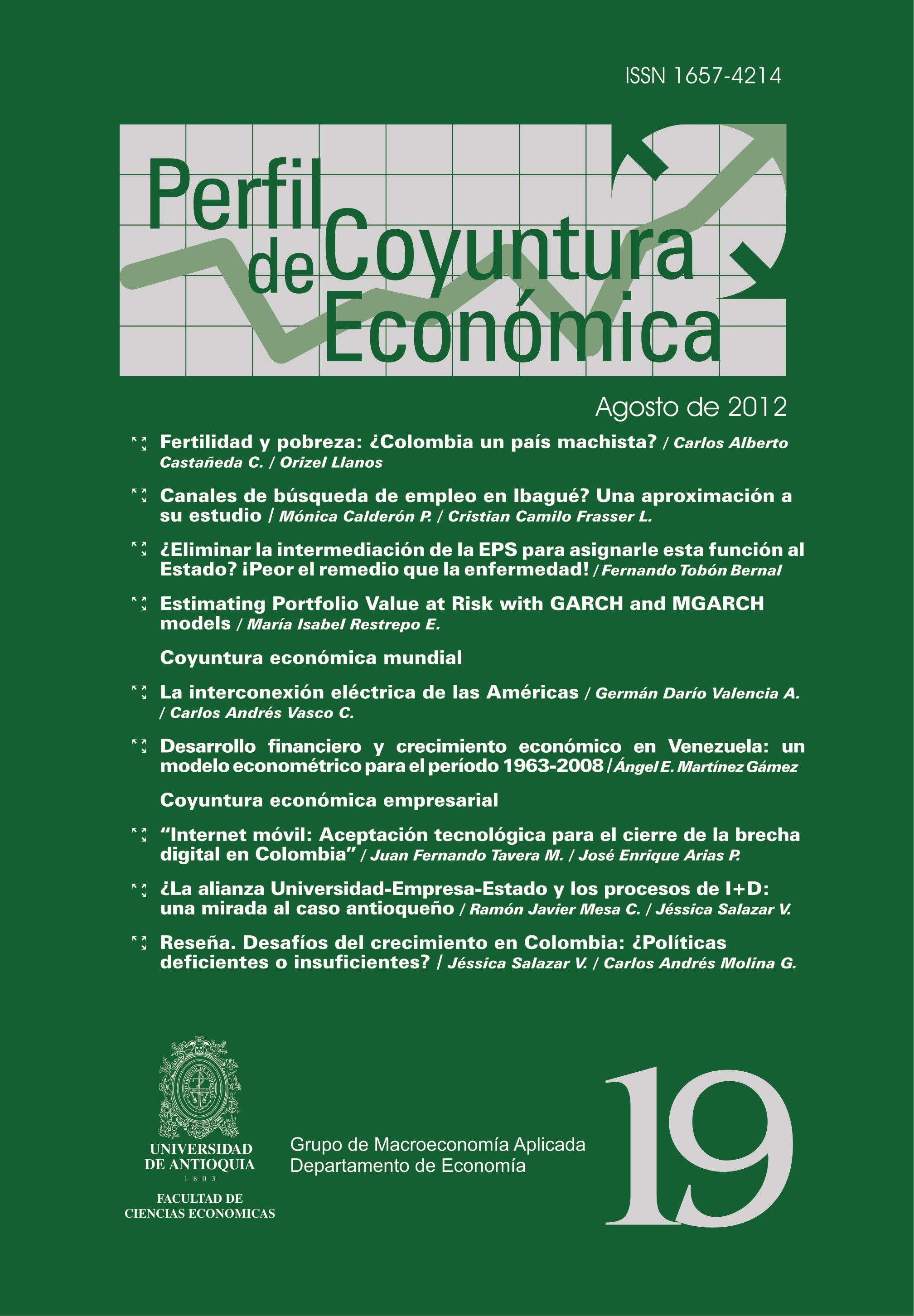
Fertilidad y Pobreza: ¿Colombia un país machista?
Keywords:
fertility, povertyAbstract
This paper analyses the existing link between fertility and poverty. For that we use the
methodology proposed by Dupta and Dubey (2003), which propose to use the gender of the
second child born at home as a natural random experiment that may explain the relation between
fertility and poverty. The hypothesis of this instrument is that homes in which the first child’s
gender is female use to have a higher fertility rate, and that make them more likely to fall in a
poverty situation. The results for Colombia using Quality Life Survey of 2008 (Encuesta de Calidad
de Vida) shows that the gender of the first child born at home is an instrument that may explain
the relation between fertility and poverty in rural areas, but not in urban areas, in which it seems
that the first child’s gender does not have any relation with the fertility rate.
Downloads
References
ANDERSON, D., SWEENEY, D., Y WILLIAMS, T. (1999). "Estadística para Administración y
Economía". Buenos Aires: International Thomson.
ASSAVE, A. (2005). “Fertility and poverty in developing countries: a comparative analysis
for Albania, Ethiopia, Indonesia and Vietnam”. Institute for Social and Economic
Research.
DANE. (2008). Recuperado en 2013, de
http://www.dane.gov.co/index.php?option=com_content&view=article&id=115&It
emid=66
DUPTA, N., Y DUBEY, A. (2003). “Poverty and Fertility: An Instrumental Variables
Analysis on Indian Micro Data”. Working Paper 03-11. Department of Economics,
Aarhus School of Bussines.
BILLY, J., TANFER, K., GRADY, W. Y KLEPINGER, D. (1993). "The Sexual Behavior of Men
In the United States. Family Planning Perspectives", Vol. 25, No. 2.
Misión para el Empalme de las Series de Empleo, Pobreza y Desigualdad (MESEP) (2010).
Cifras de Pobreza, Pobreza Extrema y Desigualdad 2009. Documento Electrónico
[Disponible en]:
http://www.dnp.gov.co/PortalWeb/LinkClick.aspx?fileticket=ltogs6K6cUQ%3D&t
abid=337
NÚÑEZ MÉNDEZ, J.A., Y CUESTA, L. (2006). “Efectos de la Demografía Sobre el Bienestar
de las Madres y sus Hijos en Colombia”. Departamento Nacional de Planeación,
MERPD.
SCHOUMAKER, B. (2004). “Poverty and Fertility in Sub-Saharan Africa: Evidence from 25
countries”. Population Association of America Meeting.
THE ECONOMIST. (2011). “Add sugar and spice India’s sex ratio is getting worse. The trend
can be reversed”. Articulo de Prensa [Disponible en]:
http://www.economist.com/node/18530101?story_id=18530101&fsrc=nlw|hig|07-
-2011|editors_highlights