

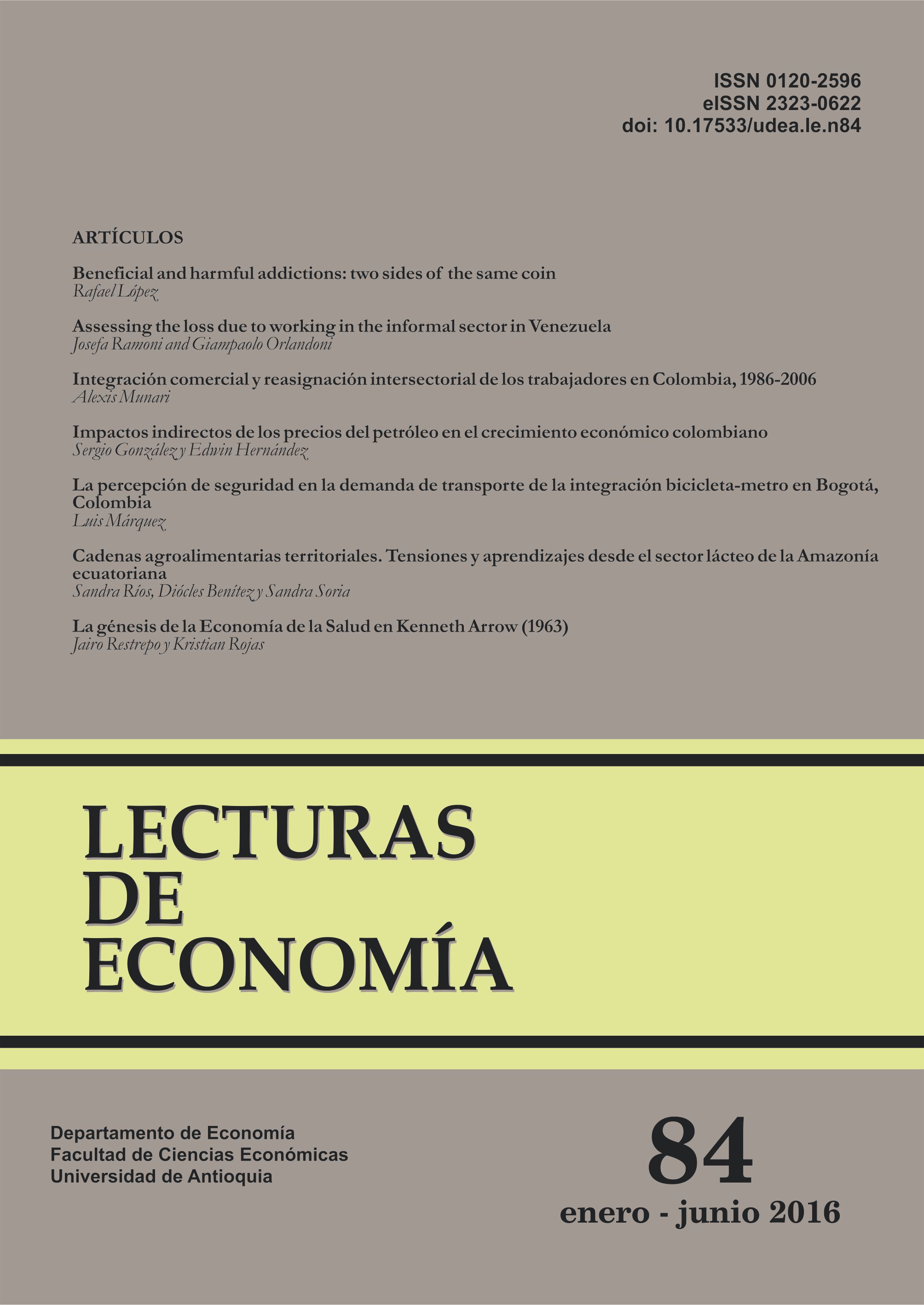
Assessing the loss due to working in the informal sector in Venezuela
DOI:
https://doi.org/10.17533/udea.le.n84a02Keywords:
employment in the informal sector, Venezuelan labor market, DID regression models, quantile regression, propensity score matchingAbstract
In Venezuela, 40% of the workers are employed in the informal sector. This sector is known for being underproductive, meaning that the income received by its workers is less than what they could earn working in formal sector jobs. This paper uses data from the Household Sample Survey (2012-2013) to estimate differencein-differences linear and quantile regression models, controlling for some demographic characteristics, to quantify the loss associated with working in this market, as an indirect way to quantify the size of the informal sector. The parallel trend assumption is satisfied through propensity score matching, exception made for the highest quartile. The results suggest that informal sector workers lose about 34% of their potential income, loss that is larger for women and with an ambiguous behavior across levels of education. The study also indicates that the average difference in wages between the two sectors tends to narrow over time.
Downloads
References
ANDERSON, Patricia & MEYER, Bruce (2000). “The Effects of the Unemployment Insurance Payroll Tax on Wages, Employment, Claims, and Denials”, Journal of Public Economics, Vol. 78, No. 1, pp. 81-106.
AZEVEDO, Joao (2004, september). “An investigation of the labour market earnings in deprived areas: evaluating the sources of wage inequality in the slums”, In: EGDI and UNU–WIDER Conference, Helsinki, Finlandia.
BECKER, Sascha & ICHINO, Andrea (2002). “Estimation of average treatment effects based on propensity scores”, The Stata Journal, Vol. 2, No. 4, pp. 358-377.
BECKER, Sascha & HVIDE, Hans (2013). “Do entrepreneurs matter?”, IZA Discussion Paper, No. 9295. Institute for the Study of Labor, IZA.
BLUNCH, Niels; CANAGARAJAH, Sudharshan & RAJU, Dhushyanth (2001). “The Informal Sector Revisited: A Synthesis Across Space and Time”, Social Protection Discussion Paper Series, No. 0119. Social Protection Unit, The World Bank.
BOZA, María (2004). “¿Cómo es el Mercado venezolano?”, Debates IESA, Vol. 9, No. 3, pp. 30-37.
CALIENDO, Marco & KOPEINIG, Sabine (2005). “Some particular guidance for the implementation of propensity score matching”, Discussion Paper Series, No. 1588. Institute for the Study of Labor, IZA.
CARD, David (1990). “The Impact of the Mariel Boatlift on the Miami Labor Market”, Industrial and Labor Relations Review, Vol. 23, No. 2, pp. 245-257.
CARD, David & KRUEGER, Alan (1994). “Minimum wages and unemployment: a case study of the fast food industry in New Jersey and Pennsylvania”, The American Economic Review, Vol. 84, pp. 316-361.
CHAPA, Joana; FLORES, Daniel & VALERO, Jorge (2007). La economía informal. Estimaciones, comportamiento y potencial recaudatorio. México: Trillas.
CIMOLI, Mario; PRIMI, Annalisa & PUGNO, Maurizio (2006). “A low-growth model: informality as a structural constraint”, Cepal Review, No. 88, pp. 85-102.
DEVICIENTI, Franceso; GROISMAN, Fernando & POGGI, Ambra (2009). “Informality and poverty: Are these processes dynamically interrelated? Evidence from Argentina”, Working Paper, No. 146. Society for the Study of Economic Inequality.
DÍAZ, William & CORREDOR, Melvy (2008). “Evolución de la economía informal en Venezuela”, Observatorio de la Economía Latinoamericana, No. 105. pp. 1-5.
DINARDO, John; FORTIN, Nicole & LEMIEUX, Thomas (1996). “Labor market institutions and the distribution of wages, 1973-1992: A semi-parametric approach”, Econometrica, Vol. 64, No. 5, pp. 1001-1044.
ECONOMIC COMMISSION FOR LATIN AMERICA AND THE CARIBBEAN (ECLAC) (2014). Panorama social de América Latina, 2014. Santiago de Chile: Author.
FEIGE, Edgar (1990). “Defining and estimating underground and informal economies: The new institutional economics approach”, World Development, Vol. 18, No. 7, pp. 989-1002.
FORLAC-ILO (2014). “Recent experiences of formalization in Latin America and the Caribbean”. Notes on Formalization. Available at: http://www.ilo.org/wcmsp5/groups/public/---americas/---ro-lima/documents/publication/wcms_245882.pdf
GARNICA, Elizabeth (1991). La fuerza de trabajo en la agricultura venezolana Caracas: Fundación Polar-Universidad de Los Andes.
GUERRA, Alexei (2006). “Ciudadanía, informalidad y Estado en Venezuela: una aproximación a través de las redes”, Espacio Abierto, Vol. 15, No. 4, pp. 759-786.
HECKMAN, James (1979). “Sample selection bias as a specification error’, Econometrica, Vol. 47, No. 1, pp. 153-162.
HECKMAN, James; ICHIMURA, Hideiko & TODD, Petra (1998). “Matching as an econometric evaluation estimator”, Review of Economic Studies, Vol. 65, pp. 261-294.
HUESCA, Luis & CAMBEROS, Mario (2009). “El mercado laboral mexicano 1992 y 2002: Un análisis contrafactual de los cambios en la informalidad”, Economía Mexicana Nueva Época, Vol. 18, No. 1, pp. 5-43.
ILO(1972). “Employment, incomes and equality: A strategy for increasing productive employment in Kenya”. Available at: http://www.ilo.org/public/libdoc/ilo/1972/
B09_608_engl.pdf
ILO (2012). The Statistical Update on Employment in the Informal Economy. Available at: http://laborsta.ilo.org/informal_economy_E.html
ILO (2014). Panorama Temático Laboral: Transición a la Formalidad en América Latina y el Caribe. Available at: http://ilo.org/wcmsp5/groups/public/---americas/---ro-lima/ documents/publication/wcms_315054.pdf
INTER-AMERICAN DEVELOPMENT BANK (2008). Outsiders? The changing pattern of exclusión in Latin America and The Caribbean. Washington. Available at: http://www.iadb.org/en/research-and-data/publication-details,3169.html?pub_id=B-2008.
KOENKER, Roger & HALLOCK, Kevin (2001). “Quantile Regression”, Journal of Economic Perspectives, Vol. 15, No. 4: pp.143–156.
KOLEV, Atanas & MORALES, Jesus (2006). “La política monetaria y el sector informal”, Serie Documentos de Trabajo, Nº 75. Banco Central de Venezuela.
MÁRQUEZ, Gustavo & PORTELA, Carmen (compiladores) (1991). Economía informal. Caracas, Ediciones IESA.
MINCER, Jacob (1976). “Unemployment Effects of Minimum Wages”, Journal of Political Economy, Vol. 84, No.4, pp. 87-104.
MORENO, Jorge (2007). “Los salarios del sector formal e informal en México: Análisis de ganancias y pérdidas por formalización”, Ensayos, Vol. 26, No.1, pp. 1-44.
PRIETO, Ana; ZERPA, Leiniz & MARTÍNEZ, Marle (2008). “La actividad económica informal y el negocio de franquicia en Venezuela”, Revista de Ciencias Sociales, Vol. 14, No. 2, pp. 333-345.
ORLANDO, María (2000). “El sector informal en Venezuela ¿Plataforma o barrera para la reducción de la pobreza?”, Borradores de Trabajo, No. 15, Universidad Católica Andrés Bello.
OSTA, Karelys (2007). “Desempleo e informalidad en América Latina: Definiendo políticas públicas para Venezuela”, Revista Venezolana de Gerencia, Vol. 12, No. 38, pp. 262-278.
RAMONI, Josefa (2004). Compensation Comparisons Between the Public and Private Sectors in the United States: A Propensity Score Matching Approach. A dissertation submitted for the degree of Doctor of Philosophy, Department of Economics, College of Business Administration, University of South Florida.
RAMONI, Josefa (2012). Descripción y Análisis de los principales indicadores laborales. Mérida: Consejo de Publicaciones ULA y Banco Central de Venezuela.
RAMONI Josefa; ORLANDONI, Giampaolo & CASTILLO, Laura (2010). “The Size of the Informal Economy in Venezuela”, El Norte-Finnish Journal of Latin American Studies, No. 5, pp. 1-12.
RAMONI Josefa; ORLANDONI, Giampaolo; SINHA, Surendra; TORRES, Elizabeth & ZAMBRANO, Ángel (2014). “Análisis de la duración del desempleo en Venezuela”, Serie Documentos de Trabajo S/N. Banco Central de Venezuela.
ROSENBAUM, Paul & RUBIN, Donald (1983). “The central role of the propensity score in observational studies for causal effects”, Biometrika, Vol. 70, pp. 41-55.
ROSENBAUM, Paul & RUBIN, Donald (1985). “Constructing a control group using multivariate matched sampling methods that incorporate the propensity score”, The American Statistician, Vol. 39, No. 1, pp. 33-38.
RUBIN, Donald (1973). “Matching to Remove Bias in Observational Studies”, Biometrics, No. 29, pp. 159-183.
SMITH, Jeffrey & TODD, Petra (2005). “Does matching overcome LaLonde’s critique on nonexperimental estimators?”, Journal of Econometrics, Vol. 125, No. 1-2, pp. 305-353.
TOKMAN, Victor (1994). “Informalidad y pobreza: progreso social y modernización productiva”, El trimestre económico, Vol. 61, No.1241, pp. 16-31.
VIVANCOS, Francisco (1988). La economía informal en Venezuela: Una aproximación econométrica. Caracas: IIES-UCAB
Published
How to Cite
Issue
Section
License
This page, by Universidad de Antioquia, is licensed under a Creative Commons Attribution License.
Authors who publish with this journal agree to retain copyright and grant the journal right of first publication, with the article licensed under a Creative Commons Attribution-NonCommercial-ShareAlike License allowing others to share it as long as they acknowledge its authorship and original publication in this journal.
Authors can enter into separate, additional contractual arrangements for the non-exclusive distribution of the journal's published version of the work (e.g., post it to an institutional repository or publish it in a book), provided that these arrangements be not for profit and the journal be acknowledged as the original source of publication.
Authors are permitted and encouraged to post their papers online (e.g., in institutional repositories or on their websites), as it can lead to valuable exchanges as well as greater citation of the published work.




