
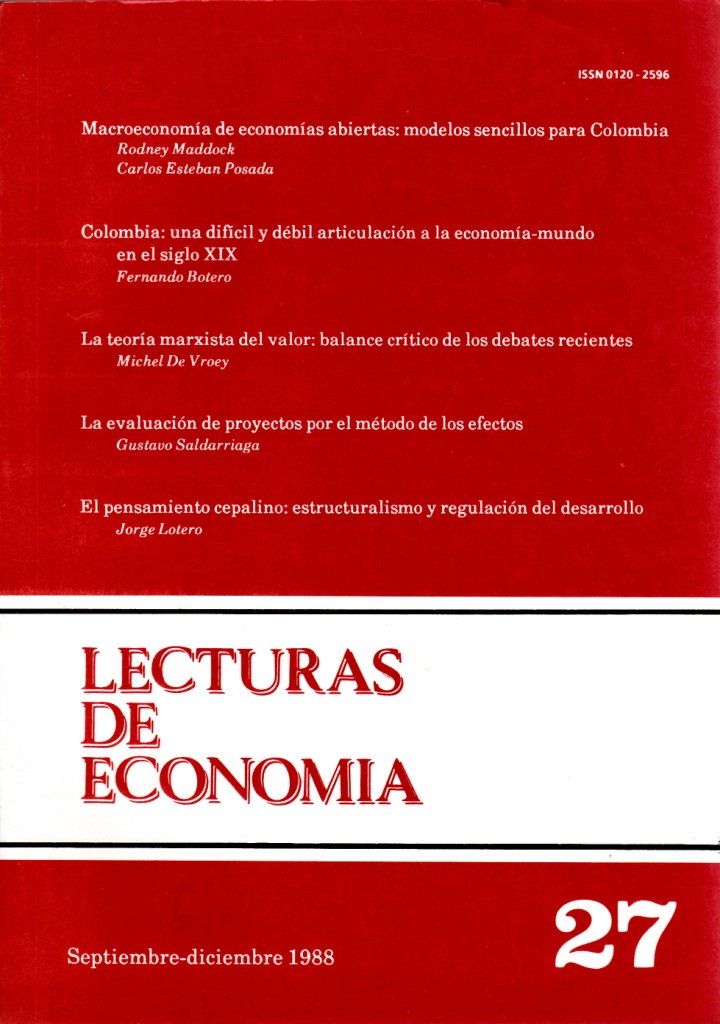
La evaluación de proyectos por el método de los efectos
DOI:
https://doi.org/10.17533/udea.le.n27a7758Abstract
- Resumen: La literatura sobre la evaluación económica de proyectos ha estado dominada por los métodos duales (precios de cuenta) en detrimento de los métodos primales como el Método de los Efectos, del cual existe un gran desconocimiento en nuestros medios académicos e institucionales, a pesar de ser un método de amplia aceptación y aplicación generalizada en muchos países en vías de desarrollo. El autor analiza las características fundamentales del Método de los Efectos, el cual se revela por su sencillez y facilidad de aplicación como un excelente instrumento para la selección de las mejoras alternativas de inversión que garanticen un máximo crecimiento económico
- Abstract: Economic literature concerning project evaluation has been dominated by the dual methods (accounting prices), against other worthy methods such as the Effect Method. Our academic and institutional environment reveals a wide ignorance on the latter method despite it being a widely accepted method, which has been applied in many countries, undergoing development. The author analyses the fundamental characteristics of the Effect Method which turns out to be an excellent instrument when choosing the best investment alternatives that guarantee the highest economic growth, due to its simplicity and applicability.
Downloads
Downloads
Published
How to Cite
Issue
Section
License
This page, by Universidad de Antioquia, is licensed under a Creative Commons Attribution License.
Authors who publish with this journal agree to retain copyright and grant the journal right of first publication, with the article licensed under a Creative Commons Attribution-NonCommercial-ShareAlike License allowing others to share it as long as they acknowledge its authorship and original publication in this journal.
Authors can enter into separate, additional contractual arrangements for the non-exclusive distribution of the journal's published version of the work (e.g., post it to an institutional repository or publish it in a book), provided that these arrangements be not for profit and the journal be acknowledged as the original source of publication.
Authors are permitted and encouraged to post their papers online (e.g., in institutional repositories or on their websites), as it can lead to valuable exchanges as well as greater citation of the published work.




