
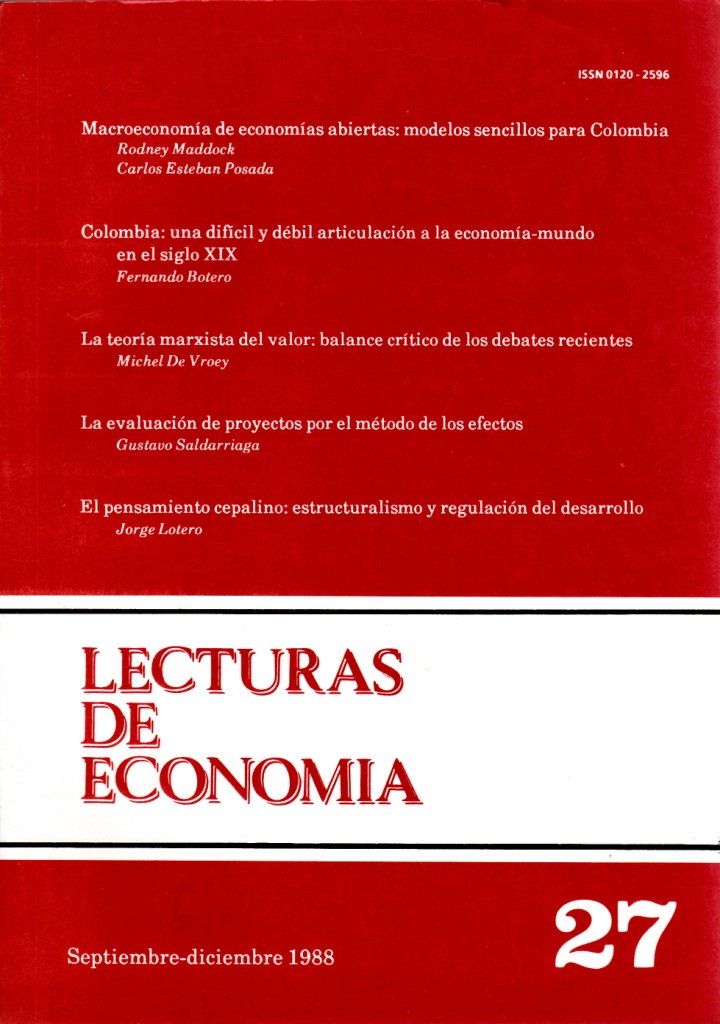
El pensamiento cepalino: estructuralismo y regulación del desarrollo
DOI:
https://doi.org/10.17533/udea.le.n27a7759Abstract
• Resumen: En este artículo se intenta presentar el pensamiento clásico de la teoría de la Escuela francesa de la Regulación. Se tratará de mostrar cómo las tesis originales de la CEPAL sobre el subdesarrollo latinoamericano nos remiten implícita, aunque parcialmente, a la ,problemática del desarrollo capitalista, analizado en términos de régimen de acumulación y modo de regulación y los cambios que se producen después de la crisis de 1929. Este acercamiento de ambas teorías heterodoxas permiten obtener algunos resultados sobre los alcances y límites del pensamiento estructuralista en relación con nuevos enfoques que intentan también dar cuenta de la problemática del desarrollo.
• Abstract: This article tries to present the classical CEPAL economic thought, concerning development, in the light of the theoretical ideas of the French Regulation School. It attempts to show how the original CEPAL thesis about latin american undervelopment implicity (and partially) takes us back to the capitalist development problem, analyzed in terms of the accumulation regime and type of regulation and the changes that took place after the 1929 crisis. The approaching of the two heterodox theories will alIow us to obtain certain results about the scope and limits of structuralist thought in relationship with new lines of thought that also try lo take into account the development problem.
Downloads
Downloads
Published
How to Cite
Issue
Section
License
This page, by Universidad de Antioquia, is licensed under a Creative Commons Attribution License.
Authors who publish with this journal agree to retain copyright and grant the journal right of first publication, with the article licensed under a Creative Commons Attribution-NonCommercial-ShareAlike License allowing others to share it as long as they acknowledge its authorship and original publication in this journal.
Authors can enter into separate, additional contractual arrangements for the non-exclusive distribution of the journal's published version of the work (e.g., post it to an institutional repository or publish it in a book), provided that these arrangements be not for profit and the journal be acknowledged as the original source of publication.
Authors are permitted and encouraged to post their papers online (e.g., in institutional repositories or on their websites), as it can lead to valuable exchanges as well as greater citation of the published work.




