

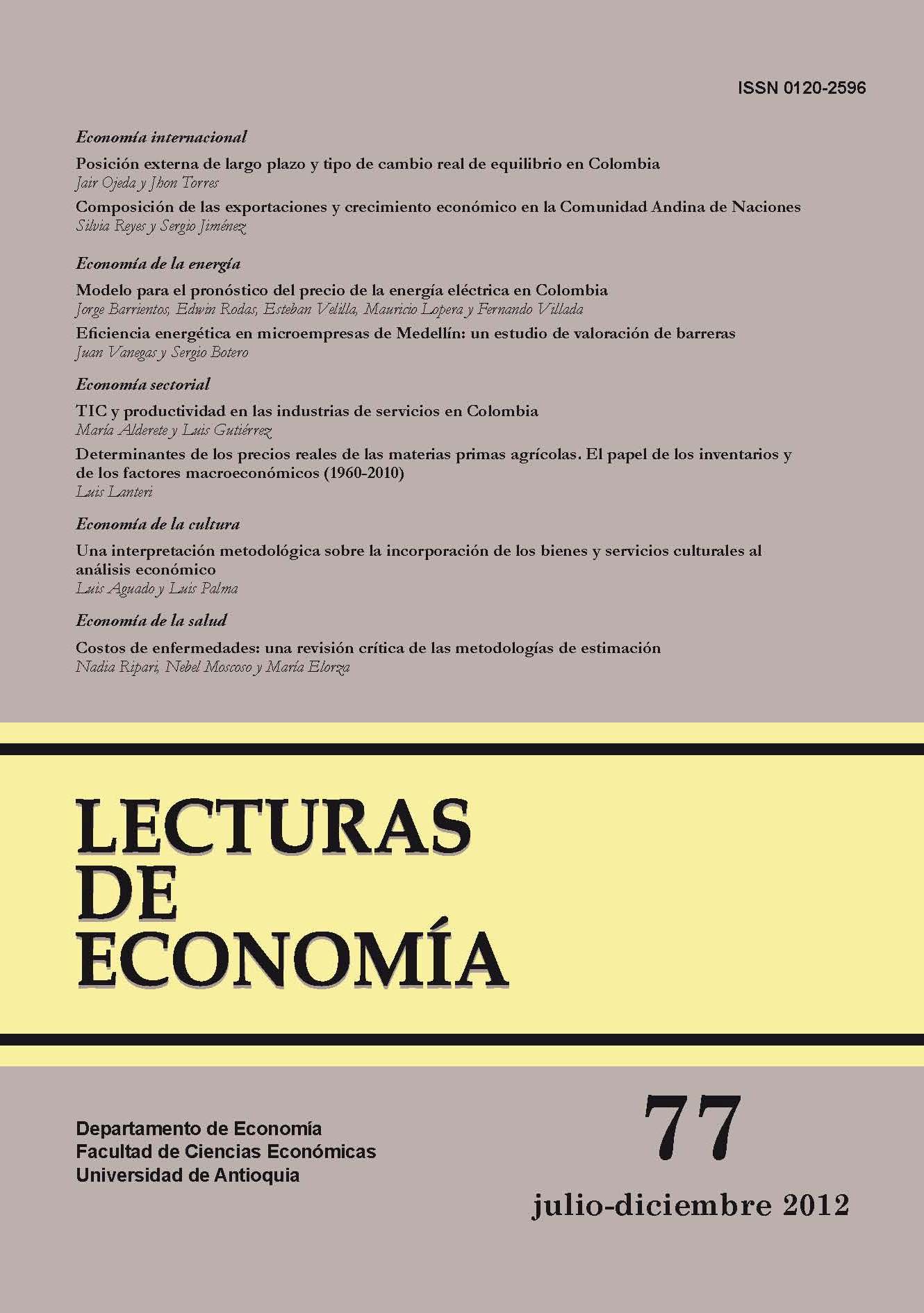
Export composition and economic growth in the Andean Community of Nations
DOI:
https://doi.org/10.17533/udea.le.n77a14770Keywords:
Economic growth, panel data, SURE estimation, export composition, Andean CommunityAbstract
This paper analyzes the relation between export composition and economic growth. Based on the structure developed by Feder (1983) and Crespo-Cuaresma and Wörz (2005), we develop a panel data model involving Bolivia, Colombia, Ecuador, Peru and Venezuela, member countries of the Andean Community (except Venezuela since 2011), during 1970-2009. The analysis was made for the countries both jointly and individually using the SURE method, then focusing on the degree of disaggregation of exports, and finally grouping exports according to the level of technological intensity. The results suggest that the influence of the export structure is different across countries and is divided between different types of exports; but the majority of the exports that affect positively and significantly economic growth in the Andean Community countries correspond to the manufacturing industry and high technology, and they do so via externality effect.
Downloads
References
Agosín, Manuel (2009). “Crecimiento y diversificación de exportaciones en economías emergentes”, Revista Cepal No. 97, abril de 2009, pp. 117-134.
Awokuse, Titus (2008). “Trade Openness and Economic Growth: is Growth Export-led or Import-led?”, Applied Economics No. 40, pp. 161-173.
Balaguer, Jacint & Cantavella-Jordá, Manuel (2001). “Examing the Export- Led Growth Hipothesis for Spain in the Last Century”, Applied Economics Letters No. 8, pp. 681-685.
Balaguer, Jacint & Cantavella-Jordá, Manuel (2004). “Export Composition and Spanish Economic Growth: Evidence from the 20th Century”. Journal of Policy Modeling No. 26, pp. 165-179.
Balassa, Béla (1978). “Exports and Economic Growth: further evidence”, Journal of Development Economics No. 5 (2), pp. 181-189.
Balassa, Béla (1985). “Exports, Policy Choices and Economic Growth in Developing Countries after the 1973 Shock”, Journal of Development Economics No. 18, pp. 23-35.
Banco Mundial (2010). World Development Indicators. Disponible en www. worldbank.org. Washington D.C.
Barro, Robert & Lee, Jong Wha. (2010). “A New Data Set of Educational Attainment in the World, 1950-2010”, NBER Working Paper No. 15902.
Cepal (2011). “Banco de Datos Estadísticos de Comercio Exterior – BADECEL”, disponible en la Base de Datos en Línea BADESTAT de la CEPAL, www.cepal.org.
Chang, Roberto; Kaltani, Linda & Loaysa, Norman (2009). “Openness can be good for growth: the role of policy complementarities”, Journal of Development Economics 90, pp. 33-49.
Crespo-Cuaresma, Jesús & Wörz, Julia (2005). “On Export Composition and Growth”, Review of World Economics, Vol. 141, No. 1, pp. 33-49.
Darratt, Ali (1987). “Are Exports an Engine of Growth”, Applied Economics No.19, pp. 277-283.
Donoso, Vicente & Martín, Víctor (2009). “Exportaciones y crecimiento económico: estudios empíricos”, WP05/09. Instituto Complutense de Estudios Internacionales, Universidad Complutense de Madrid, España.
Feder, Gershon (1983). “On Exports and Economic Growth”, Journal of Development Economics 12, pp. 59-73.
Fosu, Augustin (1990). “Export Composition and the Impact of Exports on Economic Growth of Developing Economics”, Economics Letters No. 34, pp. 67-71.
Ghatak, Subrata; Milner, Chris & Utkulu, Utku (1997). “Exports, Export Composition and Growth: Cointegration and Causality Evidence for Malaysia”, Applied Economics No. 29, pp. 213-223.
Ghirmay, Teame; Grabowski, Richard & SHARMA, Subhash (2001): “Exports, investment, efficiency and economic growth in LDC: an empirical investigation”, Applied Economics No. 33, pp. 689-700.
Greenaway, David; Morgan, Wyn & Wright, Peter (1999). “Exports, Export Composition and Growth”, The Journal of International Trade and Economic Development, Vol. 8, No. 1, pp. 41-51.
Gujarati, Damodar (2004). Econometría. 4a edición. McGraw-Hill.
Hausmann, Ricardo; Hwang, Jason & Rodrick, Dani (2007). “What You Export Matters”, Journal of Economic Growth, Vol. 12, No. 1, pp. 1-25.
Hatemi, Abdulnasser & Irandoust, Manuchehr (2000). “Time Series Evidence for Balassa’s Export-Led Growth Hypothesis”, The Journal of International Trade and Economic Development, Vol. 9, No. 3, pp. 355-365.
Heston, Alan; Summers Robert & Aten, Bettina (2011). Penn World Table version 7.0, Center for International Comparisons at the University of Pennsylvania (CICUP), June.
Ibrahim, Izani & Mac Phee, Craig (2003). “Export Externalities and Economic Growth”, The Journal of International Trade and Economic Development No. 12 (3), pp. 257-283.
Jung, Woo & Marshall, Peyton (1985). “Exports, Growth and Causality in Developing Countries”, Journal of Development Economics No. 18, pp. 1-12.
Krueger, Anne (1980). “Trade Policy as an Input for Development”, American Economic Review, Vol. 70, No. 2, pp. 288-292.
Melitz, Marc (2003). “The impact of trade on intra-industry reallocations and aggregate industry productivity”, Econometrica, Vol. 71, No. 6, pp. 1695-1725.
Michaely, Michael (1977). “Exports and Growth: an empirical investigation”, Journal of Development Economics, No. 4, pp. 49-53.
Moschos, Demetrios (1989). “Export Expansion, Growth and the Level of Economic Development”, Journal of Development Economics, No. 30, pp. 93-102.
Ram, Rati (1985). “Exports and Economic Growth in Developing Countries: evidence from time series and cross-section data”, Economic Development and Cultural Change, No. 33, pp. 415-425.
Salvatore, Dominick & Hatcher, Thomas (1991). “Inward and Outward Oriented Trade Strategies”, Journal of Development Studies, No. 27, pp. 7-25.
Tyler, William (1981). “Growth and Export Expansion in Developing Countries: some empirical evidence”, Journal of Development Economics, No. 9, pp. 121-130.
Ukpolo, Víctor (1994). “Export Composition and Growth of Selected Low- Income African Countries: evidence from time series data”, Applied Economics No. 26, pp. 445-449.
Published
How to Cite
Issue
Section
License
This page, by Universidad de Antioquia, is licensed under a Creative Commons Attribution License.
Authors who publish with this journal agree to retain copyright and grant the journal right of first publication, with the article licensed under a Creative Commons Attribution-NonCommercial-ShareAlike License allowing others to share it as long as they acknowledge its authorship and original publication in this journal.
Authors can enter into separate, additional contractual arrangements for the non-exclusive distribution of the journal's published version of the work (e.g., post it to an institutional repository or publish it in a book), provided that these arrangements be not for profit and the journal be acknowledged as the original source of publication.
Authors are permitted and encouraged to post their papers online (e.g., in institutional repositories or on their websites), as it can lead to valuable exchanges as well as greater citation of the published work.




