

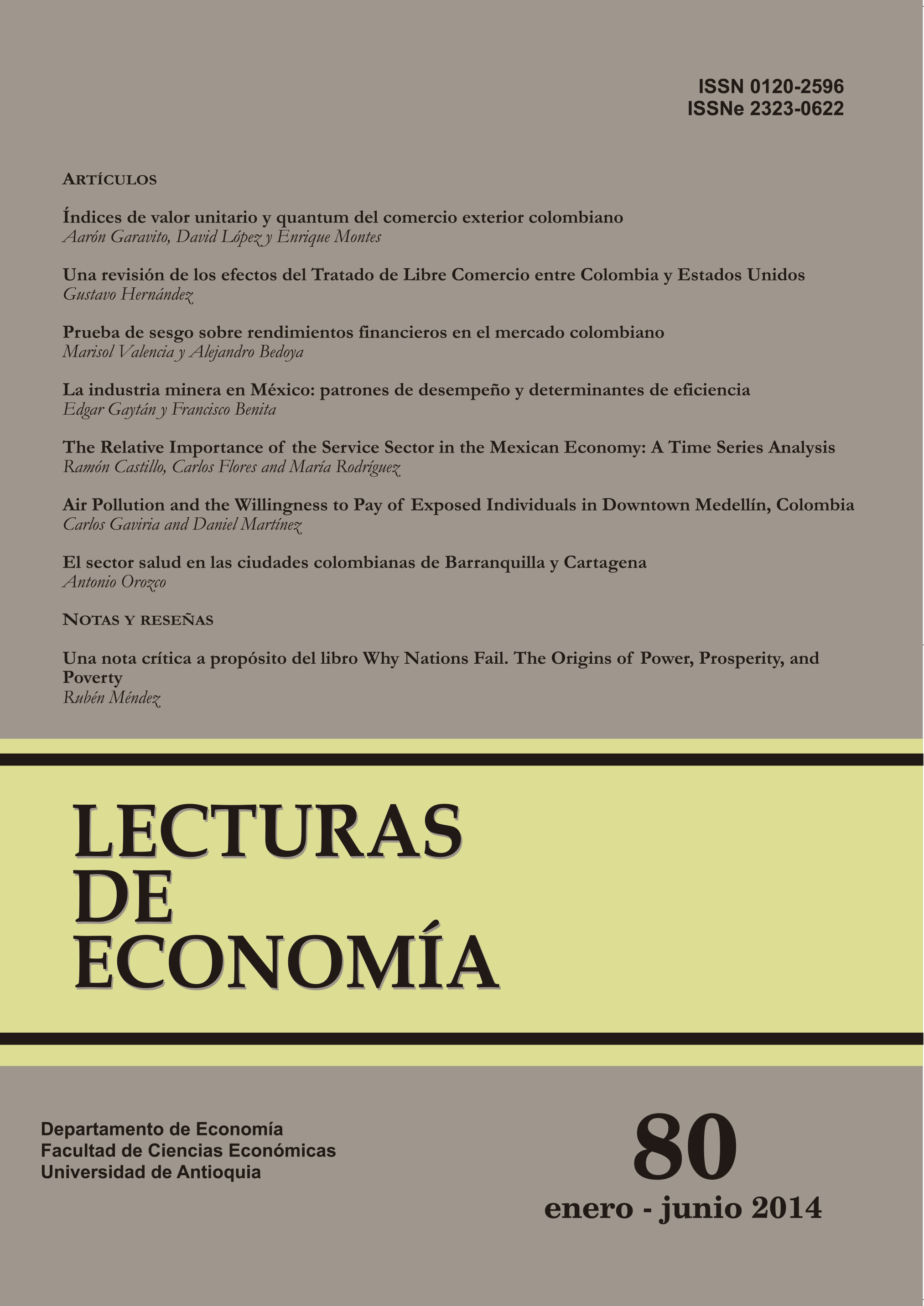
The Relative Importance of the Service Sector in the Mexican Economy: A Time Series Analysis
DOI:
https://doi.org/10.17533/udea.le.n80a5Keywords:
Service sector, Mexico, cointegration, common cyclesAbstract
We conduct a study of the secondary and tertiary sectors with the goal of highlighting the relative importance of services in the Mexican economy. We consider a time series analysis approach designed to identify the stochastic nature of the series, as well as to define their long-run and-short run relationships with Gross Domestic Product (GDP). The results of cointegration tests suggest that, for the most part, activities in the secondary and tertiary sectors share a common trend with GDP. Interestingly, the long-run elasticities of GDP with respect to services are on average larger than those with respect to secondary activities. Common cycle tests results identify the existence of common cycles between GDP and the disaggregated sectors, as well as with manufacturing, commerce, real estate and transportation. In this case, the short-run elasticities of secondary activities are on average larger than those corresponding to services.
Downloads
References
Aguayo Lorenzo, Eva and Álvarez Baeza, Lía (2003). “El Sector Servicios Privados en las Regiones Mexicanas: Un Modelo Econométrico”, Estudios Económicos Regionales y Sectoriales, Vol. 3, pp. 35-60.
Aguayo Lorenzo, Eva and Álvarez Baeza, Lía (2007). “Análisis Econométrico del Sector Servicios en las Regiones de México, 1993-2001”, Investigación Económica, Vol. 66, No. 261, pp. 35-60.
Beveridge, Stephen and Nelson, Charles (1981). “A New Approach to Decomposition of Economic Time Series into Permanent and Transitory Components with Particular Attention to the Measurement of the Business Cycle”, Journal of Monetary Economics, Vol. 7, Issue 2, pp. 151-174.
Blomstrom, Magnus and Persson, Håkan (1983). “Foreign Investment and Spillover Efficiency in an Underdeveloped Economy: Evidence from the Mexican Manufacturing Industry”, World Development, Vol. 11, Issue 6, pp. 493-501.
Castillo Ponce, Ramón A.; Varela Llamas Rogelio and Ocegueda Hernandez, Juan Manuel (2010). “Synchronization of Economic Activity between Mexico and the US: What are the Causes?”, Economic Analysis Review, Vol. 25, No. 1, pp. 15-48.
Chiquiar, Daniel and Ramos-Francia, Manuel (2003). “Trade and Business-Cycle Synchronization: evidence from Mexican and US Manufacturing Firms”, North American Journal of Economics and Finance, Vol. 16, Issue 2, pp. 187-216.
Coll-Hurtado, Atlántida and Córdoba y Ordoñez, Juan (2006). “La Globalización y el Sector Servicios en México”, Investigaciones Geográfi¬cas, No. 61, pp. 114-131.
Cragg, Michael I. and Epelbaum, Mario (1996). “Why has Wage Dispersion Grown in Mexico? Is it the Incidence of Reforms or the Growing Demand for Skills?”, Journal of Development Economics, Vol. 51, Issue 1, pp. 99-116.
Dávila Flores, Alejandro (2002). “Matriz de Insumo-Producto de la Economía de Coahuila e Identificación de sus Flujos Intersectoriales más Importantes”, Economía Mexicana, Nueva Época, Vol. 11, No. 1, pp. 79-162.
Eichengreen, Barry and Gupta, Poonam (2009). “The Two Waves of Service Sector Growth”, NBER Working Paper, 14968. National Bureau of Economic Research.
Fuentes, Noé A. (2005). “Construcción de una Matriz Regional de Insumo- Producto”, Problemas del Desarrollo, Vol. 36, No. 140, pp 89-112.
Hanson, Gordon (1996). “Economic Integration, Intraindustry Trade and Frontier Regions”, European Economic Review, Vol. 40, Issues 3-5, pp. 941-949.
Harvey, David; Leybourne, Stephen and Taylor, Robert (2011). “Testing for Unit Roots in the Possible Presence of Multiple Trend Breaks Using Minimum Dickey-Fuller Statistics”, Journal of Econometrics, Vol. 177, Issue 2, pp. 265-284.
Hatemi-J, Abdulnasser (2008). “Test for Cointegration with Two Unknown Regime Shifts with an Application to Financial Market Integration”, Empirical Economics, Vol. 35, pp. 497-505.
Instituto Nacional de Estadística y Geografía (INEGI) (s.f.). Estadís¬ticas, Banco de Información Económica, Cobertura Temática, Cuentes Nacionales, Producto Interno Bruto Trimestral. Recuperado de: http://www. inegi.org.mx/sistemas/bie/ (Enero 2013)
Issler, João V. and Vahid, Farshid (2001). “Common Cycles and the Importance of Transitory Shocks to Macroeconomic Aggregates”, Journal of Monetary Economics, Vol. 47, Issue 3, pp. 449-475.
Kwiatkowski, Denis; Phillips, Peter; Schmidt, Peter and Shin, Yongcheol (1992). “Testing the Null Hypothesis of Stationarity against the Alternative of a Unit Root”, Journal of Econometrics, Vol. 54, Issues 1-3, pp. 159–178.
Mejía Reyes, Pablo; Gutiérrez, Elías and Farías, Claudia (2006). “La Sincronización de los Ciclos Económicos de México y Estados Unidos”, Investigación Económica, Vol. 65, No. 258, pp. 15-46.
Ramírez Cruz, María Delfina (2004). “Desigualdad Salarial y Desplazamientos de la Demanda Calificada en México, 1993-1999”, Trimestre Económico, Vol. 71, No. 289, pp. 625-680.
Tybout, James R. and Westbrook, M. Daniel (1996). “Trade Liberalization and the Dimensions of Efficiency Change in Mexican Manufacturing Industries”, Journal of International Economics, Vol. 39, Issue 1-2, pp. 53- 78.
Vahid, F. and Engle, Robert (1993). “Common Trends and Common Cycles”, Journal of Applied Econometrics, Vol. 8, Issue 4, pp. 341-360.
Wolfl, Anita (2005). “The Service Economy in OECD Countries”, OECD STI Working Paper, 2005/3. OECD/Centre d’études prospec¬tives et d’informations internationales (CEPII).
Downloads
Published
How to Cite
Issue
Section
License
This page, by Universidad de Antioquia, is licensed under a Creative Commons Attribution License.
Authors who publish with this journal agree to retain copyright and grant the journal right of first publication, with the article licensed under a Creative Commons Attribution-NonCommercial-ShareAlike License allowing others to share it as long as they acknowledge its authorship and original publication in this journal.
Authors can enter into separate, additional contractual arrangements for the non-exclusive distribution of the journal's published version of the work (e.g., post it to an institutional repository or publish it in a book), provided that these arrangements be not for profit and the journal be acknowledged as the original source of publication.
Authors are permitted and encouraged to post their papers online (e.g., in institutional repositories or on their websites), as it can lead to valuable exchanges as well as greater citation of the published work.




