

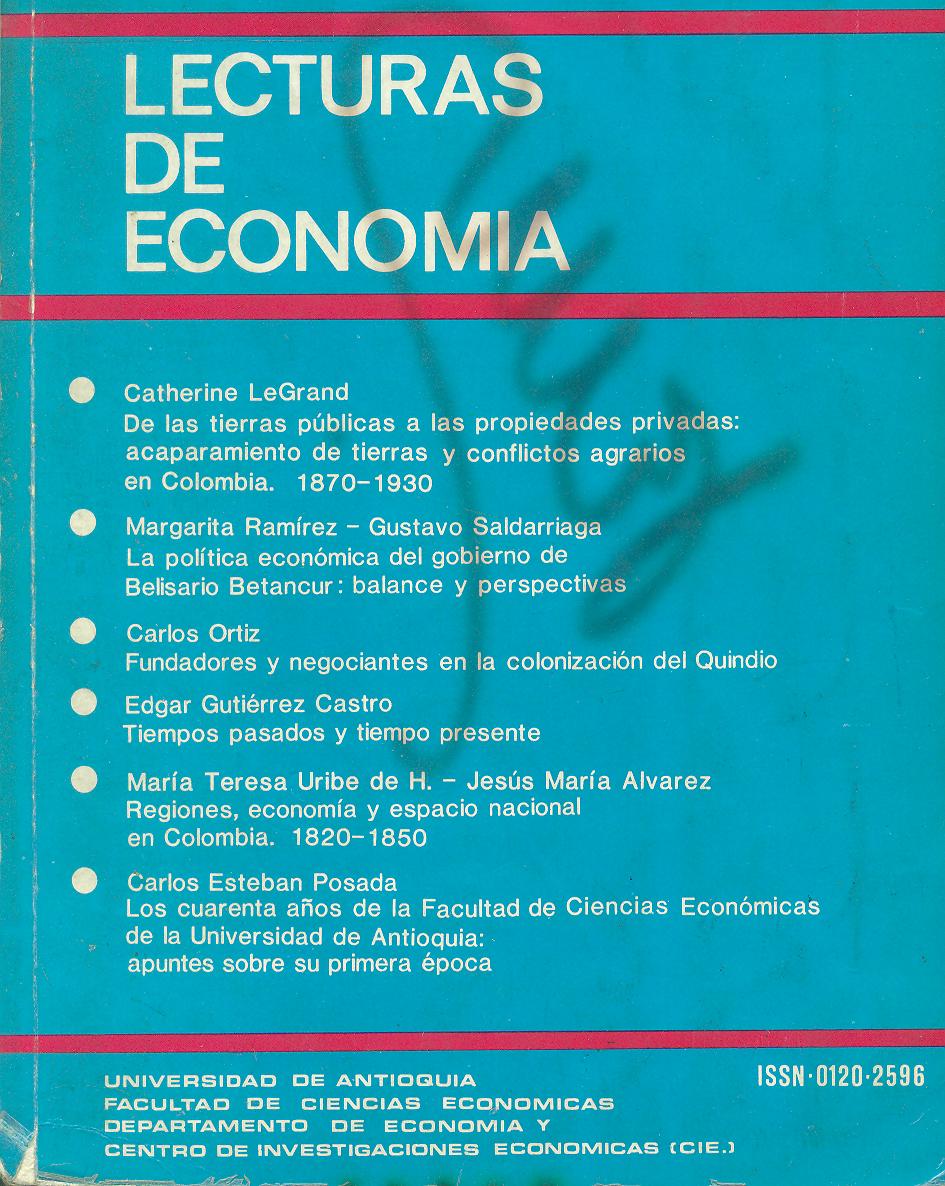
Fundadores y negociantes en la colonización del Quindío
DOI:
https://doi.org/10.17533/udea.le.n13a18555Keywords:
Quindío – Colombia, historia política de Colombia, historia económica de Colombia, grupos sociales.Abstract
Este artículo pretende rastrear los orígenes de los grupos sociales en el Quindío, recorriendo los pasos iniciales de su proceso de diferenciación. Cronológicamente, el objetivo de este texto, se circunscribe en las últimas seis décadas del siglo XIX. Colonización, desbroces y fundaciones tejen esa historia; la cual se intenta indagar sólo hasta los inicios de la expansión del café, lo cual aconteció en el tránsito del siglo XIX al siglo XX. Conviene advertir que el área considerada no se limita estrictamente al actual Departamento del Quindío, pues el acto legal que en 1965 dio existencia a esta nueva unidad político-administrativa, no reflejó necesariamente el sentimiento ni la movilización de todos los municipios que habían participado en las diferentes campañas "separatistas"; sólo los de Caldas harían parte del Departamento nuevo, mientras los del Valle seguirían dependiendo de Cali.Downloads
Downloads
Published
How to Cite
Issue
Section
License
This page, by Universidad de Antioquia, is licensed under a Creative Commons Attribution License.
Authors who publish with this journal agree to retain copyright and grant the journal right of first publication, with the article licensed under a Creative Commons Attribution-NonCommercial-ShareAlike License allowing others to share it as long as they acknowledge its authorship and original publication in this journal.
Authors can enter into separate, additional contractual arrangements for the non-exclusive distribution of the journal's published version of the work (e.g., post it to an institutional repository or publish it in a book), provided that these arrangements be not for profit and the journal be acknowledged as the original source of publication.
Authors are permitted and encouraged to post their papers online (e.g., in institutional repositories or on their websites), as it can lead to valuable exchanges as well as greater citation of the published work.




