

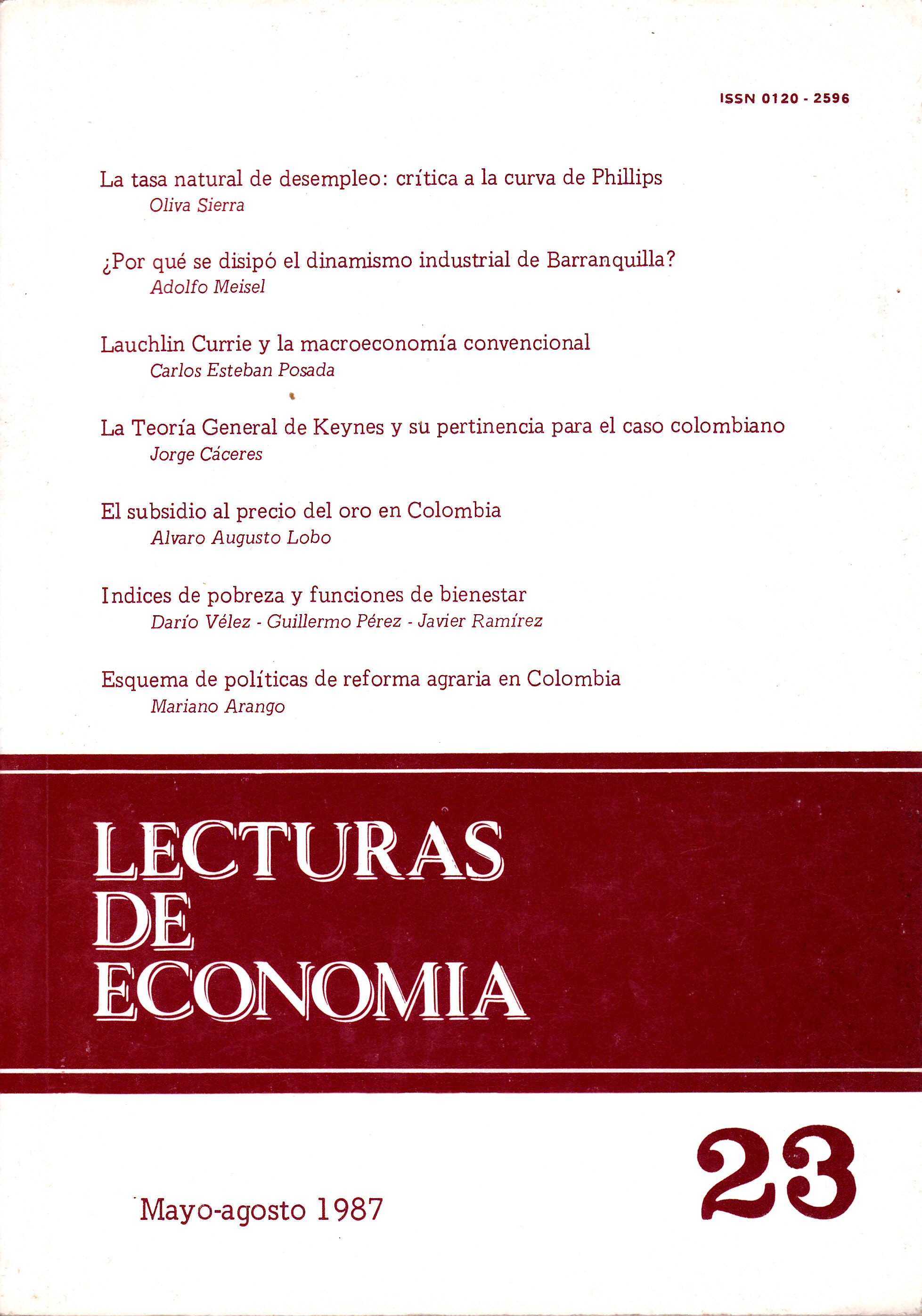
La tasa natural de desempleo: crítica a la curva de Phillips
DOI:
https://doi.org/10.17533/udea.le.n23a7772Abstract
Resumen: Este artículo es una síntesis de los fundamentos teóricos de la formulación de la tasa natural de desempleo según Milton Friedman. Desde la perspectiva neoclásica dicha teoría constituye un ataque frontal a las recomendaciones de política que se desprenden de la curva de Phillips de largo plazo: esto es, la posibilidad de reducir la tasa de desempleo -bajo el supuesto de que ésta no se corresponde con el equilibrio en el mercado laboral- a la vez que se soporta una mayor tasa de inflación. A manera de conclusión se señalan las implicaciones económicas y políticas de la tasa natural, en contraposición con la teoría keynesiana.
Abstract: This article synthesizes the theoretical foundations of Milton Friedman's formulations of the natural rate of unemployment. From the neoclassical perspective his theory challenged the standard policy recommendations which arise from the existence of a long run Phillips curve, via, the possibility of reducing the long run rate of unemployment at the cost of a higher rate of inflation. The concluding section of the paper highlights the economic and policy implications of the natural rate in juxtaposition with those which arise from a Keynesian perspective.
Downloads
Downloads
Published
How to Cite
Issue
Section
License
This page, by Universidad de Antioquia, is licensed under a Creative Commons Attribution License.
Authors who publish with this journal agree to retain copyright and grant the journal right of first publication, with the article licensed under a Creative Commons Attribution-NonCommercial-ShareAlike License allowing others to share it as long as they acknowledge its authorship and original publication in this journal.
Authors can enter into separate, additional contractual arrangements for the non-exclusive distribution of the journal's published version of the work (e.g., post it to an institutional repository or publish it in a book), provided that these arrangements be not for profit and the journal be acknowledged as the original source of publication.
Authors are permitted and encouraged to post their papers online (e.g., in institutional repositories or on their websites), as it can lead to valuable exchanges as well as greater citation of the published work.




