

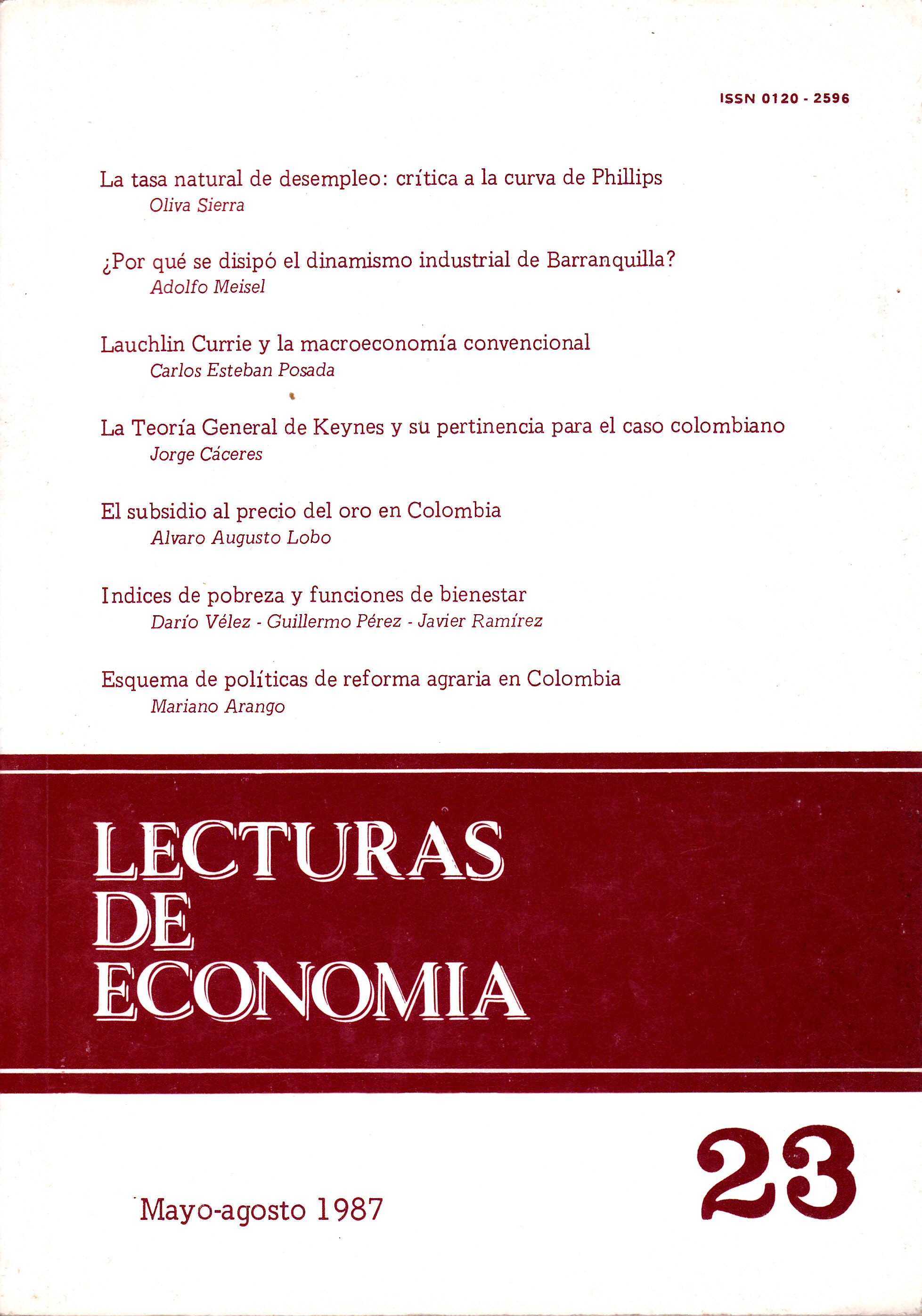
Lauchlin Currie y la macroeconomía convencional
DOI:
https://doi.org/10.17533/udea.le.n23a7774Abstract
• Resumen: Este artículo presenta una interpretación de las tesis de Lauchlin Currie en los campos del desarrollo económico y de la macroeconomía desde el punto de vista del modelo macroeconómico convencional de oferta y demanda agregadas. Según esta interpretación las tesis de Currie son coherentes con este modelo pero no pueden reducirse al keynesianismo ni al clasicismo tradicional: tienen su propia especificidad y, a juicio del autor, son de gran pertinencia para los países subdesarrollados.
• Abstract: This paper interprets Laughlin Currie's thesis in the fields of economic development and macroeconomics from the conventional supply and demand macroeconomic model approach. According to this interpretation; Currie's thesis can be encompassed in this model but they cannot be limited to textbook Keynesian or classic schemes. They have their own identity and the author considers them of great importance for underdeveloped countries.
Downloads
Downloads
Published
How to Cite
Issue
Section
License
This page, by Universidad de Antioquia, is licensed under a Creative Commons Attribution License.
Authors who publish with this journal agree to retain copyright and grant the journal right of first publication, with the article licensed under a Creative Commons Attribution-NonCommercial-ShareAlike License allowing others to share it as long as they acknowledge its authorship and original publication in this journal.
Authors can enter into separate, additional contractual arrangements for the non-exclusive distribution of the journal's published version of the work (e.g., post it to an institutional repository or publish it in a book), provided that these arrangements be not for profit and the journal be acknowledged as the original source of publication.
Authors are permitted and encouraged to post their papers online (e.g., in institutional repositories or on their websites), as it can lead to valuable exchanges as well as greater citation of the published work.




