

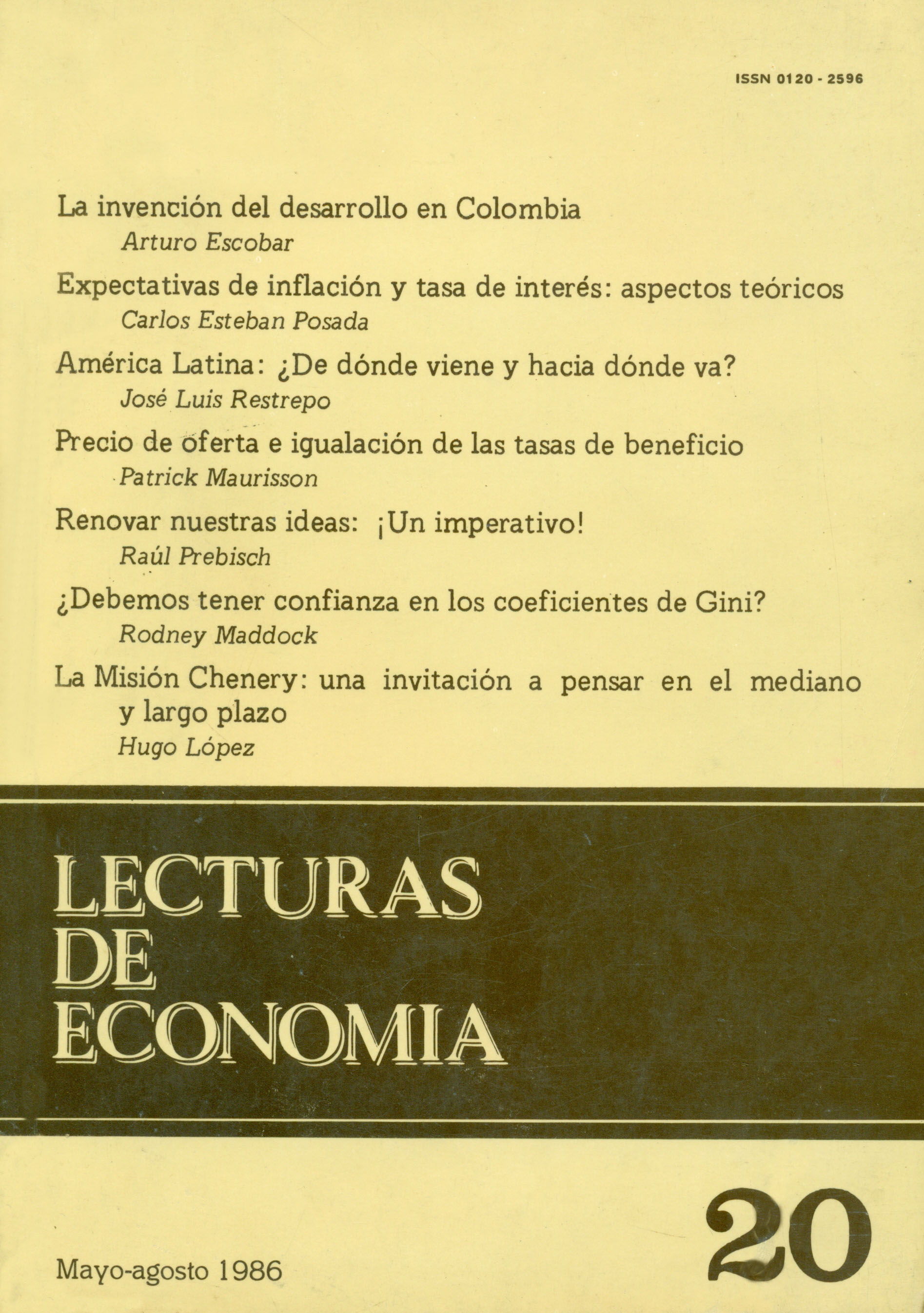
Expectativas de inflación y tasa de interés: aspectos teóricos
DOI:
https://doi.org/10.17533/udea.le.n20a7997Abstract
• Resumen: ¿Qué efectos tienen los cambios en las expectativas de inflación sobre las tasas de interés, nominales y reales? ¿Cómo se producen esos efectos? Existen dos grandes respuestas teóricas antagónicas a las preguntas anteriores: la clásica y la keynesiana. En este artículo se resumen dichas respuestas y se exponen sus alcances y limitaciones. A partir de este resumen se construye un modelo "cuasi-keynesiano", pero que arroja una conclusión que coincide con la respuesta clásica al respecto: las expectativas de inflación tienden a quedar incorporadas en la tasa nominal de interés sin modificar de manera permanente la tasa real de interés. En países o épocas con alteraciones significativas de las expectativas de inflación esta conclusión puede ser la correcta, no así la keynesiana.
• Abstract: This question of just how expectations of inflation influence the real and the nominal rate of interest have been addressed from both a Keynesian and a classical perspective. This paper presents a critical summary of these arguments in the context of a quasi-keynesian model. Its finding is however is essentially classical – that inflationary expectations will be incorporated into the nominal rate of interest without having any permanent effect on the real rate.
Downloads
Downloads
Published
How to Cite
Issue
Section
License
This page, by Universidad de Antioquia, is licensed under a Creative Commons Attribution License.
Authors who publish with this journal agree to retain copyright and grant the journal right of first publication, with the article licensed under a Creative Commons Attribution-NonCommercial-ShareAlike License allowing others to share it as long as they acknowledge its authorship and original publication in this journal.
Authors can enter into separate, additional contractual arrangements for the non-exclusive distribution of the journal's published version of the work (e.g., post it to an institutional repository or publish it in a book), provided that these arrangements be not for profit and the journal be acknowledged as the original source of publication.
Authors are permitted and encouraged to post their papers online (e.g., in institutional repositories or on their websites), as it can lead to valuable exchanges as well as greater citation of the published work.




