

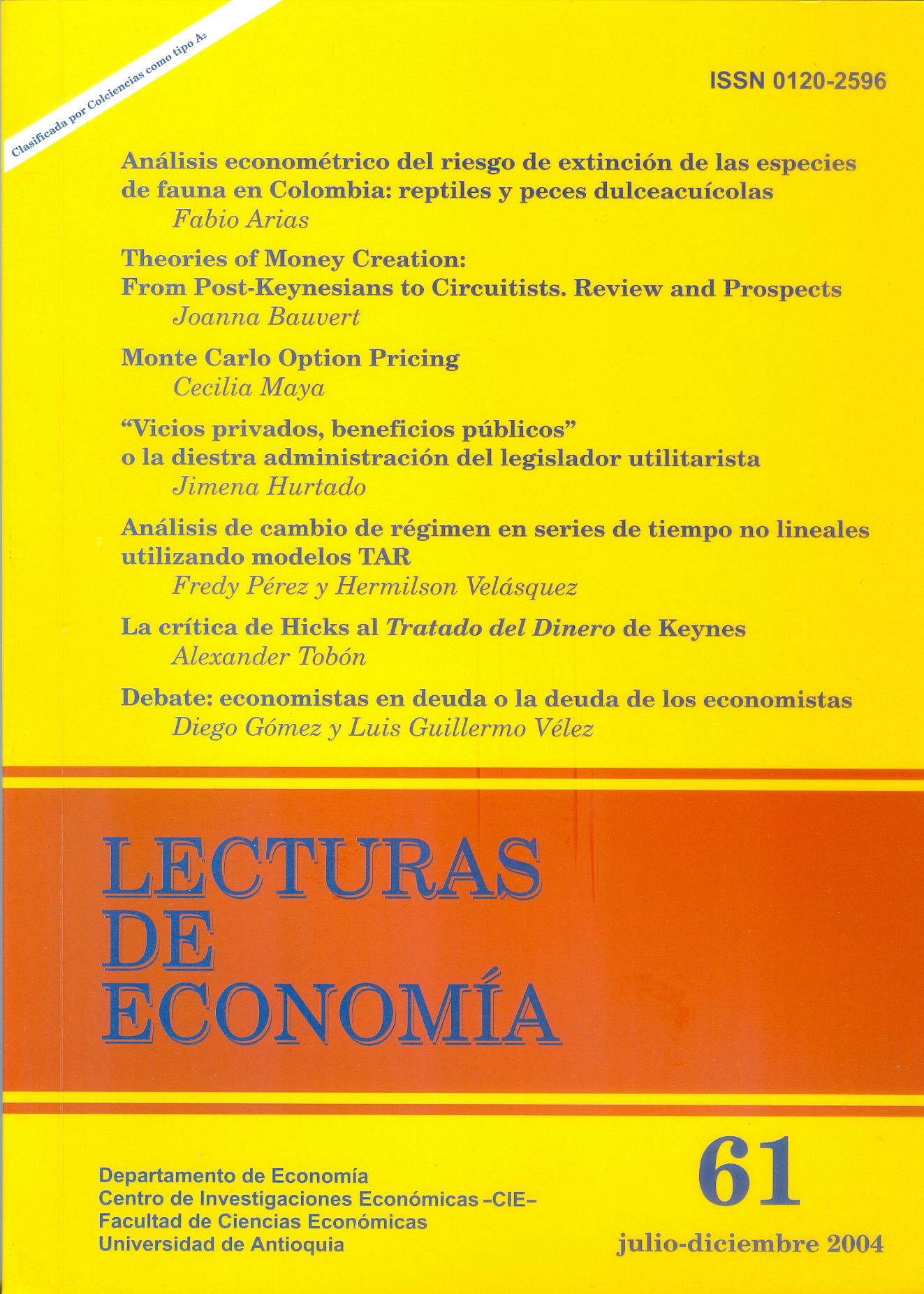
Análisis econométrico del riesgo de extinción de las especies de fauna en Colombia: reptiles y peces dulceacuícolas.
DOI:
https://doi.org/10.17533/udea.le.n61a2727Abstract
El riesgo de extinción de una especie se estima por la evaluación del estado de deterioro de la población. Una especie silvestre y no extinta puede ser evaluada y clasificada como: en peligro crítico, en peligro, vulnerable, cuasiamenazada o de preocupación menor. En Colombia se ha realizado esta clasificación para algunos grupos de fauna y flora. En este trabajo se utiliza la información de la serie Libros rojos de especies amenazadas de Colombia (reptiles y peces dulceacuícolas) para calcular el cambio en la probabilidad del riesgo de extinción ante variaciones de variable económicas que describen algún tipo de presión por explotación directa del recurso o modificación del hábitat. La herramienta cuantitativa para el análisis de la información es un modelo de variable dependiente discreta ordenada.
Palabras clave: recursos naturales renovables, extinción de las especies, modelo multinomial ordenado. Clasificación JEL: Q29
Abstract:
A species' risk of extinction is estimated by the deterioration state of the population. A wild and non extinct species could be evaluated and ranked as follows: Critically Endangered, Endangered, Vulnerable, Near Threatened, Of Minor Concern. This ranking has been applied in Colombia for some groups of fauna and flora. Information of the Red Books Series of Threatened Species of Colombia —Libros rojos de species amenazadas de Colombia— (reptiles, fresh water fish), is used in this paper for estimating the probability change of extintion risk upon changes in economic variables which show some kind of pressure for direct exploitation of habitat change. The quantitative tool for information analysis is a model of ordered discrete dependent variable.
Key Words: renewable natural resources, extinction of the species, ordered multinomial model. JEL: Q29
Résumé:
Le risque d'extinction d'une espèce est estimé par l'état de détérioration de la population. Une espèce sauvage et non éteinte pourrait être évaluée et rangée comme suit : En Mis en danger critique, Mis en danger, Vulnérable, Près De Menacé, Moindre Souci. Ce rang a été appliqué en Colombie pour quelques groupes de faune et de flore. L'information de la Série Le Livre Rouge de les Espèces Menacés de la Colombie —Libros rojos de especies amenazadas de Colombia— (reptiles, poissons d'eau douce) , est employée en cet article pour estimer le changement de probabilité du risque d'extintion face aux changements des variables économiques qui montrent un certain pression pour l'exploitation directe du changement d'habitat. L'outil cuantitative pour l'analyse de l'information est un modèle de variable dépendente discrète.
Mots clés: ressources naturelles renouvelable, extinction des espèces, ont modèle commandé multinomiale.
Downloads
Downloads
Published
How to Cite
Issue
Section
License
This page, by Universidad de Antioquia, is licensed under a Creative Commons Attribution License.
Authors who publish with this journal agree to retain copyright and grant the journal right of first publication, with the article licensed under a Creative Commons Attribution-NonCommercial-ShareAlike License allowing others to share it as long as they acknowledge its authorship and original publication in this journal.
Authors can enter into separate, additional contractual arrangements for the non-exclusive distribution of the journal's published version of the work (e.g., post it to an institutional repository or publish it in a book), provided that these arrangements be not for profit and the journal be acknowledged as the original source of publication.
Authors are permitted and encouraged to post their papers online (e.g., in institutional repositories or on their websites), as it can lead to valuable exchanges as well as greater citation of the published work.




