

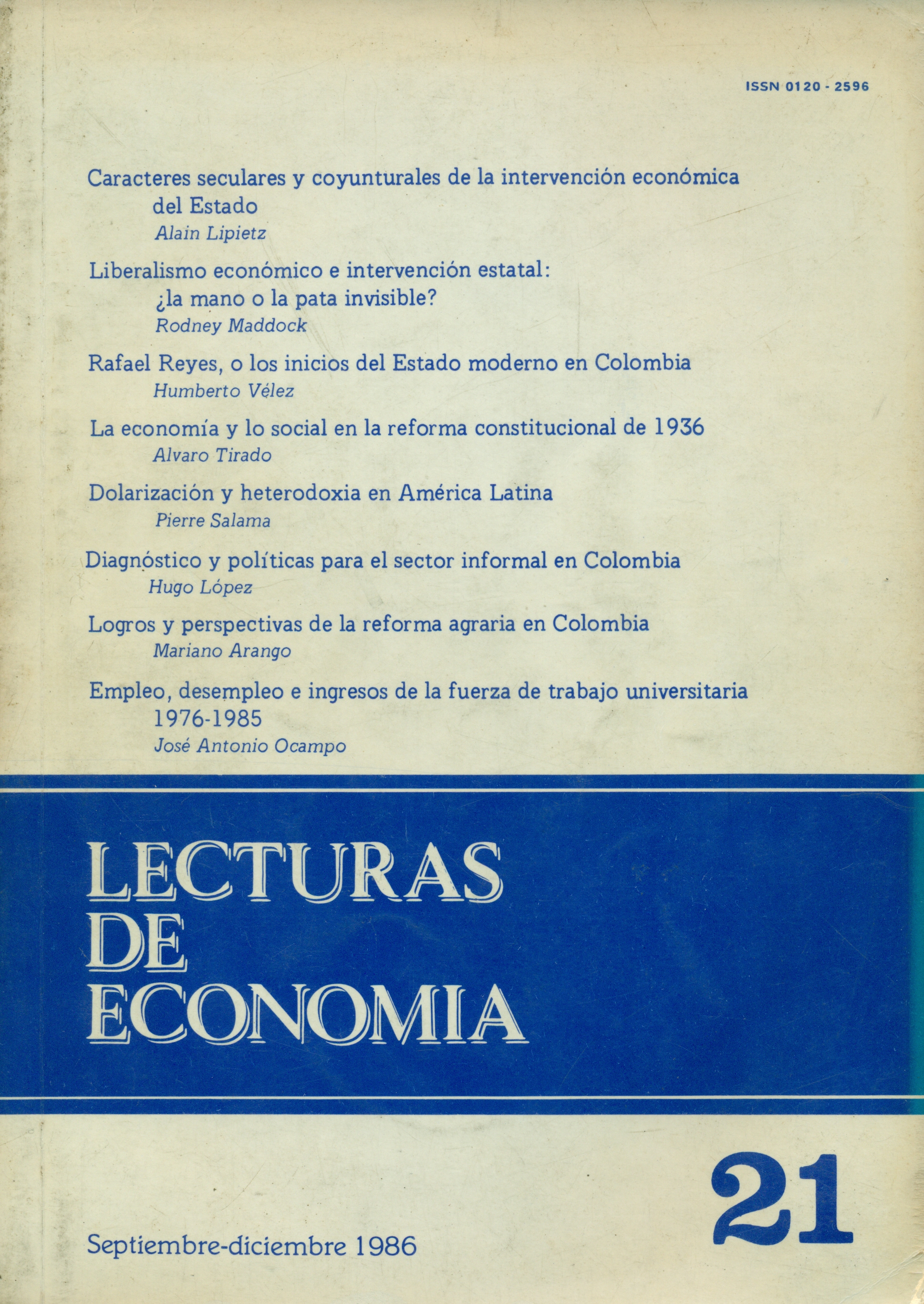
La economía y lo social en la reforma constitucional de 1936
DOI:
https://doi.org/10.17533/udea.le.n21a7952Abstract
• Resumen: Por medio de un repaso de las principales constituciones colombianas (las de 1832, 1843, 1858, 1863 Y 1886), se trata en este artículo de corroborar como en ellas se observan ciertas constantes, entre otras: la vigencia del régimen republicano, la separación de los poderes públicos y la garantía de las libertades individuales: pero en cada caso se incluyeron elementos consustanciales que perdieron vigencia con el paso de los tiempos, y elementos de mayor perdurabilidad: es el caso de las reformas a la Constitución Nacional en 1936, al darle un profundo viraje al antiguo andamiaje constitucional, colocándola de esta manera en la problemática del siglo XX, en la cual se analiza, especialmente , el intervencionismo de Estado.
• Abstract: This article analyses the various Colombian Constitutions most particularly that of 1936. It is shown that while each Constitution deals with certain constants (republicanism, the separation of powers, and the guarantee of individual liberties) it also demonstrates characteristics specific to its historical moment. In the case of the National Constitution of 1936 this latter element featured a sharp break with the traditional framework, meeting the challenge of the twentieth century with a new emphasis on the intervention of the State in the society.
Downloads
Downloads
Published
How to Cite
Issue
Section
License
This page, by Universidad de Antioquia, is licensed under a Creative Commons Attribution License.
Authors who publish with this journal agree to retain copyright and grant the journal right of first publication, with the article licensed under a Creative Commons Attribution-NonCommercial-ShareAlike License allowing others to share it as long as they acknowledge its authorship and original publication in this journal.
Authors can enter into separate, additional contractual arrangements for the non-exclusive distribution of the journal's published version of the work (e.g., post it to an institutional repository or publish it in a book), provided that these arrangements be not for profit and the journal be acknowledged as the original source of publication.
Authors are permitted and encouraged to post their papers online (e.g., in institutional repositories or on their websites), as it can lead to valuable exchanges as well as greater citation of the published work.




