

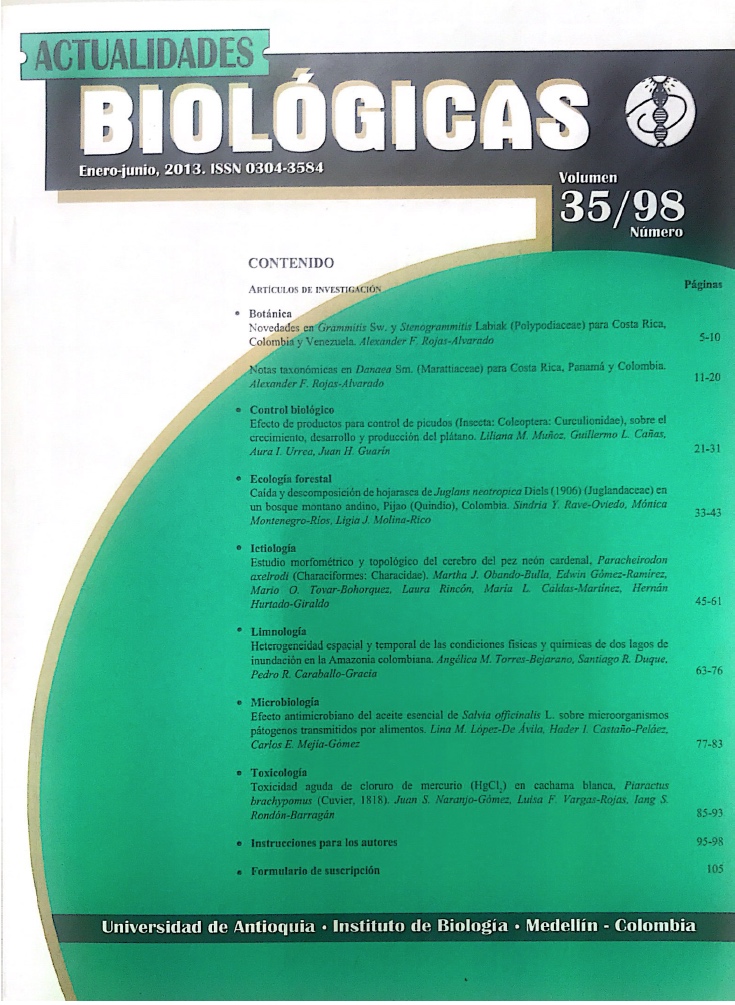
Acute toxicity of mercury chloride (HGCL2) to Cachama Blanca, Piaractus brachypomus/i> (Cuvier, 1818)
DOI:
https://doi.org/10.17533/udea.acbi.329220Keywords:
aquatic toxicology, mercury, mercury chloride, Piaractus brachypomusAbstract
The improper disposal of mercury-containing substances may cause toxicity and accumulate in fish tissues. In this study, the median lethal concentration (LC50) of mercury exposure at 96 hours in cachama blanca [Piaractus brachypomus (Cuvier, 1818)] was estimated through a semi-static acute toxicity test by using mercury chloride (HgCl2) as a metal source. The experiment was carried out in the toxicology laboratory of the University of Tolima (Colombia), under controlled conditions (28.09 ± 1.86 °C) and a 12:12 (light:darkness) photoperiod. The cachama blanca fingerlings (6.55 ± 1.3 g) were housed in glass aquaria with constant aeration without filter and feeding was suppressed 24 hours before beginning the experiment. Four cencnetrations of mercury (Hg) were used with replicas including controls. The concentrations were: 0.45, 0.55, 0.65, and 0.75 mg Hg/l. Histopathological analyses were conducted on 2 fish per treatment group on samples of liver, brain and gills tissues. Fish exposed to the lowest concentrations (0.45-0.55 mg Hg/l) of HgCl2 showed hyperactivity, whereas fish exposed to high concentrations (0.65-0.75 mg Hg/l) showed decreased activity. Histopathological analysis showed gills and liver lesions, like a lamellar hyperplasia and lipid vacuolization, respectively, in response to detoxification processes. The value of LC50-96 h was estimated by using the TSK software (Trimmed-Spearman-Karber) and produced a value of 0.56 mg Hg/l. This value is close to those reported for other fish species and represents the first report of acute toxicity to the mercury in cachama blanca.
Downloads
References
Acherman J. 2007. Análisis del estado de alteración y contaminación del humedal Jaboque Bogotá (Colombia) [Tesis de pregrado]. [Bogotá (Colombia)]: Pontificia Universidad Javeriana de Bogotá. p. 110.
Aduayom I, Denizeau F, Jumarie C. 2005. Multiple effects of mercury on cell volume regulation, plasma membrane permeability, and thiol content in the human intestinal cell line Caco-2. Cell Biology and Toxicology, 21 (3- 4): 163-179. DOI: https://doi.org/10.1007/s10565-005-0157-7
Alvarez S, Jessick AM, Palacio JA, Kolok AS. 2012. Methylmercury concentrations in six fish species from two Colombian rivers. Bulletin of Environmental Contamination and Toxicology, 88 (1): 65-68. DOI: https://doi.org/10.1007/s00128-011-0458-x
APHA. 1998. Toxicity. En: APHA, AWWA, WPCF, editores. Standard methods for the examination of water and wastewater. 20th edition. Washington D. C. (U. S. A.): American Public Health Association (APHA), American Water Works Association (AWWA) & Water Environment Federation (WEF). p. 140-150.
Appleton J, Williams T, Orbea H, Carrasco M. 2001. Fluvial contamination associated with artisanal gold mining in the Ponce Enríquez, Protovelo-Zaruma and Nambija areas, Ecuador. Water, Air and Soil Pollution, 131 (1-4): 19-39. DOI: https://doi.org/10.1023/A:1011965430757
Balasubramanian S, Baby RP, Arul PA, Prakash M, Senthilraja P, Gunasekaran G. 2012. Antimicrobial properties of skin mucus from four freshwater cultivable fishes (Catla catla, Hypophthalmichthys
molitrix, Labeo rohita and Ctenopharyngodon idella). African Journal of Microbiology Research, 6 (24): 5110-5120.
Buhl KJ. 1997. Relative sensitivity of three endangered fishes, Colorado squawfish, bonytail, and razorback sucker, to selected metal pollutants. Ecotoxicology Environmental and Safety, 37 (2): 186-192. DOI: https://doi.org/10.1006/eesa.1997.1543
Charuwan-Somsiri L. 1982. Acute toxicity of mercury, copper and zinc to the Nile tilapia (Tilapia nilotica, Linnaeus, 1757). Thai Fish Gazette, 35 (3): 313-318.
Cooley HM, Evans RE, Klaverkamp JF. 2000. Toxicology of dietary uranium in lake white fish (Coregonus clupeaformis). Aquatic Toxicology, 48 (4): 495-515. DOI: https://doi.org/10.1016/S0166-445X(99)00057-0
Das K, Siebert U, Gillet A, Dupont A, Di-Poï C, Fonfara S, Mazzucchelli G, De Pauw E, and De Pauw-Gillet M-C. 2008. Mercury immune toxicity in harbour seals: links to in vitro toxicity. Environmental Health, 7 (52): 1-17. DOI: https://doi.org/10.1186/1476-069X-7-52
Day RD, Segars AIL, Arendt MD, Lee AM, Peden-Adams MM. 2007. Relationship of blood mercury levels to health parameters in the loggerhead sea turtle (Caretta caretta). Environmental Health Perspectives, 115 (10): 1421-1428. DOI: https://doi.org/10.1289/ehp.9918
Dorea JG, Moreira BM, East G, Barbosa AC. 1998. Selenium and mercury concentrations in some fish species of the Madeira River, Amazon Basin, Brazil. Biological Trace Element Research, 65: 211-220. DOI: https://doi.org/10.1007/BF02789097
Esteban MA. 2012. An overview of the immunological defenses in fish skin. ISRN Immunology (International Scholarly Research Network Immunology), 2012: 1-29. Ferguson HW. 2006. Systemic pathology of fish. 2th ed. London: Scotian Press. p. 366. DOI: https://doi.org/10.5402/2012/853470
Fillion M, Mergler D, Passos CJS, Larribe F, Lemire M, Guimarães JRD. 2006. A preliminary study of mercury exposure and blood pressure in the Brazilian amazon. Environmental Health, 5: 29. DOI: https://doi.org/10.1186/1476-069X-5-29
Francis-Floyd R. 1995. The use of salt in aquaculture. Florida: University of Florida. Fact Sheet VM 86. Fecha de acceso: 07 de mayo de 2013. Disponible en: <http://edis.ifas.ufl.edu/pdffiles/VM/VM00700.pdf>.
Geier DA, King PG, Sykes LK, Geier MR. 2008. A comprehensive review of mercury provoked autism. The Indian Journal of Medical Research, 128 (4): 383-411.
Hamilton MA, Russo RC, Thurston RV. 1977. Trimmed Spearman-Karber method for estimating median lethal concentrations in toxicity bioassays. Environmental Science & Technology, 11 (7): 714-719. DOI: https://doi.org/10.1021/es60130a004
Hirt LM, Domitrovic HA. 2002. Toxicidad y respuesta histopatológica en Cichlasoma dimerus (Pisces, Cichlidae) expuestos a bicloruro de mercurio en ensayos agudos y subletales. Revista Ictiología, 10 (1/2): 37-52.
Ishikawa NM, Tavares MJ, Lombardi JV. 2007. Acute toxicity of mercury (HgCl2) to Nile tilapia, Oreochromis niloticus. Boletim do Instituto de Pesca, 33 (1): 99-104.
Jiraungkoorskul W, Upatham ES, Kruatrachue M, Sahaphong S, Vichasri-Grams S, Pokethitiyook P. 2003. Biochemical and histopathological effects of glyphosate herbicide on Nile tilapia (Oreochromis niloticus). Environmental Toxicology, 18 (4): 260-267. DOI: https://doi.org/10.1002/tox.10123
Jones T, Hunt R, King N. 1997. Veterinary pathology. 6th edition. New York: Lippincott Williams and Wilkins. p. 1392.
Kempuraj D, Asadi S, Zhang B, Manola A, Hogan J, Peterson E, Theoharides TC. 2010. Mercury induces inflammatory mediator release from human mast cells. Journal of Neuroinflammation, 7: 20. DOI: https://doi.org/10.1186/1742-2094-7-20
Lebel J, Mergler D, Lucotte M. 1996. Evidence of early nervous systems dysfunction in amazonian populations exposed to low-levels of methylmercury. Neurotoxicology, 17 (1): 157-167.
Lin H, Randall D. 1995. Proton pumps in fish gills. En: Wood C, Shuttleworth T, editores. Cellular and molecular approaches to fish ionic regulation, 14. San Diego (CA, U. S. A.): Academic Press (Elsevier). p. 229-255. DOI: https://doi.org/10.1016/S1546-5098(08)60248-4
Mancera-Rodríguez NJ, Álvarez-León R. 2006. Estado del conocimiento de las concentraciones de mercurio y otros metales pesados en peces dulceacuícolas de Colombia. Acta Biológica Colombiana, 11 (1): 3-23.
Marrugo-Negrete J, Benítez LN, Olivero-Verbel J. 2008. Distribution of mercury in several environmental compartments in an aquatic ecosystem impacted by gold mining in northern Colombia. Archives of DOI: https://doi.org/10.1007/s00244-007-9129-7
Environmental Contamination and Toxicology, 55 (2): 305-316.
Monteiro DA, Rantin FT, Kalinin AL. 2010. Inorganic mercury exposure: toxicological effects, oxidative
stress biomarkers and bioaccumulation in the tropical freshwater fish matrinxã, Brycon amazonicus (Spix and Agassiz, 1829). Ecotoxicology, 19 (1): 105-123. DOI: https://doi.org/10.1007/s10646-009-0395-1
Muñoz-Escobar EM, Palacio-Baena JA. 2010. Efectos del cloruro de mercurio (HgCl2) sobre la sobrevivencia y crecimiento de renacuajos de Dendrosophus bogerti. Actualidades Biológicas, 32 (93): 189-197. DOI: https://doi.org/10.17533/udea.acbi.13814
OECD. 1992. Test N.o 203: Fish, Acute Toxicity Test. Paris: OECD Publishing. p. 1-9.
Papadimitriou JC, Drachenberg CB, Brenner DS, Newkirk C, Trump BF, Silverberg SG. 2000. “Thanatosomes”: A unifying morphogenetic concept for tumor hyaline globules related to apoptosis. Human Pathology, 31 (12): 1455-1465. DOI: https://doi.org/10.1053/hupa.2000.20376
Pellissó SC, Muñoz MJ, Carballo M, Sánchez-Vizcaíno JM. 2008. Determination of the immunotoxic potential of heavy metals on the functional activity of bottlenose dolphin leukocytes in vitro. Veterinary Immunology and Immunopathology, 121 (3-4): 189-198. DOI: https://doi.org/10.1016/j.vetimm.2007.09.009
Ramamurthi R, Naidu KA, Subbiah MB, Balaji N, Rao MVR. 1982. Toxicity of mercury to some freshwater organisms. Geobios (Jodhpur Journal), 9: 89-90.
Ramírez-Duarte WF, Rondón-Barragán IS, Eslava-Mocha PR. 2008. Acute toxicity and histopathological alterations of Roundup® herbicide on ̈Cachama blanca ̈ (Piaractus brachypomus). Pesquisa Veterinária Brasileira, 28 (11): 547-554. DOI: https://doi.org/10.1590/S0100-736X2008001100002
Ramírez-Duarte W, Rondón-Barragán I, Vidal H, Eslava-Mocha P. 2009. Toxicidad aguda y lesiones histopatológica en cachama blanca (Piaractus brachypomus) expuestas a la muestra de herbicida DOI: https://doi.org/10.21897/rmvz.365
Roundup® más el surfactante Cosmoflux® 411F. Revista MVZ Córdoba, 14 (1): 1563-1575.
Sarkar B, Chatterjee A, Adhikari S, Ayyappan S. 2005. Carbofuran and cypermethrin-induced histopathological alterations in the liver of Labeo rohita (Hamilton) and its recovery. Journal of Applied Ichthyology, 21 (2): 131-135. DOI: https://doi.org/10.1111/j.1439-0426.2004.00590.x
Schober SE, Sinks TH, Jones RL, Bolger PM, McDowell M, Osterloh J, Garrett ES, Canady RA, Dillon CF, Sun Y, Joseph CB, Mahaffey KR. 2003. Blood mercury levels in US children and women of childbearing age, 1999-2000. The Journal of the American Medical Association, 289 (13): 1667-1674. DOI: https://doi.org/10.1097/01.OGX.0000083702.01676.C1
Schwenk M, Klein R, Templeton DM. 2009. Immunological effects of mercury (IUPAC Technical report). International Union of Pure and Applied Chemistry, 81 (1): 153-167. DOI: https://doi.org/10.1351/PAC-REP-08-04-02
Sheir SK, Handy RD, Galloway TS. 2010. Tissue injury and cellular immune responses to mercuric chloride exposure in the common mussel Mytilus edulis: modulation by lipopolysaccharide. Ecotoxicology and Environmental Safety, 73 (6): 1338-1344. DOI: https://doi.org/10.1016/j.ecoenv.2010.01.014
Yanong RPE. 2003. Necropsy techniques for fish. En: Echols S, editor. Practical gross necropsy of exotic animal species. Seminars in avian and exotic pet medicine. Philadelphia (U. S. A.): W. B. Saunders Co. p. 89-105. DOI: https://doi.org/10.1053/saep.2003.127885
Zelikoff JT, Raymond A, Carlson E, Li Y, Beaman JR, Anderson M. 2000. Biomarkers of immunotoxicity in fish: from the lab to the ocean. Toxicology Letters, 112-113: 325-331. DOI: https://doi.org/10.1016/S0378-4274(99)00202-7
Zhu L, Yan B, Wang L, Pan X. 2012. Mercury concentration in the muscle of seven fish species from Chagan Lake, Northeast China. Environmental Monitoring and Assessment, 184 (3): 1299-1310. DOI: https://doi.org/10.1007/s10661-011-2041-7
Downloads
Published
How to Cite
Issue
Section
License
The authors exclusively authorize the Actualidades Biológicas journal to edit and publish the submitted manuscript if its publication is recommended and accepted, without this representing any cost to the Journal or the University of Antioquia.
All the ideas and opinions contained in the articles are sole responsibility of the authors. The total content of the issues or supplements of the journal is protected under the Creative Commons Attribution-NonCommercial-ShareAlike 4.0 International License, so they cannot be used for commercial purposes, but for educational purposes. However, please mention the Actualidades Biológicas journal as a source and send a copy of the publication in which the content was reproduced.




