

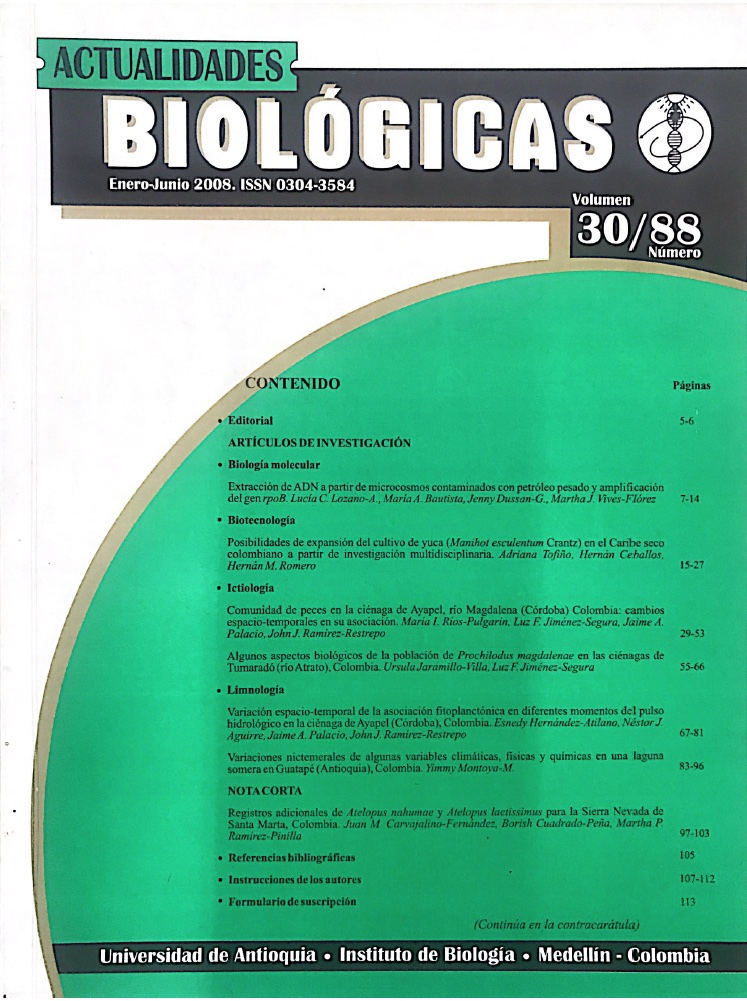
Possibilities of cassava (Manihot esculentum crantz) expansion in colombian caribbean coast drought zones by multidisciplinary research
DOI:
https://doi.org/10.17533/udea.acbi.329317Keywords:
adaptation drought potential, leaf retention, Manihot, net leaf photosynthesis, root depth, water stressAbstract
Where prolonged drought is a major constraint for the success of food crops such as cereals and cassava(Manihot esculenta Crantz) produce reasonably well where prolonged drought is a major constraint for theircommercial success. In the case of cassava, this is due to its intermediate C3-C4 photosynthesis. Cassava hasentered the modern market economy and has a growing demand for its use in processed food, animal feeding,ethanol production, starch and its derivates, and for many different industrial applications. A shift from thetraditional small-scale plantings for the fresh market to larger-scale plantings for factory sales requires increasedyield, quality, and stability of production in drought-prone zones. In Latin America, approximately 45% of totalcassava area comes from sub-humid zones or with sporadic rainfall. Moreover, expansion of this crop tends tooccur in marginal lands. Although a wide range of genetic variability in most drought tolerant traits existswithin cassava germoplasm, a multidisciplinary research could increase the efficiency for the selection of thebest progenitors and gene pyramidation to increase preexisting drought tolerant physiological traits in cassavagenome. The main goal of this review is to outline potential research on physiology, biotechnology, andbreeding and their possibilities to improve traits to drougth tolerance in cassava.
Downloads
References
Ahloowalia B, Maluszynski M, Nichterlein K. 2004. Glo-bal impact of mutation-derived varieties. Euphytica,135:187-204.
Alves A, Setter T. 2000. Response of cassava to waterdeficit: Leaf area growth and abscisic acid. CropScience, 40:131-137.
Anderson J, Delseny M, Fregene M, Jorge V, Mba C,Lopez C, Restrepo S, Soto M, Piegu B, Verdier V,Cooke R, Tohme J, Horvath D. 2004. An EST resourcefor cassava and other species of Euphorbiaceae.Plant Molecular Biology, 56(4):527-539.
Angelov M, Sun J, Byrd G, Brown R, Black C. 1993. Novelcharacteristics of cassava, Manihot esculenta Crantz,a reputed C3-C4 intermediate photosynthesis species.Photosynthesis Research, 38(1):61-72.
Archana P, Taware S, Raut V. 2004. Induced variation inquantitative traits due to physical (gamma rays),chemical (EMS) and combined mutagen treatmentsin soybean [Glycine max (L.)Merrill]. SoybeanGenetics Newsletter, 31:49-58.
Aswath C, Kim SH, Mo SY, Kim DH. 2005. Transgenicplants of creeping bent grass harbouring the stressinducible gene, 9-cis-epoxycarotenoid dioxygenase,are highly tolerant to drought and NaCl stress. PlantGrowth Regulation, 47:129-139.
Baker G, Fukai S, Wilson G. 1989. The response of cassavato water deficits at various stages of growth in thesubtropics. Australian Journal of AgriculturalResearch, 40(3):517-528.
Caetano-Anollés G, Bassam B, Gresshoff P. 1993.Enhanced detection of polymorphic DNA by multiplearbitrary amplicon profiling of endonuclease-digested DNA: identification of markers tightly linkedto the supernodulation locus in soybean. MolecularGenetics, 241(1-2):57-64.
Calatayud P, Duchon S, Lamaze T. 1998. Estimation ofcarbon and nitrogen modification during waterdeficiency in leaves of cassava (Manihot esculentumCrantz). Revista Brasileira da Mandioca, 17:39-47.
Calatayud P,Llovera E, Bois J,Lamaze T. 2000.Photosynthesis in drought-adapted cassava.Photosynthetica, 38:97-104.
Cayón M, el-Sharkawy M, Cadavid L. 1997. Leaf gasexchange of cassava as affected by quality ofplanting material and water stress. Photosynthetica,34(3):409-418.
Ceballos H, Iglesias C, Pérez J, Dixon A. 2004. Cassavabreeding: opportunities and challenges. PlantMolecular Biology, 56(4):503-516.
Ceballos H, Fregene M, Lentini Z, Sanchez T, Puentes Y,Pérez J, Rosero A, Tofino, A. 2006. Developmentand identification of high-value cassava clones. ActaHorticulturae, 703:63-70.
CIAT. 2005. Project IP3, Improved cassava for thedeveloping World, annual report, 2005. Cali,Colombia.Cortés D, Reilly K, Okogbenin E, Beeching J, Iglesias C,Tohme J. 2002. Mapping wound-response genesinvolved in post-harvest physiological deterioration(PPD) of cassava (Manihot esculentum Crantz).Euphytica, 128(1):47-53.
Changjie Y; Song Y; Zhengqiu Z; Guohua L, Jufei L,Minghong G. 2006. Genetic analysis and gene finemapping for a rice novel mutant (rl 9(t)) with rolling leafcharacter. Chinese Science Bulletin, 51(1):63-69.
Chavarriaga P, Maya M, Bonierbale M, Kresovich S,Fregene M, Tohme J, Kochert G. 1998. Microsatellitesin cassava (Manihot esculentum Crantz): discovery,inheritance and variability. Theoretical AppliedGenetic, 97:493-501.
Chen Shuai, Mohammad H, Peisker H, Tschiersch U,Sonnewald F, Börnke F. 2005. Decreased sucrose-6-phosphate phosphatase level in transgenictobacco inhibits photosynthesis, alterscarbohydrate partitioning, and reduces growth.Planta, 221:479-492.
Cheng T, Chandlee F. 1999. The structural, biochemical,and genetic characterization of a new radiation induced, variegated leaf mutant of soybean [Glycinemax (L.) Merr.] a soybean leaf variegated mutant.Proceedings of the National Science CouncilRepublic of China, 23(1):27-37.
Cheng L, Zhou R, Reidel E, Sharkey T, Dandekar A. 2005.Antisense inhibition of sorbitol synthesis leads toup-regulation of starch synthesis without alteringCO2 assimilation in apple leaves. Planta, 220(5):767-776.
Chinnusamy V, Xiong L, Zhu JK. 2005. Use of geneticengineering and molecular biology approaches forcrop inprovement for strees environments. Pp. 47-95. En: Ashraf M, Harris PJ (eds.). Abiotic stressesplant resistance through breeding and molecularapproaches. Food Products Press. Binghamton (NY),U. S. A.
Denyer K, Johnson P, Zeeman S, Smith A. 2001. The con-trol of amylose synthesis. Journal of PlantPhysiology, 158:479-487.
Do K, Dao M, Hung P, Nguyen T. 2006. Rice mutationimprovement for short duration, high yield andtolerance to adverse conditions in Mekong Delta ofViet Nam. Plant Mutation Reports, 1(1):49-52.
Edwards G, Sheta E, Moore B, Dai Z, Franceschi V, ChengS, Lin Ch, Ku M. 1990. Photosynthetic characteristicsof cassava (Manihot esculentum Crantz), a C3 specieswith chlorenchymatous bundle sheath cells. Plantand Cell Physiology, 31(8):1199-1206.
Eisenbarth D, Weig A. 2005. Sucrose carrier rcscr1 isinvolved in sucrose retrieval, but not in sucroseunloading in growing hypocotyls of Ricinuscommunis L. Plant Biology, 7:98-103.
el-Sharkawy M. 1993. Drought-tolerant cassava for Afri-ca, Asia, and Latin America. BioScience, 43(7):441-451.
el-Sharkawy M, Cadavid L. 2002. Response of cassava toprolonged water stress imposed at different stagesof growth. Experimental Agriculture, 38:333-350
el-Sharkawy M. 2004. Cassava biology and physiology.Plant Molecular Biology, 56(4):481-501.
Fregene M, Angel F, Gomez R, Rodriguez F, ChavarriagaP, Roca W, Tohme J, Bonierbale M. 1997. A moleculargenetic map of cassava (Manihot esculentum Crantz).Theoretical Applied Genetics, 95(3):431-441.
Fregene M, Okogbenin E, Mba C, Angel F, Suarez M,Gutierrez J, Chavarriaga P, Roca W, Bonierbale M,Tohme J. 2001. Genome mapping in cassavaimprovement: Challenges, achievements, andopportunities. Euphytica, 120:159-165.
Fofana I, Sangare A, Collier R, Taylor C, Fauquet C. 2004.A geminivirus-induced gene silencing system forgene function validation in cassava. Plant MolecularBiology, 56:613-624.
Grover A, Kapoor A, Lakshmi S, Agarwal S, Sahi Ch,Katiyar-Agarwal S, Agarwal M, Dubey H. 2001.Understanding molecular alphabets of the plantabiotic stress responses. Current Science, 80(2):206-216.
Henikoff S, Till B, Comai L. 2004. TILLING. Traditionalmutagenesis meets functional genomics. PlantPhysiology, 135:1-7.
Hu H, Dai M, Yao J, Xiao B, Li X, Zhang Q, Xiong L. 2006.Overexpressing a NAM, ATAF, and CUC (NAC)transcription factor and salt tolerant in rice.Proceedings of the National Academy of the UnitedStates of America, 103:12987-12992.
IAEA. 1998. In vitro techniques for selection of radiationinduced mutations adapted to adverseenvironmental conditions. Proceedings of a finalResearch Co-ordination Meeting organized by theJoint FAO/IAEA Division of Nuclear Techniques inFood and Agriculture and held. TECDOC-1227. 17-21 August. Shanghai, China.
Isamah G. 2004. ATPase, peroxidase and lipoxygenaseactivity during post-harvest deterioration of cassava(Manihot esculentum Crantz) root tubers.International Biodeterioration andBiodegradation, 54(4):319-323.
Jauhar PP. 2006. Modern biotechnology as an integralsupplement to conventional plant breeding: Theprospects and challenges. Crop Science, 46:1841-1859.
Jobling S. 2004. Improving starch for food and industrialapplications. Current Opinion of Plant Biology,7:210-218.
Jorge V, Fregene M, Duque M, Bonierbale M, Tohme J,Verdier V. 2000. Genetic mapping of resistance tobacterial blight disease in cassava (Manihotesculentum Crantz). Theoretical Applied Genetics,101(5-6):865-872.
Joseph R, Yeoh H, Loh S. 2004. Induced mutations incassava using somatic embryos and the identificationof mutant plants with altered starch yield andcomposition. Plant Cell Reproduction, 23:91-98.
Jorgensen K, Bak S, Kamp Busk P, Sorensen Ch, OlsenC, Puonti-Kaerlas J, Moller B. 2005. Cassava plantswith a depleted cyanogenic glucoside content inleaves and tubers. Distribution of cyanogenicglucosides, their site of synthesis and transport, andblockage of the biosynthesis by RNA interferencetechnology. Plant Physiology, 139:363-374.
Kawano K, Narintaraporn K, Narintaraporn P, SarakarnS, Limsila A, Limsila J, Suparhan D, Sarawat V,Watananonta W. 1998. Yield improvement in aMultistage Breeding Program for Cassava. CropScience, 38(2):325-332.
Ku M. 2000. Scientists achieve major breakthrough inrice; data to be shared with worldwide researchcommunity. School of Biological Sciences Was-hington State University. U. S. A. <http://www.biotech-info.net/rice_breakthrough.html>. Fe-cha de consulta: 20 de junio de 2006.
Lahai M, Ekanayake I, George J. 2003. Leaf chlorophyllcontent and tuberous root yield of cassava in inlandvalley. African Crop Science Journal, 11(2):107-117.
Lagoda P. 2004. Cells suspention in cassava. PlantBreeding Genetics Newsletter, 3:13.Lenis J, Calle F, Jaramillo G, Perez J, Ceballos H, CockJ. 2006. Leaf retention and cassava productivity.Field Crop Research, 95:126-134.
Lin Y, Tanaka S. 2006. Ethanol fermentation from biomassresources: current state and prospects. AppliedMicrobiological Biotechnology, 29(6):627-642.
Magnaghi A. 2005. Local self-sustainable development:Subjects of transformation. TailoringBiotechnologies, 1(1):79-102.
Matsuoka M, Furbank R, Fukayama H, Myyao M. 2001.Molecular engineering of C4 photosynthesis. AnnualReview of Plant Molecular Biology, 52:297-314.
Mejía De Tafur S, el-Sharkawy M, Calle F. 1997.Photosynthesis and yield performance of cassava inseasonally dry and semiarid environments.Photosynthetica, 33(2):249-257.Mejia De Tafur S, el-Sharkawy M, Cadavid L. 1997.Response of cassava (Manihot esculentum Crantz)to water stress and fertilization. Photosynthetica,34(2):233-239.
Mejía de Tafur S. 2002. Fisiología de la yuca. Pp. 34-45Ceballos H, Ospina B (eds.). En:La yuca en el ter-cer milenio. CIAT. Palmira (Valle del cauca), Colom-bia.Nakashima K, Yamagushi-Shinozaki K. 2005.Molecular studies on stress responsive geneexpression in Arabidopsis and improvement ofstress tolerance in crop plants by regulonbiotechnology. Jarq-Japan Agricultural ResearchQuarterly, 39:221-229.
Nomura M, Sentoku N, Nishimura A, Lin JH, Honda C,Taniguchi M, Ishida Y, Ohta S, Komari T, TokutomiM, Murikami Y, Tajimare S, Ku M, Matsuoka M.2000. The evolution of C4 plants: acquisition of cis-regulatory sequences in the promoter of C4- typepyruvate orthophosphate dikinasa gene. The PlantJournal, 22(3): 211-221.
Otani M, Saito H, Abe T, Shimada T. 2006. Induction ofmutations in sweetpotato plants by heavy-ionbeam irradiation. ISHS Acta Horticulturae, 703: IIinternational symposium on sweetpotato andcassava: innovative technologies forcommercialization. International Society forHorticultural Science (ISHS). Leuven, Bélgica.
Pérez J, Ceballos H, Ortega E, Lenis J. 2005. Análisis dela interacción genotipo por ambiente en yuca(Manihot esculentum Crantz). Fitotecnia Colombia-na, 5(2):11-19.
Pospísilová J. 2003. Participation of phytohormones in thestomatal regulation of gas exchange during waterstress. Biologia Plantarum, 46(4):491-506.
Rai SP, Luthra R, Gupta MM, Kumar S. 2001. Pleiotropicmorphological and abiotic stress resistancephenotypes of the hyper-abscisic acid producingAbo-mutant in the periwinkle Catharanthus roseus.Journal of Biosciences, 26(1):57-70.
Ramírez L. 2004. Caracterización de RUBISCO en intro-ducciones de café y su relación con la actividadfotosintética. Tesis de Doctorado. Unidad de tercerciclo Programa de Análisis Experimental en Biología,Universidad Pablo de Olavide. Sevilla, España.Raemakers K, Schreuder M, Suurs L, Furrer-VerhorstH, Vincken J, Vetten N, Jacobsen E, Visser R. 2005.
Improved cassava starch by antisense inhibition ofgranule-bound starch synthase i. MolecularBreeding, 16(2):163-172.
Rehman S, Harris P, Ashraf M. 2005. Stress environmentsand their impact on crop production. Pp. 3-18. En:Ashraf M, Harris P (eds.). Abiotic stresses plantresistance through breeding and molecularapproaches. Food Products Press. Binghamton (NY),U. S. A.
Sage R. 2004. The evolution of C4 photosynthesis. NewPhytologist, 161:341-370.
Sahrawy M, Ávila C, Chueca A, Canovas F, López J. 2004.Increased sucrose level and altered nitrogenmetabolism in Arabidopsis thaliana transgenic plantsexpressing antisense chloroplastic fructose-1, 6-bisphosphatase. Journal of Experimental Botany,l55(408):2495-2503.
Sánchez T, Chávez A, Ceballos H, Rodríguez D, Nestel P,Ishitani M. 2006. Reduction or delay of post-harvestphysiological deterioration in cassava rotos withhigher carotenoid content. Journal Science of Foodand Agriculture, 86:634-639.
Santisopasri V, Kurotjanawong K, Chotineeranat S,Piyachomkwan K, Sriroth K, Oates C. 2001. Impactof water stress on yield and quality of cassava starch.Industrial Crops and Products, (13):115-129.
Sarathi Reddy V, Basappa S. 1996. Direct fermentation ofcassava starch to ethanol by mixed cultures ofEndomycopsis fibuligera and Zymomonas mobilis:Synergism and limitations. Biotechnology Letters,18(11):1315-1318.
Sautter C, Poletti S, Zhang P, Gruissem W. 2006.Biofortification of essential nutritional compoundsand trace elements in rice and cassava. Proceedingsof the Nutrition Society, 56(2):153-159.
Shuurman FJ. 2005. Globalization and developmentresearch: some contentious issues. Tailoring Biotechnologies,1:65-78.
Siritunga D, Sayre R. 2004. Engineering cyanogensynthesis and turnover in cassava (Manihotesculentum Crantz). Plant Molecular Biology,56(4):661-669.
Smith A. 2005. How plants make and degrade starchgranules. Pp. 7-13. En: Tetlow J, Anderson P (eds.).Proceedings Starch Update 2005: The thirdconference on Starch Technology. Bankok, Thailand.Spencer M. 2006. Identification and pyramiding of mutatedgenes: novel approaches for improving croptolerance to salinity and drought. Plant Breedingand Genetics Newsletter, 17:9-17.
Sriroth K, Piyachomkwan K, Santisopasri V, Oates C.2001. Environmental conditions during rootdevelopment: Drought constraint on cassava starchquality. Euphytica, 120(1):95-102.
Sundaresan S, Sudhakaran P. 1995. Water stress-inducedalterations in the proline metabolism of drought-sus-ceptible and tolerant cassava (Manihot esculentumCrantz) cultivars. Physiologia Plantarum, 94(4):635-643.
Taylor N, Chavarriaga P, Raemakers K, Siritunga D,ZhangP. 2004. Development and application oftransgenic technologies in cassava. Plant MolecularBiology, 56:671-688.
Tofiño A, Fregene M, Ceballos H, Cabal D. 2006. Regula-ción del almidón en plantas terrestres: perspecti-vas de modificación. Acta Agronómica, 55(1):1-13.
Umezawa T, Fujita M, Fujita Y, Yamaguchi-Shinozaki K,Shinozaki K. 2006. Engineering drought tolerance inplants: discovering and tailoring genes to unlock thefuture. Current opinion in Biotechnology, 17:113-122.
Wu J, Wu C, Lei C, Baraoidan M, Bordeos A, MadambaM, Ramos-Pamplona M, Mauleon R, Portugal A, UlatV, Bruskiewich R, Wang G, Leach J, Khush G, LeungH. 2005.Chemical- and irradiation-induced mutantsof indica rice IR64 for forward and reverse genetics.Plant Molecular Biology, 59:85-97.
Yamaguchi-Shinozaki K, Shinozaki K. 2006.Transcriptional regulatory networks in cellularresponses and tolerance to dehydration and coldstresses. Annual Review of Plant Biology,57:781-803.
Zhang X, Holt J, Colvin J. 2000. A general model of plant-virus disease infection incorporating vectoraggregation. Plant Pathology, 49(4):435-444.
Zhang P, Gruissem W. 2004. Extension of cassava leaflife by autoregulatory inhibition of senescence. Pág.99. Sixth International Scientific Meeting of theCassava Biotechnology Network. March 8-14. Cali,Colombia.
Downloads
Published
How to Cite
Issue
Section
License
Copyright (c) 2017 Actualidades Biológicas

This work is licensed under a Creative Commons Attribution-NonCommercial-ShareAlike 4.0 International License.
The authors exclusively authorize the Actualidades Biológicas journal to edit and publish the submitted manuscript if its publication is recommended and accepted, without this representing any cost to the Journal or the University of Antioquia.
All the ideas and opinions contained in the articles are sole responsibility of the authors. The total content of the issues or supplements of the journal is protected under the Creative Commons Attribution-NonCommercial-ShareAlike 4.0 International License, so they cannot be used for commercial purposes, but for educational purposes. However, please mention the Actualidades Biológicas journal as a source and send a copy of the publication in which the content was reproduced.




