

Theories on the evolution of Rhodnius
DOI:
https://doi.org/10.17533/udea.acbi.329778Keywords:
Chagas disease, Rhodnius, Psammolestes, evolution, population geneticsAbstract
Current methods of Chagas disease control rely mainly on elimination of the domestic vector populations. Domestication of these insects has clearly been a recent event in evolutionary terms, associated with a series of genetic and phenetic changes, and this paper reviews current knowledge about the sequence of events leading to the domestication of species of Rhodnius that are important vectors of Chagas disease in the Andean pact and Central American countries. Available evidence suggests that species of Rhodnius have radiated from an ancestral source in the Amazon region, giving three main adaptive lines: southwards into the cerrados of Brazil, northwards into the llanos of Venezuela, and northwestwards through the Andean Cordillera into the Magdalena valley of Colombia. There has also been specialisation within the Amazon forest itself. The form of radiative adaptation is predicted from morphological and biogeographic characters, and subsequently supported by a series of morphometric and genetic markers including mtDNA sequence analysis.
|Abstract = 2056 veces
|
PDF (ESPAÑOL (ESPAÑA)) = 417 veces|
Downloads
Download data is not yet available.
Downloads
Published
2017-11-22
How to Cite
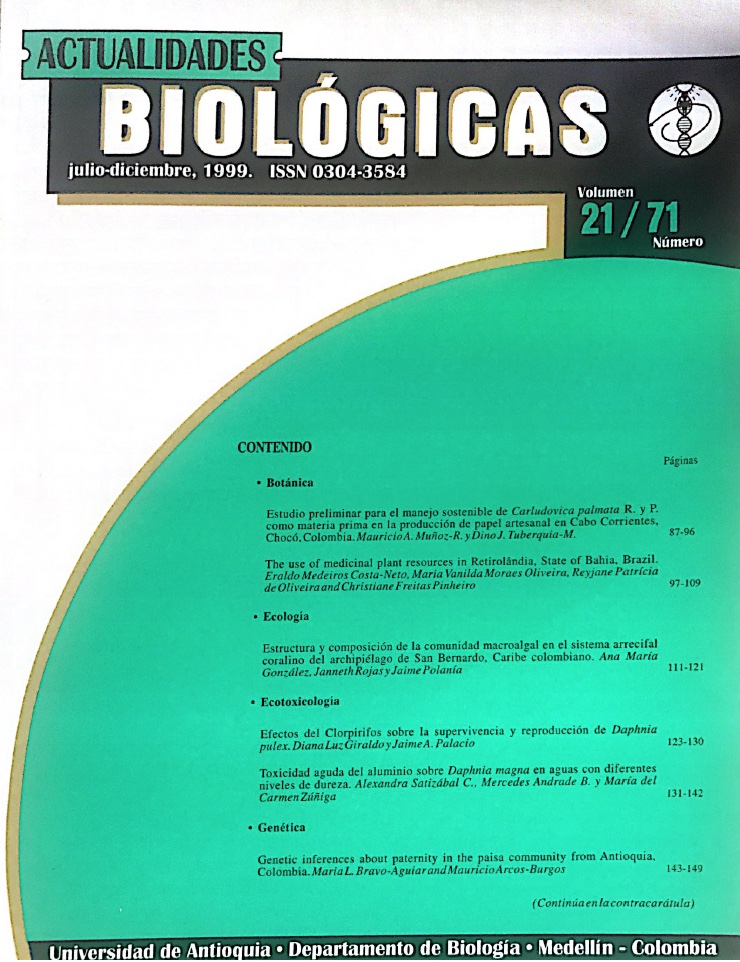
Schofield, C. J., & Dujardin, J.-P. (2017). Theories on the evolution of <i>Rhodnius</i>. Actualidades Biológicas, 21(71), 183–197. https://doi.org/10.17533/udea.acbi.329778
Issue
Section
Review articles
License
The authors exclusively authorize the Actualidades Biológicas journal to edit and publish the submitted manuscript if its publication is recommended and accepted, without this representing any cost to the Journal or the University of Antioquia.
All the ideas and opinions contained in the articles are sole responsibility of the authors. The total content of the issues or supplements of the journal is protected under the Creative Commons Attribution-NonCommercial-ShareAlike 4.0 International License, so they cannot be used for commercial purposes, but for educational purposes. However, please mention the Actualidades Biológicas journal as a source and send a copy of the publication in which the content was reproduced.




