

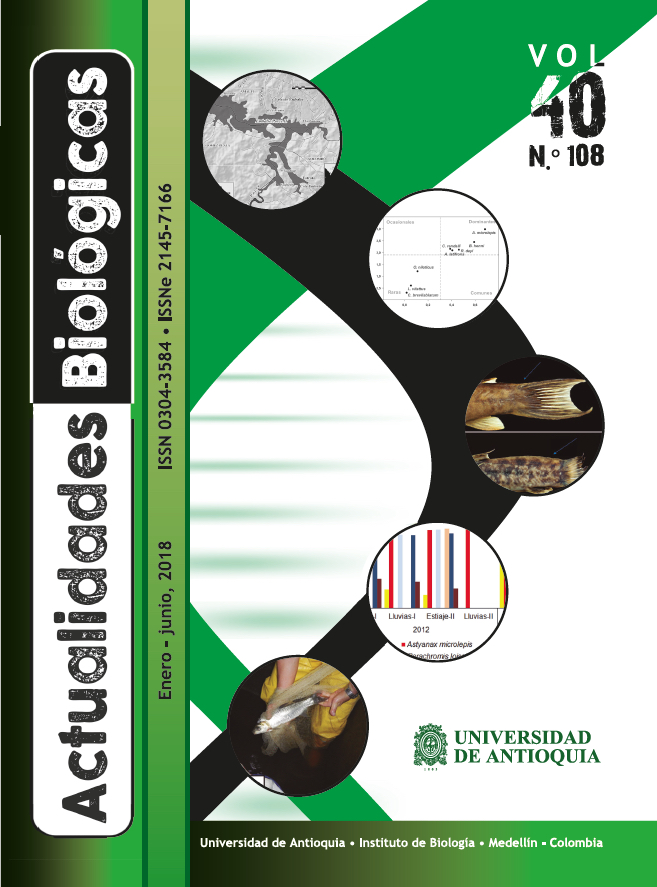
DNA Barcode methods reveal diversity of Astroblepus species in the Porce River drainage, Colombia
DOI:
https://doi.org/10.17533/udea.acbi.v40n108a06Keywords:
mitochondrial DNA, COI gene, GMYC, Neotropical ichthyofauna, genetic distances, morphometricsAbstract
The genus Astroblepus, is endemic to the Andean region and is represented by 81 valid species inhabiting high mountain rivers from Panama to Bolivia. In Colombia, about 32 species of this genus have been reported, of which 23 were recorded in the Porce River drainage, which indicates that about 71% of species diversity can be found in this area. Morphologically the species of Astroblepus are very similar and the characters traditionally used for their determination are not very diagnostic, which limits their identification at species level. In order to determine the diversity of Astroblepus in the Porce River drainage, 129 individuals were analyzed using genetic identification tools through the sequencing of the 580bp Cytochrome Oxidase subunit I (COI) gene and an analysis based on morphometry. The genetic analyses and the method of delimitation of species "General mixed "Yulecoalescent";, indicated the presence of 12 taxonomic entities, which were
supported by genetic distances and by 13 body measurements based on corporal
proportions. The results indicate that the diversity of species has been overestimated in this river and highlight the importance to integrate different methodologies in the delimitation species studies.
Downloads
References
Acinas SG, Klepac-Ceraj V, Hunt DE, Pharino C, Ceraj I, Distel DL, Polz MF. 2004. Fine-scale phylogenetic architecture of a complex bacterial community. Nature, 430(6999): 551-554. DOI:10.1038/nature02649
Barraclough TG, Herniou E. 2003. Why do species exist? Insights from sexuals and asexuals, Zoology (Jena), 106(4): 275–282. DOI:10.1078/0944-2006-00130.
Boulenger, GA. 1887. On new siluroid fishes from the Andes of Columbia. Annals and magazine of natural history, 19(113): 348-350.
https://doi.org/10.1080/00222938709460255.
Drummond A, Suchard M, Xie D, Rambaut A. 2012. Bayesian phylogenetics with BEAUti and the BEAST 1.7., Molecular Biology and Evolution, 29(8): 1969-1973. doi:10.1093/molbev/mss075
Empresas Públicas de Medellín E.S.P. 2004. Análisis físico-químicos de las aguas del embalse Porce II años 2001-2003, Área Hidrometría e Instrumentación. Medellín (Colombia): Empresas Públicas de Medellín.
Eigenmann CH. 1912. Some results from an ichthyological reconnaissance of Colombia, South America. Part II. Bloomington (USA): Indiana University studies, 16(8): 1- 27. http://www.scielo.org.co/scielo.php script=sci_arttext&pid=S0123-30682013000200009.
Eigenmann CH. 1918. Eighteen new species of fishes from northwestern South America. Proceedings of the American Philosophical Society, 56(7): 673-689.
Eschmeyer WNR, Fong JD. 2017. Catalog of fishes. San Francisco (CA): California Academy of Sciences; [fecha de acceso mayo 1, 2017]. http://researcharchive.calacademy.org/research/ichthyology/catalog/speciesbyfamily.asp
Fujisawa T, Barraclough TG. 2013. Delimiting species using single-locus data and the generalized mixed Yule coalescent approach: a revised method and evaluation on simulated data sets. Systematic Biology, 62(5): 707-24. doi:10.1093/sysbio/syt033
Gerard T, Vlad D, Vila R.2013. Factors affecting species delimitation with the GMYC model: insight from a butterfly survey. Methods in Ecology and Evolution, 4(12): 1101-1110. https://doi.org/10.1111/2041-210X.12107.
Hall T. 1999. BioEdit: a user-friendly biological sequence alignment editor and analysis program for Windows 95/98/NT. Nucleic Acids Symposium, 41: 95-98.
Hammer Ø, Harper DAT, Ryan PD. 2001 PAST: Paleontological statistics software package for education and data analysis. Paleontologia electronica, [fecha de acceso noviembre 20, 2016]; 4(1): 9. https://palaeo-electronica.org/2001_1/past/past.pdf
Hebert PD, Cywinska A, Ball SL, deWaard JR. 2003. Biological identifications through DNA barcodes. Biological Science, 270(1512): 313–321. DOI: 10.1098/rspb.2002.2218.
Hernández M, Ochoa L, Jiménez LF. 2016. Integración de métodos de DNA barcode y morfometría geométrica revelan diversidad de especies del género Astroblepus en la cuenca del río Porce, Colombia [Trabajo de pregrado]. [Medellín (Colombia)]: Instituto de Biología, Universidad de Antioquia.
Humboldt F. 1805. Mémoire sur une nouvelle espèce de pimelode, jetée par les volcans du Royaume de Quito. En: Voyage de Humboldt et Bonpland, Deuxième partie. Observations de Zoologie et d'Anatomie comparée. Paris: F. Schoell. 3(7): 21-25.
Jacobsen D. 2008. Tropical high-altitude streams. En: D Dudgeon editor. Tropical Stream Ecology. Netherlands: Elsevier. p. 219–256.
Jiménez LF, Álvarez J, Ochoa LE, Loaiza A, Londoño JP, Restrepo D, Aguirre K, Hernández A, Correa JD, Jaramillo U. 2014. Guía Ilustrada Peces Cañón del río Porce, Antioquia. Medellín (Colombia): Empresas Públicas de Medellín.
Johnson RD. 1912. Notes on the habits of a climbing catfish (Arges marmoratus) from the Republic of Colombia. Annals of the New York Academy of Sciences, [fecha de acceso junio 15, 2016]; 22(1): 327-333. https://nyaspubs.onlinelibrary.wiley.com/doi/pdf/10.1111/j.1749-
1912.tb55167.x
Lo PC, Liu SH, Nor SAM, Chen WJ. 2017. Molecular exploration of hidden diversity in the Indo-West Pacific sciaenid clade. PloS one, [fecha de acceso mayo 29, 2017]; 12(7). DOI:10.1371/journal. pone.0176623.
Miles C. 1971. Los peces del río Magdalena. (“A field book of Magdalena fishes”). 2a edición. Ibagué (Colombia): Universidad del Tolima ediciones.
Miranda-Chumacero G. 2006. Distribución altitudinal, abundancia relativa y densidad de peces en el río Huarinilla y sus tributarios (Cotapata, Bolivia). Ecología en Bolivia, [fecha de acceso marzo 15, 2016]; 41(1): 79-93. http://www.scielo.org.bo/scielo.php?script=sci_arttext&pid=S160525282006000700006&lng=es&nrm=iso
Pearson N. 1937. The fishes of the Atlantic and Pacific slopes near Cajamarca, Peru. Proceedings of the California Academy of Sciences, 23(4): 87-98. https://www.biodiversitylibrary.org/page/3188251#page/113/mode/1up
Regan CT. 1904. A monography of the family Loricariidae. Transactions of the Zoological Society of London, 17(3): 191-350. https://doi.org/10.1111/j.10963642.1904.tb00040.x
Reis E, Sven O, Ferraris C, editores. 2003. Check List of the Freshwater Fishes of South and Central America. Porto Alegre (Brasil): Edipucrs.
Rosso J, Mabragaña E, González C, Astarloa D. 2012. DNA barcoding Neotropical fishes: recent advances from the Pampa Plain, Argentina. Molecular Ecology Resources. [fecha de acceso febrero 15, 2016]; 12(6): 999-1011. https://doi.org/10.1111/17550998.12010.
Schaefer S, Arroyave J. 2010. Rivers as islands: determinants of the distribution of Andean astroblepid catfishes. Journal of Fish Biology, [fecha de acceso mayo 21, 2015]; 77(10). DOI: 10.1111/j.1095-8649.2010.02822.x.
Schaefer S, Chakrabarty P, Geneva A, Sabaj M. 2011. Nucleotide sequence data confirm diagnosis and local endemism of variable morphospecies of andean astroblepid catfishes (siluriformes: Astroblepidae). Zoological Journal of the Linnean Society,
(1): 90-102. https://doi.org/10.1111/j.1096-3642.2010.00673.x
Steindachner F. 1882. Beiträge zur Kenntniss der Flussfische Südamerika’s (IV). Anzeiger der Akademie für Wissenschaftlichen, Wien 19(19): 175-180.
Talavera G, Dinca V, Vila R. 2013. Factors affecting species delimitations with the GMYC
model: insight from a butterfly survey. Methods in Ecology and Evolution, 4(12): 1101-1110. https://doi.org/10.1111/2041-210X.12107
Tapan KB, Surya NS, Bijayalaxmi S, Bibarani T, Usha R. 2017 Morphological and genetic analyses of the first record of longrakered trevally, Ulua mentalis (Perciformes: Carangidae) and of the pinjalo snapper, Pinjalo pinjalo (Perciformes: Lutjanidae) in the Odisha coast, Bay of Bengal. Mitochondrial DNA Part A, DNA mapping,
sequencing and analysis, 29(4): 552-560. https://doi.org/10.1080/24701394.2017.1320993
Tamura K, Peterson D, Peterson N, Stecher G, Nei M, Kumar S. 2011. MEGA5: molecular evolutionary genetics analysis using maximum likelihood, evolutionary distance, and maximum parsimony methods. Molecular Biology and Evolution, 28(10): 2731-2739. DOI: 10.1093/molbev/msr121
Thompson JD, Higgins DG, Gibson TJ. 1994. CLUSTAL W: improving the sensitivity of progressive multiple sequence alignment through sequence weighting, position-specific gap penalties and weight matrix choice. Nucleic Acids Research, 22(22): 4876-4880.
Valdez M, Ivanova V, Gutiérrez M, Contreras S, Hebert PD. 2009. Probing diversity in freshwater fishes from Mexico and Guatemala with DNA barcodes. Journal of Fish Biology, 74(2): 377-402. https://doi.org/10.1111/j.1095-8649.2008.02077.x
Ward RD, Zemlak TS, Innes BH, Last PR, Hebert PD. 2005. DNA barcoding Australia’s fish species. Philosophical Transactions of the Royal Society B, 360(1462): 1847-1857. DOI:10.1098/rstb.2005.1716
Ward RD. 2009. DNA barcode divergence among species and genera of birds and fishes. Molecular Ecology Resource, 9(4): 1077–1085. DOI: 10.1111/j.17550998.2009.02541.x
Waugh J. 2007. DNA barcoding in animal species: progress, potential and pitfalls. BioEssays, 29(2): 188-197. DOI: 10.1002/bies.20529
Wilson G. 1998. A description of the early juvenile colour patterns of eleven Lethrinus species (Pisces: Lethrinidae) from the Great Barrier Reef, Australia. Records of the Australian Museum, 50(1): 55-83. DOI:10.3853/j.0067-1975.50.1998.1274
Published
How to Cite
Issue
Section
License
Copyright (c) 2018 Actualidades Biológicas

This work is licensed under a Creative Commons Attribution-NonCommercial-ShareAlike 4.0 International License.
The authors exclusively authorize the Actualidades Biológicas journal to edit and publish the submitted manuscript if its publication is recommended and accepted, without this representing any cost to the Journal or the University of Antioquia.
All the ideas and opinions contained in the articles are sole responsibility of the authors. The total content of the issues or supplements of the journal is protected under the Creative Commons Attribution-NonCommercial-ShareAlike 4.0 International License, so they cannot be used for commercial purposes, but for educational purposes. However, please mention the Actualidades Biológicas journal as a source and send a copy of the publication in which the content was reproduced.




