

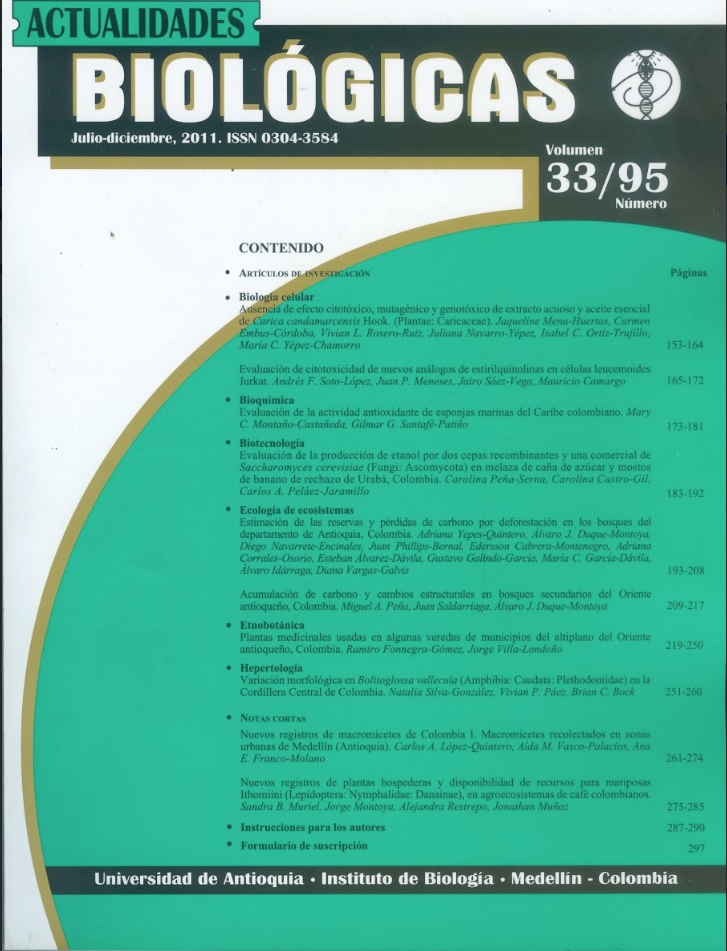
Acumulación de carbono y cambios estructurales en bosques secundarios del Oriente antioqueño, Colombia
DOI:
https://doi.org/10.17533/udea.acbi.14307Palabras clave:
área basal, biomasa aérea, bosques tropicales, densidad de árboles, regeneración natural, sucesiónResumen
En el Oriente antioqueño (Antioquia), Colombia, en tierras utilizadas previamente en ganadería extensiva, se estudió la sucesión secundaria analizando la densidad arbórea, área basal y biomasa aérea. Se evaluaron seis fragmentos de bosque, agrupados en dos categorías de edad: bosques secundarios (BS) de 15 a 20 años y BS de 25 a 30 años. La recuperación de los BS fue comparada con respecto a información secundaria de bosques maduros (BM). Entre los BS y el BM se encontraron diferencias significativas en el promedio por hectárea de la biomasa aérea y el área basal, pero no en la densidad de individuos con respecto a la edad después del abandono. Se estimó que los bosques secundarios entre 25 a 30 años con respecto al BM recuperaron el área basal en un 85,2% y la biomasa aérea en un 52,7%. En toda el área estudiada la acumulación de biomasa aérea promedio anual en el 2005 fue de 4,6 ± 0,3 t ha-1 año-1 que corresponde a un total de 323.469,8 ± 23.227,7 toneladas (t), equivalentes a 161.734,88 ± 11.613,65 t carbono secuestrado (C). Los resultados confirman el manejo de la regeneración natural como estrategia viable y de bajo costo para lograr la recuperación de la estructura de los bosques degradados en el área de estudio. Igualmente, se ratifica la alta productividad primaria neta de los ecosistemas boscosos sucesionales y su aporte a la regulación del ciclo global del carbono.
Descargas
Citas
Aide TM, Zimmerman JK, Rosario M, Marcano H. 1996. Forest recovery in abandoned cattle pastures along an elevational gradient in northeastern Puerto Rico. Biotropica, 28: 537-548. DOI: https://doi.org/10.2307/2389095
Aide TM, Zimmerman JK, Pascarella JB, Rivera L, Marcano-Vega H. 2000. Forest regeneration in a chronosequence of tropical abandoned pastures: Implications for restoration ecology. Restoration Ecology, 8: 328-338. DOI: https://doi.org/10.1046/j.1526-100x.2000.80048.x
Chaves ME, Santamaría M (editores). 2006. Informe nacional sobre el avance en el conocimiento y la información de la Biodiversidad 1998-2004. 2 Tomos. Bogotá (Colombia): Instituto de Investigación en Recursos Biológicos Alexander von Humboldt. Bogotá. p. 199.
Chazdon RL. 2003. Tropical forest recovery: Legacies of human impact and natural disturbances. Perspectives in Plant Ecology, Evolution and Systematics, 6: 51-71. DOI: https://doi.org/10.1078/1433-8319-00042
Chazdon RL, Letcher SG, Breugel M, Martinez M, Bongers F, Finegan B. 2007. Rates of change in tree communities of secondary tropical forests following major disturbances. Proceedings of the Royal Society of London (Series B), 362: 273-289. DOI: https://doi.org/10.1098/rstb.2006.1990
Chazdon RL. 2008a. Chance and determinism in tropical forest succession. En: Carson WP, Schnitzer SA, editors. Tropical forest community ecology. Oxford (U. K.): Blackwell Publishing. p. 384-408.
Chazdon RL. 2008b. Beyond deforestation: restoring forests and ecosystem services on degraded lands. Science, 320: 1458-1460. DOI: https://doi.org/10.1126/science.1155365
Clark DB, Clark DA. 2000. Landscape-scale variation in forest structure and biomass in tropical rain forest. Forest Ecology and Management, 137: 185-198. DOI: https://doi.org/10.1016/S0378-1127(99)00327-8
Denslow JS, Guzman S. 2000. Variation in stand structure, light and seedling abundance across a tropical moist forest chronosequence, Panama. Journal of Vegetation Science, 11: 201-212. DOI: https://doi.org/10.2307/3236800
DeWalt SJ, Chave J. 2004. Structure and biomass of four lowland neotropical forests. Biotropica, 36: 7-19. DOI: https://doi.org/10.1111/j.1744-7429.2004.tb00291.x
Eggleston HS, Buendia L, Miwa K, Ngara T, Tanabe K, editores. 2006. 2006 IPCC Guidelines for national greenhouse gas inventories. Japón: IGES-IPCC National Greenhouse Gas Inventories Programme.
Disponible en: <http://www.ipcc-nggip.iges.or.jp/public/2006gl/pdf/0_Overview/V0_0_Cover.pdf>.
Etter A, McAlpine C, Pullar D, Possingham H. 2006. Modelling the conversion of Colombian lowland ecosystem since 1940: driver, patterns and rates. Journal of Environmental Management, 79: 74-87. DOI: https://doi.org/10.1016/j.jenvman.2005.05.017
Ferguson BG, Vandermeer J, Morales H, Grifith DM. 2003. Post-agricultural succession in El Peten, Guatemala. Conservation Biology, 17: 818-828. DOI: https://doi.org/10.1046/j.1523-1739.2003.01265.x
Guariguata MR, Ostertag R. 2001. Neotropical secondary forest succession: changes in structural and functional characteristics. Forest Ecology and Management, 148: 185-206. DOI: https://doi.org/10.1016/S0378-1127(00)00535-1
Holdridge LR. 1979. Ecología basada en zonas de vida. San José (Costa Rica): Editorial IICA. p. 216.
Hughes RF, Kauffman JB, Jaramillo VJ. 1999. Biomass, carbon and nutrient dynamics of secondary forest in a humid tropical region of México. Ecology, 80: 1892-1907. DOI: https://doi.org/10.1890/0012-9658(1999)080[1892:BCANDO]2.0.CO;2
Laguado WG, Rubiano JC, Zapata B, Sierra A, Yepes AP, Cardona D. 2010. Análisis del estado actual y del avance de las coberturas vegetales en las áreas aledañas a los embalses Punchiná y San Lorenzo en el Oriente antioqueño. Informe técnico (Carbono
y Bosques - ISAGEN). Medellín (Colombia): ISAGEN.
Letcher SG, Chazdon RL. 2009. Rapid recovery of biomass, species richness, and species composition in a forest chronosequence in the northeastern Costa Rica. Biotropica, 41: 608-617. DOI: https://doi.org/10.1111/j.1744-7429.2009.00517.x
Myers N, Mittermeier RA, Mittermeier CG, da Fonseca GAB, Kent J. 2000. Biodiversity hotspots for conservation priorities. Nature, 403: 853-858. DOI: https://doi.org/10.1038/35002501
Moran EF, Brondizio E, Tucker JM, Da Silva-Fosberg MC, Mc Cracken S, Falesi I. 2000. Effects of soil fertility and land-use on forest succession in Amazonia. Forest Ecology and Management, 139: 93-108. DOI: https://doi.org/10.1016/S0378-1127(99)00337-0
Oliver CD, Larson BC. 1990. Forest stand dynamics. McGraw-Hill, New York. p. 467.
Pascarella JB, Aide TM, Serrano MI, Zimmerman JK. 2000. Land-use history and forest regeneration in the Cayey Mountains, Puerto Rico. Ecosystems, 3: 217-228. DOI: https://doi.org/10.1007/s100210000021
Peña-Claros M. 2003.Changes in forest structure and species composition during secondary forest succession in the Bolivian Amazon. Biotropica, 35: 450-461. DOI: https://doi.org/10.1111/j.1744-7429.2003.tb00602.x
Rodríguez N, Armenteras D, Morales M, Romero M. 2004. Ecosistemas de los Andes colombianos. Bogotá (Colombia): Instituto de Investigación de Recursos Biológicos Alexander von Humboldt. p. 155.
Saldarriaga JG, West DC, Tharp ML, Uhl C. 1988. Long-term chronosequence of forest succession in the upper río Negro of Colombia and Venezuela. Journal of Ecology, 76: 938-958. DOI: https://doi.org/10.2307/2260625
Sierra CA, del Valle JI, Orrego SA, Moreno FH, Harmon ME, Zapata M, Colorado GJ, Herrera MA, Lara W, Restrepo DE, Berrouet LM, Loaiza LM, Benjumea JF. 2007. Total carbon stocks in a tropical forest landscape of the Porce region, Colombia. Forest Ecology and Management, 243: 299-309. DOI: https://doi.org/10.1016/j.foreco.2007.03.026
Silver WL, Ostertag R, Lugo AE. 2000. The potential for carbon sequestration through reforestation of abandoned tropical agricultural and pasture lands. Restoration Ecology, 8: 394-407. DOI: https://doi.org/10.1046/j.1526-100x.2000.80054.x
Steininger MK. 2000. Secondary forest structure and biomass following short and extended land-use in central and southern Amazonia.Journal of Tropical Ecology, 16: 689-708. DOI: https://doi.org/10.1017/S0266467400001656
Yepes AP, del Valle JI, Jaramillo SL, Orrego SA. 2010. Recuperación estructural en bosques sucesionales andinos de Porce (Antioquia, Colombia). Revista de Biología Tropical, 58: 427-445. DOI: https://doi.org/10.15517/rbt.v58i1.5220
Zapata M, Colorado G, del Valle J. 2003. Ecuaciones de biomasa aérea para bosques primarios intervenidos y secundarios. En: Orrego S, del Valle J, Moreno F, editores. Medición de la captura de carbono en ecosistemas forestales tropicales de Colombia, contribuciones para la mitigación del cambio climático. Medellín (Colombia): Universidad Nacional de Colombia (sede Medellín), Departamento de Ciencias
Forestales; Centro Andino para la Economía en el Medio Ambiente. p. 87-120.
Descargas
Publicado
Cómo citar
Número
Sección
Licencia
Los autores autorizan de forma exclusiva, a la revista Actualidades Biológicas a editar y publicar el manuscrito sometido en caso de ser recomendada y aceptada su publicación, sin que esto represente costo alguno para la Revista o para la Universidad de Antioquia.
Todas las ideas y opiniones contenidas en los artículos son de entera responsabilidad de los autores. El contenido total de los números o suplementos de la revista, está protegido bajo Licencia Creative Commons Reconocimiento-NoComercial-CompartirIgual 4.0 Internacional, por lo que no pueden ser empleados para usos comerciales, pero sí para fines educativos. Sin embargo, por favor, mencionar como fuente a la revista Actualidades Biológicas y enviar una copia de la publicación en que fue reproducido el contenido.




