

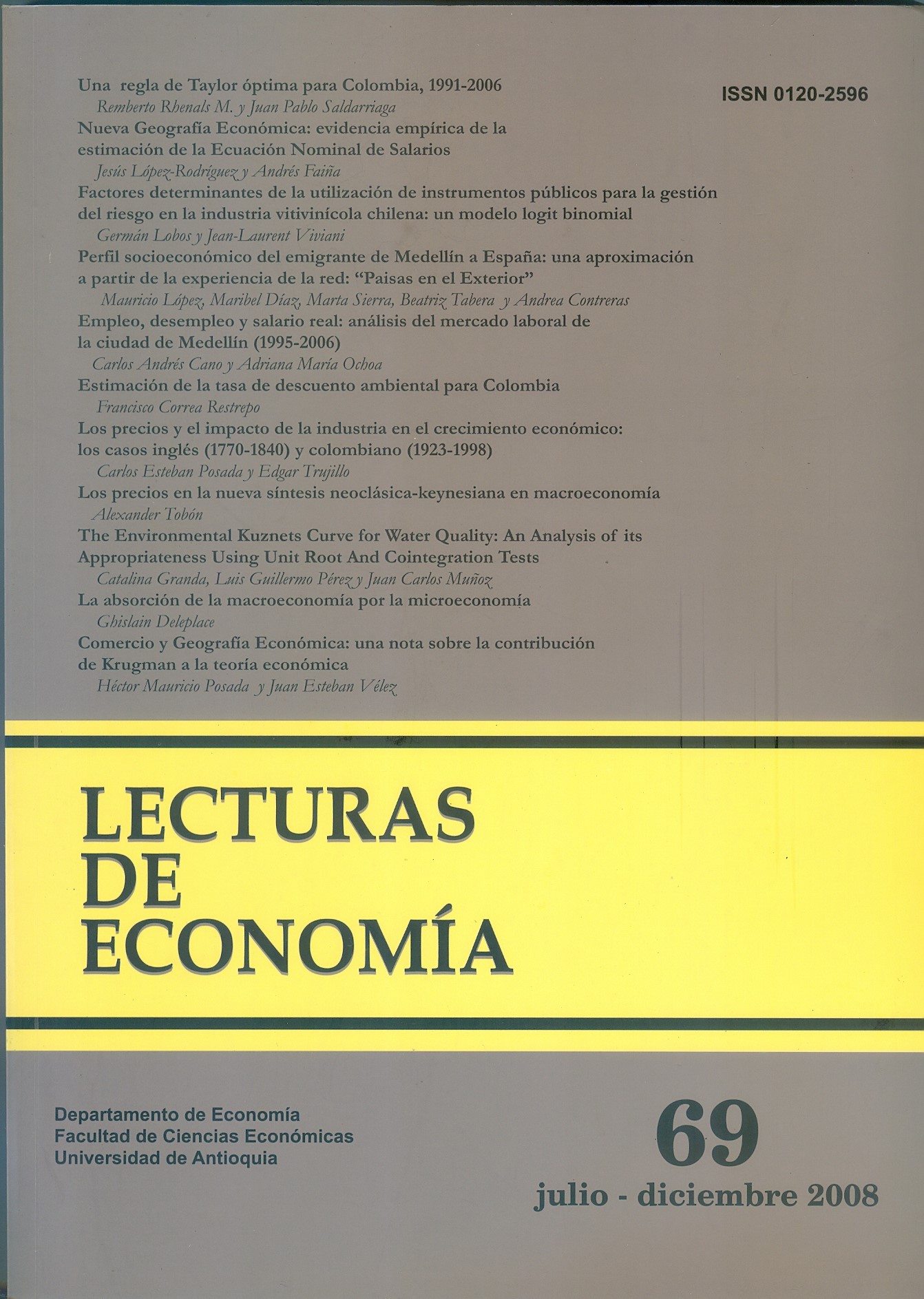
Comercio y Geografía Económica: una nota sobre la contribución de Krugman a la teoría económica
DOI:
https://doi.org/10.17533/udea.le.n69a748Abstract
El objetivo de esta nota es presentar la contribución de Paul Krugman a la teoría económica. Se muestra el aporte y la influencia que tienen sus artículos de 1979 y 1991 en la renovación de la teoría del comercio y la aparición de la nueva geografía económica. En especial, se muestra que Krugman crea un marco teórico que permite explicar fenómenos como el comercio intraindustrial, el comercio entre los países desarrollados y los procesos de aglomeración, bajo escenarios de competencia monopolística y de rendimientos crecientes a escala. El interés de la contribución de Krugman estriba en que estos fenómenos no habían podido ser explicados satisfactoriamente por el modelo neoclásico estándar.
Palabras clave: Rendimientos crecientes, competencia monopolística, Paul Krugman, nueva teoría del comercio, nueva geografía económica. Clasificación JEL: B30, F10, F12, R10
Abstract:
The purpose of this paper is to present the major contributions of Paul Krugman to economic theory. It shows the contribution and influence that articles of 1979 and 1991 have exerted on the renewal of trade theory and the emergence of new economic geography. In these articles, Krugman successfully explains intraindustry trade, trade among developed countries and agglomeration processes, all these phenomena of great importance that had not been satisfactorily explained from the point of view of standard neoclassical models. To do so, he uses a theoretical framework that incorporates monopolistic competition and increasing returns to scale.
Keywords: Increasing returns, monopolistic competition, Paul Krugman, new trade theory, new economic geography. JEL Classification: B30, F10, F12, R10
Résumé:
Cet article présente la contribution de Paul Krugman à la théorie économique. Nous montrons l.influence et la portée des articles parus 1979 et 1991 dans le renouvellement de la théorie du commerce et l'apparition de la nouvelle géographie économique. Plus précisément, on montre que Krugman établi un cadre théorique qui permet d'expliquer les phénomènes du commerce intra-industriel, du commerce entre les pays développés et les processus d'agglomération, en adoptant l.hypothèse de concurrence monopolistique et de rendements d'échelle croissants. C.est ainsi que les modèles de Krugman expliquent certains phénomènes qui n'avaient pas pu être expliqués de manière satisfaisante par la théorie néoclassique traditionnelle.
Mots Clef: Rendements croissants, concurrence monopolistique, Paul Krugman, nouvelle théorie du commerce, nouvelle géographie économique. Classification JEL: B30, F10, F12, R10.
Downloads
Published
How to Cite
Issue
Section
License
This page, by Universidad de Antioquia, is licensed under a Creative Commons Attribution License.
Authors who publish with this journal agree to retain copyright and grant the journal right of first publication, with the article licensed under a Creative Commons Attribution-NonCommercial-ShareAlike License allowing others to share it as long as they acknowledge its authorship and original publication in this journal.
Authors can enter into separate, additional contractual arrangements for the non-exclusive distribution of the journal's published version of the work (e.g., post it to an institutional repository or publish it in a book), provided that these arrangements be not for profit and the journal be acknowledged as the original source of publication.
Authors are permitted and encouraged to post their papers online (e.g., in institutional repositories or on their websites), as it can lead to valuable exchanges as well as greater citation of the published work.




