

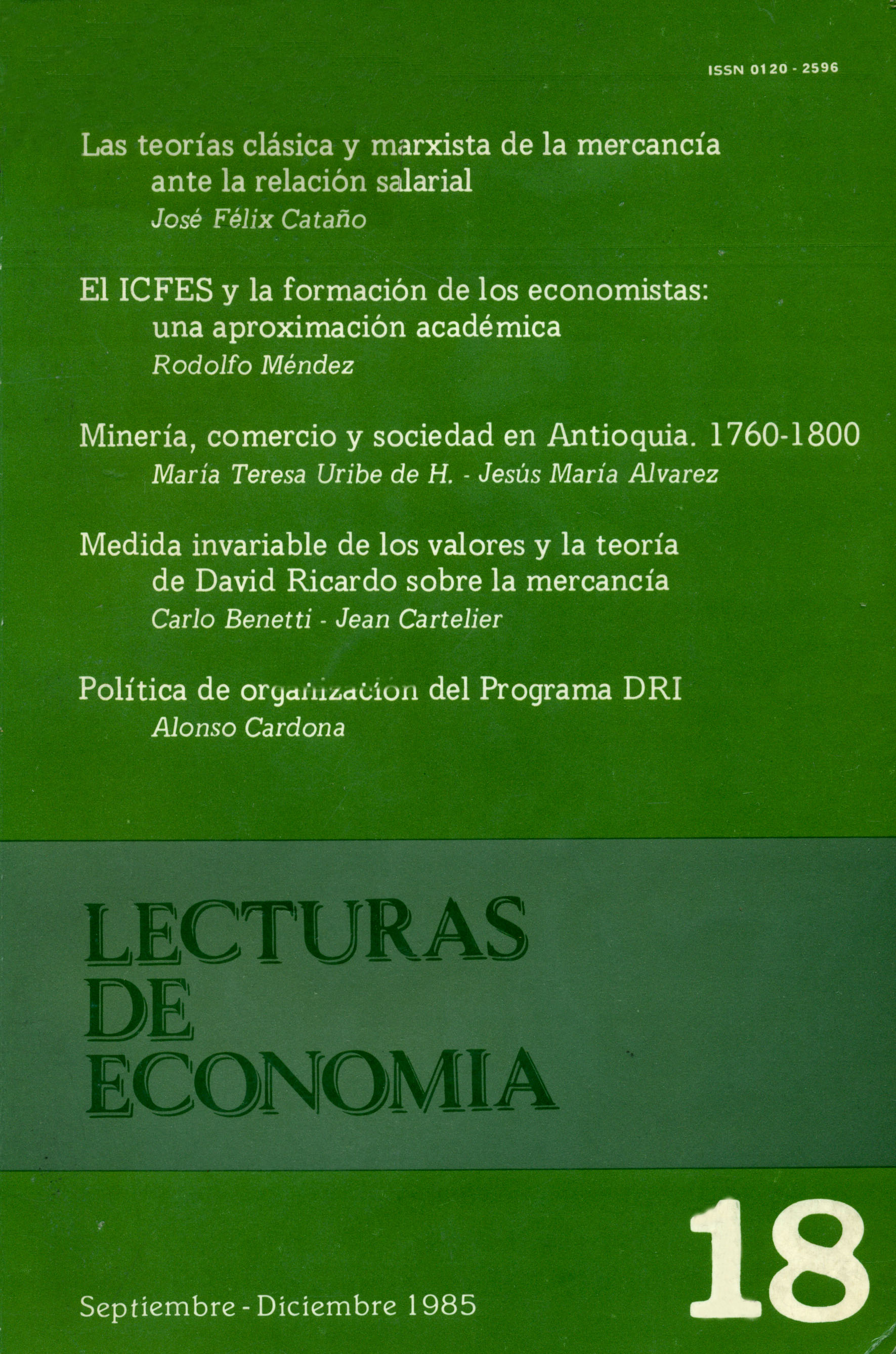
Medida invariable de los valores y la teoría de David Ricardo sobre la mercancía
DOI:
https://doi.org/10.17533/udea.le.n18a8085Abstract
• Resumen: Exponer una interpretación novedosa en tomo de la teoría de los precios desarrollada por el ricardianismo es el objetivo de este artículo. Al utilizar algunas contribuciones de Piero Sraffa se muestra, por un lado, algunos equívocos importantes incurridos por Karl Marx en la lectura del contenido de la teoría de David Ricardo; por otra parte, la ruptura analítica entre el enfoque marxista y el de su predecesor clásico. Finalmente, se propone la ubicación de la especificidad del discurso ricardiano sobre la mercancía en el concepto de "dificultad de producción" existente en un sistema económico concebido a partir de la hipótesis de la reproducción v una norma de repartición del excedente físico.
• Abstract: This article presents a recent interpretation of ricardian price theory. Some of Piero Sraffa's contributions allow us to show some important equivocations in Karl Marx's reading of Ricardo's theory and, also, the analytical brake between the marxist approach and its classical predecessor. Finally, assuming a hypothesis of reproduction and a rule for the distribution of physical surplus, the concept of "production difficulty" is proposed to capture the specific characteristics of the ricardian commodities discourse.
Downloads
Downloads
Published
How to Cite
Issue
Section
License
This page, by Universidad de Antioquia, is licensed under a Creative Commons Attribution License.
Authors who publish with this journal agree to retain copyright and grant the journal right of first publication, with the article licensed under a Creative Commons Attribution-NonCommercial-ShareAlike License allowing others to share it as long as they acknowledge its authorship and original publication in this journal.
Authors can enter into separate, additional contractual arrangements for the non-exclusive distribution of the journal's published version of the work (e.g., post it to an institutional repository or publish it in a book), provided that these arrangements be not for profit and the journal be acknowledged as the original source of publication.
Authors are permitted and encouraged to post their papers online (e.g., in institutional repositories or on their websites), as it can lead to valuable exchanges as well as greater citation of the published work.




