

Une solution au probléme de la multicolinéarité dans les modéles de fonction production á frontiére stochastique
DOI :
https://doi.org/10.17533/udea.le.n86a01Mots-clés :
analyse de frontière stochastique, efficacité technique, productivité, multicolinéarité, estimation des composants principauxRésumé
Cet article examine le probléme de la colinéarité concernant les inputs dans un modéle de production á frontiére stochastique, une question qui a reçu peu trés d’attention dans la littérature économétrique. Pour résoudre ce probléme, nous proposons une solution basée dans la méthode des composants principaux, laquelle permet d’interpréter á la fois l’efficacité et la technologie des paramétres techniques. Tout en
utilisant des données réelles et simulées, les résultats de l’application de la méthode montrent qu’elle est facile á utiliser et elle présente en plus une bonne performance
Téléchargements
Références
Aigner, Dennis; Lovell, Knox & Schmidt, Peater (1977). “Formulation and estimation of stochastic frontier production function models”, Journal of Econometrics, Vol. 6, Issue 1, pp. 21-37.
Belsley, David; Kuh, Edwin & Welsh, Roy (1980). Regression Diagnostics: Identifying Influential Data and Sources of Collinearity. New York: John Wiley & Sons, Inc.
Coelli, Timothy & Henningsen, Arne (2013). Frontier: Stochastic Frontier Analysis. Retrieved from: http://CRAN.R-Project.org/package=frontier. R package version 1.1-0. (Accessed on July 2014).
Coelli, Timothy; Rao, Prasada D.S.; O’Donnell, Christopher J. & Battese, George E. (2005). An Introduction to Efficiency and Productivity Analysis (2nd. Ed.). New York: Springer.
Filippini, Massimo; Hrovatin, Nevenka & Zoric, Jelena (2008). “Cost efficiency of slovenian water distribution utilities: an application of stochastic frontier methods”, Journal of Productivity Analysis, Vol. 29. Issue 2, pp. 169-182.
Fomby, Thomas B.; Johnson, Stanley R. & Hill, Carter (1984). Advanced Econometric Methods. New York: Springer.
Greene, William (1980a). “Maximum likelihood estimation of econometric frontier functions”, Journal of Econometrics, Vol. 13, Issue 1, pp. 27-56.
Greene, William (1980b). “On the estimation of a flexible frontier production model”, Journal of Econometrics, Vol. 13, Issue 1, pp. 101-115.
Greene, William (2008). “The econometric approach to efficiency analysis”. In: Fried, Harold; Lovell, Knox & Schmidt, Shelton (Eds.), The Measurement of Productive Efficiency and Productivity Growth (pp. 92-150). New York, Oxford University Press.
Groß, Jürgen (2003). “Linear Regression”, Lecture Notes in Statistics, Vol. 75. Springer.
Hwang, Gene J. T. & Nettleton, Dan (2003). “Principal components regression with data chosen components and related methods”, Technometrics, Vol. 45, No. 1, pp. 70-79.
Jolliffe, Ian T. (1982). “A note on the use of principal components in regression”, Journal of the Royal Statistical Society. Series C (Applied Statistics), Vol. 31, No. 3, pp. 300-303.
Jolliffe, Ian T. (2002). Principal Component Analysis (2nd Ed.). New York: Springer.
Kumbhakar, Subal C. & Lovell, C. Knox (2000). Stochastic Frontier Analysis. Cambridge: Cambridge University Press.
Mason, Robert & Gunst, Richard (1985). “Selecting principal components in regression”, Statistics and Probability Letters, Vol. 3, Issue 6, pp. 299-301.
Massy, William F. (1965). “Principal components regression in exploratory
statistical research”, Journal of the American Statistical Association, Vol. 60, Issue 309, pp. 234-256.
Meeusen, Wim & van Den Broeck, Julien (1977). “Efficiency estimation from Cobb-Douglas production functions with composed error”, International Economic Review, Vol. 18, No. 2, pp. 435-444.
Puig-Junoy, Jaume (2001). “Technical inefficiency and public capital in U.S. states: A stochastic frontier approach”, Journal of Regional Science, Vol. 41, Issue 1, pp. 75-96.
Stevenson, Rodney (1980). “Likelihood functions for generalized stochastic frontier estimation”, Journal of Econometrics, Vol. 13, Issue 1, pp. 58-66.

Téléchargements
Publié-e
Comment citer
Numéro
Rubrique
Licence
(c) Tous droits réservés Elkin Castaño, Santiago Gallón 2017

Cette œuvre est sous licence Creative Commons Attribution - Pas d'Utilisation Commerciale - Partage dans les Mêmes Conditions 4.0 International.
Cette page, par Universidad de Antioquia, est autorisée sous une Licence d'attribution Creative Commons.
Les auteurs qui publient avec cette revue acceptent de conserver les droits d'auteur et d'accorder le droit de première publication à la revue, l'article sous licence sous une licence Creative Commons Attribution-NonCommercial-ShareAlike permettant à d'autres de le partager tant qu'ils reconnaissent sa paternité et sa publication originale dans ce journal.
Les auteurs peuvent conclure des accords contractuels supplémentaires et distincts pour la distribution non exclusive de la version publiée de la revue (par exemple, la publier dans un référentiel institutionnel ou la publier dans un livre), à condition que ces accords soient sans but lucratif et être reconnu comme la source originale de publication.
Les auteurs sont autorisés et encouragés à publier leurs articles en ligne (par exemple, dans des dépôts institutionnels ou sur leurs sites Web), car cela peut conduire à de précieux échanges ainsi qu'à une plus grande citation des travaux publiés.




 (
( represent the deterministic and noise components of the frontier respectively, xi
⊤
β + vi
is the maximum output reached by the firm which constitutes the stochastic frontier, and ui
is the non-negative random technical inefficiency component (i.e., the amount by which the firm fails to achieve its optimum). A symmetric distribution, such as the normal distribution, is usually assumed for vi. It is also common to assume that vi
and ui
are independent, and that both errors are uncorre lated with xi
. Typically, the production function relies on a Cobb-Douglas, translog, or any other logarithmic production model log(yi)= xi
⊤
β + vi
- ui
, where the components of xi
are logarithms of inputs, its squares and cross products.
represent the deterministic and noise components of the frontier respectively, xi
⊤
β + vi
is the maximum output reached by the firm which constitutes the stochastic frontier, and ui
is the non-negative random technical inefficiency component (i.e., the amount by which the firm fails to achieve its optimum). A symmetric distribution, such as the normal distribution, is usually assumed for vi. It is also common to assume that vi
and ui
are independent, and that both errors are uncorre lated with xi
. Typically, the production function relies on a Cobb-Douglas, translog, or any other logarithmic production model log(yi)= xi
⊤
β + vi
- ui
, where the components of xi
are logarithms of inputs, its squares and cross products.  (
(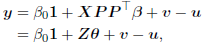 (
( Therefore, the strategy consists in preventing that the estimate goes in directions λipj
associated to fairly small λj
(see
Therefore, the strategy consists in preventing that the estimate goes in directions λipj
associated to fairly small λj
(see 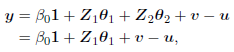
 Thus, the principal component estimator of β in (2) is given by
  (
(
 (
( where σ
u = 3, σ
v = 2.5, σ
2 = σ
2
u + σ
2
v = 15.25, r = σ
2
u/σ
2 =0.59, (β
0, β
1, β
2) = (1, 0.8, 0.7); and (x
1, x
2) ~ N (µ, Σ) with µ = (20, 25) and
Σ
=
DRD
, where
D
= diag(σ
x1 , σ
x2 )= diag(1, 2); and
where σ
u = 3, σ
v = 2.5, σ
2 = σ
2
u + σ
2
v = 15.25, r = σ
2
u/σ
2 =0.59, (β
0, β
1, β
2) = (1, 0.8, 0.7); and (x
1, x
2) ~ N (µ, Σ) with µ = (20, 25) and
Σ
=
DRD
, where
D
= diag(σ
x1 , σ
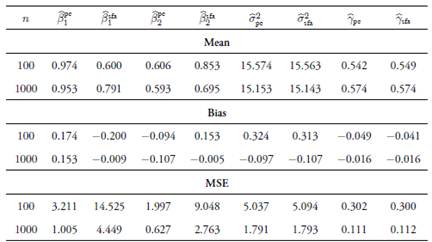
x2 )= diag(1, 2); and  with ρ = Corr(x1,x2) = 0.7, 0.8, 0.9. For the most severe multicollinearity prob lem, where ρ = 0.9, we performed the simulations with n = 1000 to study the large sample properties of the estimator. We used the frontier: Stochastic Frontier Analysis R package version 1.1-0 by
  and the usual stochastic frontier analysis
  methods for the assumed values of ρ. Results indicate that, in general, the coefficient estimators obtained with the principal-component-based method are biased, as these biases do not decrease asymptotically. However, the estimators have less MSE with respect to the ones obtained by the traditional method, even in large samples. The usual estimators are biased for finite samples with greater biases than for the proposed method, although these decrease asymptotically. The estimations for γ and σ
2 remain unaffected if the principal components are chosen correctly. Finally, when keeping fixed the number of principal components, the biases increase as the linear relationship among variables decreases.
methods for the assumed values of ρ. Results indicate that, in general, the coefficient estimators obtained with the principal-component-based method are biased, as these biases do not decrease asymptotically. However, the estimators have less MSE with respect to the ones obtained by the traditional method, even in large samples. The usual estimators are biased for finite samples with greater biases than for the proposed method, although these decrease asymptotically. The estimations for γ and σ
2 remain unaffected if the principal components are chosen correctly. Finally, when keeping fixed the number of principal components, the biases increase as the linear relationship among variables decreases. 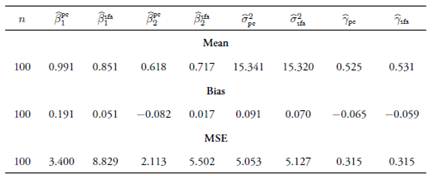
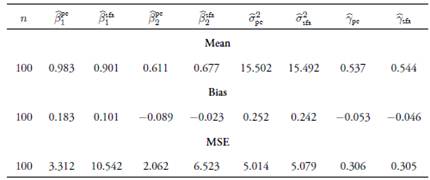
 Estimations were carried out us ing the LIMited DEPendent −LIMDEP− econometric software (version 10). As can be seen in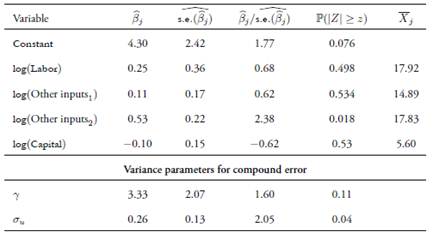
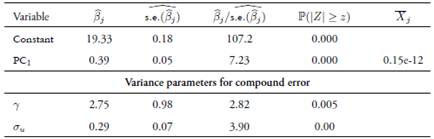
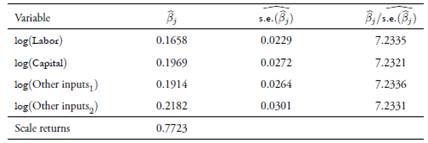
 remains are correct, the proposed method. Furthermore, when keeping fixed the number of prin cipal components, the biases of the proposed estimator increase as the linear relation between covariates decreases. The choice of the number of principal components is critical to the estimation of β, γ and σ2, as well as for the efficiency component. After applying the proposed method on real data from the agricultural and livestock sectors to evaluate its tech