

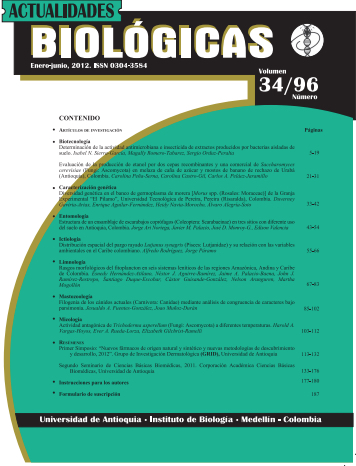
Evaluation of ethanol production from two recombinant and a commercial strains of Saccharomyces cerevisiae (Fungi: Ascomycota) in sugar-cane molasses and rejected-banana juice from Urabá (Antioquia), Colombia
DOI:
https://doi.org/10.17533/udea.acbi.14239Keywords:
adhII gene, bioethanol, pdc gene, recombinant Saccharomyces cerevisiae, rejected-banana juice, sugar-cane molassesAbstract
The production of bioethanol using Saccharomyces cerevisiae (Fungi: Ascomycota) is influenced by sugar concentration and fermentation substrate. For that reason, the kinetics of biomass production, residual sugars, and ethanol production of four of S. cerevisiae strains were evaluated in two different fermentation media (sugar-cane molasses and rejected-banana juice) at two different sugar concentrations (100 and 170g/l). The EthanolRed® and GG570-CIBII strains exhibited the greatest ethanol production, with peak values of 119.74 (35 h) and 62 g/l (15 h), Yps 0.75 and 0.43 g/g, and Qp 3.42 and 2.61 g/l/h, respectively, at 170 g/l of sugar in sugar-cane molasses broth. Additionally, the strain GG570-CIBII showed an increase of 37.1 g/l ethanol with respect to the control strain.
Downloads
References
Afanador A. 2005. El banano verde de rechazo en la producción de alcohol carburante. Revista EIA, 3: 51-68.
Brenda database [internet]. 2007. Brenda-The comprehensive enzyme information system. Department of Bioinformatics and Biochemistry TU Braunschweig. Accessed: 16th May 2010. Available from: <http://www.brenda-enzymes.org/>.
Cazetta M, Celligoi M, Buzato J, Scarmino J. 2007. Fermentation of molasses by Zymomonas mobilis: Effects of temperature and sugar concentration on ethanol production. Bioresource Technology, 98: DOI: https://doi.org/10.1016/j.biortech.2006.08.026
-2828.
Converti A, Perego P, Lodi A, Parisi F, Del Borghi M. 1985. A Kinetic Study of Saccharomyces Strains: Performance at High Sugar Concentrations. Biotechnology and Bioengineering, 27: 1108-1114. DOI: https://doi.org/10.1002/bit.260270804
Davis L, Rogers P, Pearce J, Peiris P. 2006. Evaluation of Zymomonas based ethanol production from a hydrolysed waste starch stream. Biomass and Bioenergy, 30: 809-814. DOI: https://doi.org/10.1016/j.biombioe.2005.05.003
del Rosario E, Pamatong F. 1985. Continuous-flow fermentation of banana fruit pulp sugar into ethanol by carrageenan-inmobilized yeast. Biotechnology Letters, 7: 819-820. DOI: https://doi.org/10.1007/BF01025562
Doran P. 1995. Bioprocess engineering principles. London: Academic Press. p. 439. DOI: https://doi.org/10.1016/B978-012220855-3/50013-4
Ergun M, Mutlu SF. 2000. Application of a statistical technique to the production of ethanol from sugar beet molasses by Saccharomyces cerevisiae. Bioresource Technology, 73: 251-255. DOI: https://doi.org/10.1016/S0960-8524(99)00140-6
FNB (Federación Nacional de Biocombustibles) [Internet]. 2007. ABC de los alcoholes carburantes. Accessed: 27th May 2010. Available from: <http://www.fedebiocombustibles.com/v2/main-pagina-id-5.htm>.
Gunasekaran P, Chandra K. 1999. Ethanol fermentation technology-Zymomonas mobilis. Current Science, 77: 56-68.
Hammond J, Egg R, Diggins D, Cable C. 1996. Alcohol from bananas. Bioresource Technology, 56: 125-130. DOI: https://doi.org/10.1016/0960-8524(95)00177-8
Lei F, Rotboll M, Jorgensen SB. 2001. A biochemically structured model for Saccharomyces cerevisiae. Journal of Biotechnology, 88: 205-221. DOI: https://doi.org/10.1016/S0168-1656(01)00269-3
Mackenzie K, Eddy C, Ingram L. 1989. Modulation of alcohol dehydrogenase isoenzyme levels in Zymomonas mobilis by Iron and Zinc. Journal of bacteriology, 171: 1063-1067. DOI: https://doi.org/10.1128/jb.171.2.1063-1067.1989
Manikandan K, Saravanan V, Viruthagiri T. 2008. Kinetic studies on ethanol production from banana peel waste using mutant strain of Saccharomyces cerevisiae. Indian Journal Biotechnology, 7: 83-88.
MME (Ministerio de Minas y Energía) [Internet]. 2007. Los biocombustibles en Colombia. Accessed: 7th August 2010. Available from: <http://www.minminas.gov.co/minminas/downloads/UserFiles/File/hidrocarburos/Programa.pdf>.
Monsalve J, Medina V, Ruíz A. 2006. Producción de etanol a partir de la cáscara de banano y de almidón de yuca. Revista Dyna, 150: 21-27.
Peña C, Arango R. 2009. Evaluación de la producción de etanol utilizando cepas recombinantes de Saccharomyces cerevisiae a partir de melaza de caña de azúcar. Revista Dyna, 76: 153-161.
Peña C, Arango RE, Restrepo LF. 2010. Efecto de adición de iones hierro y zinc sobre la producción de etanol de dos cepas recombinantes de Saccharomyces cerevisiae. Revista Colombiana de Biotecnología, 12: 158-168.
Sánchez O, Cardona C. 2008. Trends in biotechnological production of fuel ethanol from different feedstocks. Bioresource Technology, 99: 5270-5295. DOI: https://doi.org/10.1016/j.biortech.2007.11.013
Sharma N, Kalra K, Oberoi H, Bansal S. 2007. Optimization of fermentation parameters for production of ethanol from kinnow waste and banana peels by simultaneous saccharification and fermentation. Indian Journal Microbiology, 47: 310-316. DOI: https://doi.org/10.1007/s12088-007-0057-z
Soliclima [Internet]. 2006. El etanol como biocombustible. Accessed: 20th May 2007. Available from: <http://news.soliclima.com/divulgacion/biomasa/el-etanol-como-
biocombustible>.
Thatipamala R, Rohani S, Hill GA. 1992. Effects of high product and substrate inhibition on the kinetics and biomass and products yields during ethanol batch fermentation. Biotechnology and bioengineering, DOI: https://doi.org/10.1002/bit.260400213
: 289-297.
Vásquez J, Castaño H, Marín P, Rodriguez E, Arango R. 2007. Ingeniería genética en rutas metabólicas de Saccharomyces cerevisiae para incrementar la productividad de etanol. In: 6 SIPAL - Simposio Internacional de Alcoholes y Levaduras, 2007, Bogotá/Colombia. Bogotá (Colombia): CD-ROM de Memorias del 6 SIPAL, 2007.
Downloads
Published
How to Cite
Issue
Section
License
The authors exclusively authorize the Actualidades Biológicas journal to edit and publish the submitted manuscript if its publication is recommended and accepted, without this representing any cost to the Journal or the University of Antioquia.
All the ideas and opinions contained in the articles are sole responsibility of the authors. The total content of the issues or supplements of the journal is protected under the Creative Commons Attribution-NonCommercial-ShareAlike 4.0 International License, so they cannot be used for commercial purposes, but for educational purposes. However, please mention the Actualidades Biológicas journal as a source and send a copy of the publication in which the content was reproduced.




