

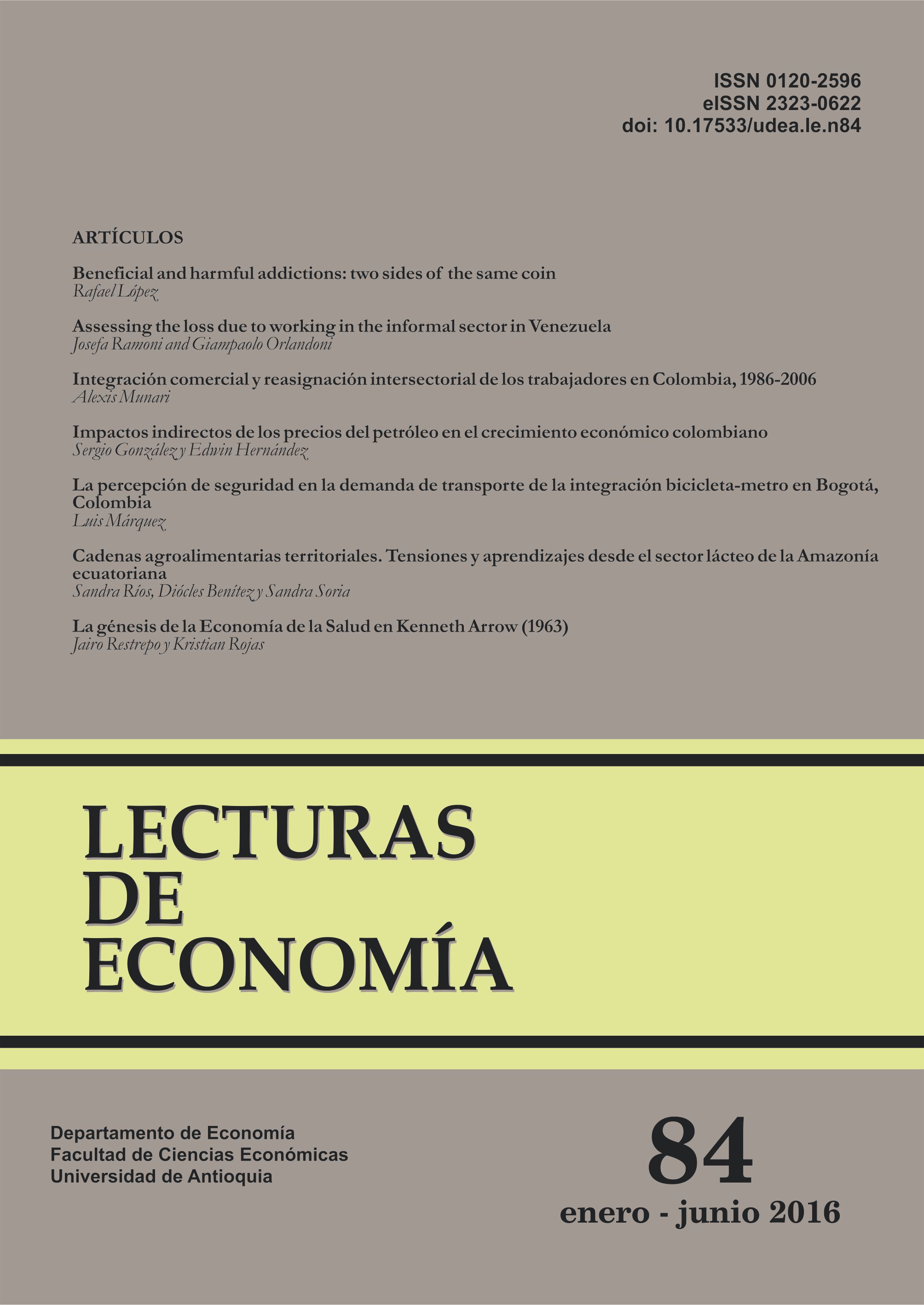
The genesis of Health Economics in Kenneth Arrow (1963)
DOI:
https://doi.org/10.17533/udea.le.n84a07Keywords:
Health Economics, welfare, Arrow, health services, market failuresAbstract
Kenneth J. Arrow is one of the most prominent economists of the twentieth century. His concerns about competitive equilibrium and optimality under uncertainty conditions led him to publish what would be recognized as the seminal article on Health Economics, “Uncertainty and the welfare economics of medical care”. This essay pays tribute to Arrow’s work and discusses the intellectual foundations of the analysis of medical benefits in a welfare economics context, the validity of Arrow’s original approach and its main implications. Here, the validity of Arrow’s central hypothesis on the impossibility of reaching an efficient resource allocation through the market is defended, mainly because of the uncertainty associated to disease incidence. Also, implications of asymmetric information, moral hazard and social norms are discussed from Arrow’s perspective, as well as the roles of state and market.
Downloads
References
ACEMOGLU, Daron; JOHNSON, Simon (2001). “The colonial origins of comparative development and empirical investigation”, The American Economic Review, Vol. 91, No. 5, pp. 1369-1401.
ARROW, Kenneth J. (1949). “On the use of winds in flight planning”, Journal of Meteorology, Vol. 6, No. 2, pp. 150-159.
ARROW, Kenneth J. (1951a). “An extension of the basic theorems of classical welfare economics”. In: Neyman Jerzy (Ed.) Proceeding of the second Berkeley Symposium on Mathematical Statatistics Probability (pp. 507–32). Berkeley: University of California Press.
ARROW, Kenneth J. (1951b). “Alternative approaches to the theory of choice in risk-taking situations”, Econometrica, Vol. 19, No. 4, pp. 404–437.
ARROW, Kenneth J. (1951c). Social Choice and Individual Values. New York, Wiley
ARROW, Kenneth J. (1963). “Uncertainty and the welfare economics of medical care”, The American Economic Review, Vol LIII, No. 5, pp. 941-973.
ARROW, Kenneth J. (1978). “A cautious case for socialism”, Dissent, September Vol. 25, No. 4, pp. 472-482.
ARROW, Kenneth J. (1992). “Autobiography”. En: Lindbeck, Assar (Ed.), Nobel lectures: Economic Sciences 1969-1980 (pp. 103 – 131). Sweden: World Scientific Publishing. University of Stockholm.
ARROW, Kenneth J. (2001). “Reflections on the Reflections”, Journal of Health Politics, Policy and Law, Vol 26, No. 5 , pp. 1197-1204.
ARROW, Kenneth J. (2009). “Some developments in economic theory since 1940: An Eyewitness Account”, Annual Review of Economics, Vol. 1 pp. 1-16.
ARROW, Kenneth J. (2013). Interview Bruce Hollingsworth. 9th World Congress in Health Economics. Recuperado de: https://www.youtube.com/watch?v=rLXJS1Aqgc0 (abril 10 de 2015).
ARROW, Kenneth J. & DEBREU, Gérard (1954). “Existence of equilibrium for a competitive economy”, Econometrica, Vol. 22, pp. 265-290.
ARROW, Kenneth J, & HURWICZ, Leonid (1977). “Appendix: An optimality criterion for decision-making under ignorance” In: Studies in resource allocation processes (pp. 461-472). Cambridge New York: Cambridge University Press.
ARROW, Kenneth J.; PANOSIAN, Claire & Gelband, Hellen (2004). Saving lives buying time: Economics of malaria drugs in an age of resistance. Washington: The National Academies Press.
ARROW, Kenneth J.; BERNHEIM, Douglas; FELDSTEIN, Martin; MCFADDEN, Daniel; POTERBA, James; SOLOW, Robert (2011). “100 años de la American Economic Review: Los 20 artículos más destacados”, Revista de Economía Institucional, Vol. 13, No. 25, 349-358.
BAUMOL, William (1952). Welfare Economics and the Theory of the State, London: London School of Economics and Political Science.
BIJLSMA, Sake (2009) “Optimal Aircraft Routing in General Wind Fields”, Journal of Guidance, Control, and Dynamics, No. 32, pp. 1025-1029.
BUCHANAN, Allen. (2000). “Trust in Managed Care Organizations”, Kennedy Institute of Ethics Journal, Vol. 3, No. 10, pp. 189-212.
CHERNEW, Michael (2001). “General Equilibrium and Marketability in the Health Care Industry”, Journal of Health Politics, Policy and Law, Vol 26, No. 5, pp. 885-897.
CHICHILNISKY, Graciela (1999). Markets, Information, and uncertainty: essays in economic theory in honor of Kenneth J. Arrow. New York: Cambridge University Press.
COOPER, Richard & AIKEN, Linda (2001). “Human Inputs: The Health Care Workforce and Medical Markets”, Journal of Health Politics, Policy and Law, Vol 26, No. 5, pp. 925-938.
CULYER, Anthony & NEWHOUSE, Joseph (2000). Handbook of Health Economics (Vol. 2). Kidlington, Oxford: Elsevier Science.
CUTLER, David; LLERAS-MUNEY Adriana & VOGL Tom (2011). “Socieconomic status and health: dimensions and mechanisms”. En: Glied, Smith P. (Eds.). The Oxford Handbook of Health Economics (pp. 124-163). Oxford: Oxford University Press.
FOLLAND, Sherman; GOODMAN, Allen & STANO, Miron (2014). The Economics of Health and Health Care (7th ed.). Canada, Scarborough: Prentice-Hall.
FUCHS, Victor (2001). “El futuro de la Economía de la Salud”, Lecturas de Economía, No. 55 pp. 9-30.
GLIED, Sherry (2001). “Health Insurance and Market Failure Since Arrow”, Journal of Health Politics, Policy and Law, Vol 26, No. 5, pp. 957-965.
GLIED, Sherry & SMITH, Peter (2011). The Oxford Handbook of Health Economics. Oxford: Oxford University Press.
HALL, Mar (2001). “Arrow on Trust”, Journal of Health Politics, Policy and Law, Vol 26, No. 5, pp. 1131-1144.
HAMMER, Peter Joseph; HAAS-WILSON, Deborah & SAGE, William M. (2001) “Kenneth Arrow and the changing economics of health care: Why Arrow? Why Now?”, Journal of Health Politics, Policy and Law, Vol. 26, No. 5, pp. 835-849.
HASS-WILSON, Deborah (2001). “Arrow and the Information Market Failure in Health Care: The Changing Content and Sources of Health Care Information”, Journal of Health Politics, Policy and Law, Vol 26, No. 5, pp. 1031-1044.
HAYEK, Friedrich (1944). The road to serfdom. USA: University of Chicago Press.
HELLE, Walter; STARR, Ross & STARRETT, David (1986). Uncertainty, Information, and Communication, Essays in Honor of Kenneth J. Arrow (Vol. 3). Cambridge: Cambridge University Press.
KLARMAN, Herbert (1965). The Economics of Health. Olney, MD, U.S.A: Columbia University Press.
KLEIN, Daniel B. (2013). “Ideological profiles of the economics laureates (Kenneth J. Arrow)”, Econ Journal Watch, Vol. 10, No. 3, pp. 268-281.
KOOPMANS, Tjalling (1950). “Statistical Inference in Dynamic Economic Models”. New York: John Wiley & Sons
KRONICK, Richard (2001). “Valuing Charity”, Journal of Health Politics, Policy and Law, Vol. 26, No. 5, pp. 993-1002.
KRUGMAN, Paul, (2009). “Why markets can’t cure health care?”. The New York Times. Disponible en: http://krugman.blogs.nytimes.com/2009/07/25/why-markets-cant-cure-healthcare (febrero 02 de 2015).
MCARDLE, Megan (2012, 18 de marzo). “Liberals Are Wrong: Free Market Health Care is Possible”. The Atlantic. Recuperado de: http://www.theatlantic.com/business/archive/2012/03/liberals-are-wrong-free-market-health-care-is-possible/254648/ (marzo 09 de 2015).
MUSGROVE, Philip (1985) “Reflexiones sobre la demanda por salud en América Latina”. Cuadernos de Economía, Año 22, No. 66, p. 293-305.
MUSGROVE, Philip (1996). “Un fundamento conceptual para el rol público y privado en la salud”, Revista de Análisis Económico, Vol. 11, No. 2, pp. 9-36.
MUSHKIN, Selma J. (1958). “Toward a definition of health economics”, Public Health Reports, Vol. 73, No. 9, pp. 785-794.
ORGANIZACIÓN MUNDIAL DE LA SALUD (OMS). (2014). Estadísticas Sanitarias Mundiales. Recuperado de: http://www.who.int/gho/publications/world_health_statistics/es/ (abril 14 de 2015).
PETERSON, Mark (2001). “From Trust to Political Power: Interest Groups, Public Choice, and Health Care”, Journal of Health Politics, Policy and Law, Vol 26, No. 5, pp. 1145-1163.
PINDYCK, Robert & RUBINFELD, Daniel (2014). Microeconomics (8th Ed.). New Jersey: Pearson Education Limited.
RESTREPO, Jairo H. (2004). “¿Qué enseña la reforma colombiana sobre los mercados de salud?”, Revista Gerencia y Políticas de Salud, No. 6, pp. 8 -34.
REINHARDT, Uwe (2001). “Can Efficiency in Health Care Be Left to the Market?”, Journal of Health Politics, Policy and Law, Vol 26, No. 5, pp. 967-992
SAVEDOFF, William D. (2004). “Kenneth Arrow and the birth of health economics”, Bulletin of the World Health Organization, Vol. 82, No. 2, pp. 139-140.
SLOAN, Frank A. (2001). “Arrow’s Concept of the Health Care Consumer: A Forty-Year Retrospective”, Journal of Health Politics, Policy and Law, Vol 26, No. 5, pp. 899-911.
STARR, Ross M. (2008). “Arrow, Kenneth Joseph (born 1921)”. In: Steven N. Durlauf and Lawrence E. Blume, The New Palgrave Dictionary of Economics (2nd. Ed.). Palgrave Macmillan.
STIGLITZ, Joseph E. (1999). Incentives and Institutions in the Provision of Health Care in Developing Countries: Toward an Efficient and Equitable Health Care Strategy. IHEA Meetingd, Rotterdam.
THE REGION (1995). Interview with Kenneth Arrow. Federal Reserve Bank of Minneapolis. Recuperado de: https://www.minneapolisfed.org/publications/the-region/interview-with-kenneth-arrow
WAGSTAFF, Adam & CULYER, Anthony (2012). “Four decades of health economics through a bibliometric lens”, Journal of Health Economics, Vol 31, No. 2, pp. 406– 439.
WORD DEVELOPMENT INDICADORS (2015). Health Indicador. Recuperado de http://data.worldbank.org/data-catalog/world-development-indicators. (14 de abril de 2015)
Published
How to Cite
Issue
Section
License
This page, by Universidad de Antioquia, is licensed under a Creative Commons Attribution License.
Authors who publish with this journal agree to retain copyright and grant the journal right of first publication, with the article licensed under a Creative Commons Attribution-NonCommercial-ShareAlike License allowing others to share it as long as they acknowledge its authorship and original publication in this journal.
Authors can enter into separate, additional contractual arrangements for the non-exclusive distribution of the journal's published version of the work (e.g., post it to an institutional repository or publish it in a book), provided that these arrangements be not for profit and the journal be acknowledged as the original source of publication.
Authors are permitted and encouraged to post their papers online (e.g., in institutional repositories or on their websites), as it can lead to valuable exchanges as well as greater citation of the published work.




