

Colombia’s stock market predictability
DOI:
https://doi.org/10.17533/udea.le.n91a04Keywords:
predictability, risk premium, dividend yield, Colombia’s stock market, expected returnsAbstract
This paper studies historical stock market returns in Colombia and their medium- and long-term predictability with the purpose of examining whether there is a constant or time-varying risk premium and its relationship with other economic variables. With this goal in mind, the paper presents a historical price index, returns and the aggregate dividend yield of Colombia’s stock market for the 1995-2017 period, using information for the whole universe of issuers. Most of the variation in the dividend yield is explained by expected returns, which implies that the stock market has medium- and long-term cycles and the risk premium is time varying. The predictive power of the model increases if extended to include information on housing finance, the real exchange rate and returns of the S&P 500 index, suggesting that credit frictions and small open economy considerations could play a role when modelling risk premium in Colombia’s stock market.
Downloads
References
Alonso, J. C. & García, J. (2009). ¿Qué tan buenos son los patrones del IGBC para predecir su comportamiento?: Una aplicación con datos de alta frecuencia. Estudios Gerenciales, 25(11),13-36.
Ang, A. & Bekaert, G. (2007). Stock return predictability: Is it there? The Review of Financial Studies, 20(3), 651-707.
Arango, L. E., González, A. & Posada, C. (2002). Returns and the interest rate: a non-linear relationship in the Bogotá stock market. Applied Financial Economics, 12(11), 835-842.
Bastidas, A. (2008). Incertidumbre de la prima de riesgo del mercado accionario de Colombia 1991-2007. Perfil de Coyuntura Económica, 12, 159–178.
Boyd, J., Hu, J. & Jagannathan, R. (2005). The Stock Market’s Reaction to Unemployment News: Why Bad News Is Usually Good for Stocks. The Journal of Finance, 60(2), 649–672.
Campbell, J. Y. & Ammer, J. (1993). What Moves the Stock and Bond Markets? A Variance Decomposition for Long-Term Asset Returns. The Journal of Finance, 48(1), 3–37.
Campbell, J. Y. (1987). Stock Returns and the Term Structure. Journal of Financial Economics, 18(2), 373–399.
Campbell, J. Y. (1990). Measuring the Persistence of Expected Returns (NBER working paper No. 3305). Recuperado del sitio web The National Bureau of Economic Research: https://www.nber.org/papers/w3305
Campbell, J. & Shiller, R. (1988a). The Dividend-Price Ratio and Expectations of Future Dividends and Discount Factors. The Review of Financial Studies, 1(3), 195–228.
Campbell, J. & Shiller, R. (1988b). Stock Prices, Earnings, and Expected Dividends. The Journal of Finance, 43(3), 661–676.
Chen, N.-F., Roll, R. & Ross, S.A. (1986). Economic Forces and the Stock Market. Journal of Business, 59(3), 383–403.
Cochrane, J. (2007). The Dog that Did Not Bark: A Defense of Return Predictability. The Review of Financial Studies, 21(4), 1533–1575.
Cochrane, J. (2011). Presidential Address: Discount Rates. The Journal of Finance, 66 (4), 1047-1108.
Cutler, D., Poterba, J. & Summers, L. H. (1989). What Moves Stock Prices? Journal of Portfolio Management, 15(2), 4-12.
Fama, E. F. (1981). Stock Returns, Real Activity, Inflation, and Money. The American Economic Review, 71(4), 545-565.
Fama, E. F. & Schwert, G. (1977). Asset returns and inflation. Journal of Financial Economics, 5(2), 115–146.
Geske, R. & Roll, R. (1983). The Fiscal and Monetary Linkage between Stock Returns and Inflation. The Journal of Finance, 38(1), 1–33.
Gómez-Sánchez, A.M. & Astaiza-Gómez, J. (2015). Primas de riesgo de renta variable ex-post y ciclos económicos en Colombia: Una investigación empírica utilizando los filtros de Kalman y Hodrick-Prescott. Revista Finanzas y Política Económica, 7 (1), 109-129.
Goyal, A. & Welch, I. (2003). Predicting the Equity Premium with Dividend Ratios. Management Science, 49(5), 639–654.
Harvey, C. (1991). The World Price of Covariance Risk. The Journal of Finance, 46 (1), 111–157.
Hjalmarsson, E. (2010). Predicting Global Stock Returns. Journal of Financial and Quantitative Analysis, 45(1), 49–80.
Kristjanpoller, W. & Muñoz, R. (2012). Analysis of Day of the Week Effect in the main Latin-American stock markets: an approximation through the Stochastic Dominance Criterion. Estudios de Economía, 39(1), 5-26.
Larrain, B. & Yogo, M. (2008). Does firm value move too much to be justified by subsequent changes in cash flow? Journal of Financial Economics, 87 (1), 200–226.
Lettau, M. & Ludvigson, S. (2005). Expected returns and expected dividend growth. Journal of Financial Economics, 76 (3), 583–626.
Lo, A. W. & MacKinlay, A. (1988). Stock Market Prices do not Follow Random Walks: Evidence from a Simple Specification Test. The Review of Financial Studies, 1(1), 41–66.
Ludvigson, S. C. & Ng, S. (2009). Macro Factors in Bond Risk Premia. The Review of Financial Studies, 22(12), 5027-5067.
Montenegro, A. (2007). El efecto día en la bolsa de valores de Colombia (Documentos de Economía No. 2007-09). Recuperado del Departamento de Economía, Pontificia Universidad Javeriana, Bogota.
Nelson, C. R. (1976). Inflation and Rates of Return on Common Stocks. The Journal of Finance, 31(2), 471–483.
Newey, W. & West, K. (1987). A Simple, Positive Semi-Definite, Heteroskedasticity and Autocorrelation Consistent Covariance Matrix. Econometrica, 55(3), 703–708.
Ochoa, C. M. & Avendaño, G. I. (2005). The Unification of the Colombian Stock Market: A Step Towards Efficiency–Empirical Evidence. Latin American Business Review, 5(4), 69–98.
Ospina, J. (2007). Características generales del mercado accionario colombiano como mercado emergente. Economía y Desarrollo, 6 (1), 105-136.
Pearce, D. & Roley, V. (1983). The Reaction of Stock Prices to Unanticipated Changes in Money: A note. The Journal of Finance, 38(4), 1323–1333.
Perez-Villalobos, J. & Mendoza-Gutiérrez, J. (2010). Efecto día en el mercado accionario colombiano: una aproximación no paramétrica (Borradores de Economía, No. 585). Recuperado del Banco de la República: http://www.banrep.gov.co/es/borrador-585
Rangvid, J., Schmeling, M. & Schrimpf, A. (2014). Dividend Predictability Around the World. Journal of Financial & Quantitative Analysis, 49(5-6), 1255–1277.
Rapach, D., Strauss, J. & Zhou, G. (2013). International Stock Return Predictability: What Is the Role of the United States? The Journal of Finance, 68(4), 1633-1662.
Rapach, D., Wohar, M. & Rangvid, J. (2005). Macro variables and international stock return predictability. International Journal of Forecasting, 21(1), 137–166.
Restrepo, M., Zuluaga, S. & Guerra, M. (2002). El mercado de capitales colombiano en los noventa y las firmas comisionistas de bolsa. Colección Economía Colombiana. Bogotá. Fedesarrollo.
Sierra, K., Duarte, J. & Ortiz, V. (2015). Predictibilidad de los retornos en el mercado de Colombia e hipótesis de mercado adaptativo. Estudios Gerenciales, 31(137), 411–418.
Solnik, B. (1993). The performance of international asset allocation strategies using conditioning information. Journal of Empirical Finance, 1(1), 33–55.
Vélez-Pareja, I. (2000). The Colombian Stock Market: 1930-1998. Latin American Business Review, 1(4), 61–84.
Yepes-Rios, B., Gonzalez-Tapia, K. & Gonzalez-Perez, M. (2015). The integration of stock exchanges: The case of the Latin American Integrated Market (MILA) and its impact on ownership and internationalization status in Colombian brokerage firms. Journal of Economics, Finance and Administrative Science, 20(39), 84–93.

Published
How to Cite
Issue
Section
License
Copyright (c) 2019 José Ignacio López-Gaviria

This work is licensed under a Creative Commons Attribution-NonCommercial-ShareAlike 4.0 International License.
This page, by Universidad de Antioquia, is licensed under a Creative Commons Attribution License.
Authors who publish with this journal agree to retain copyright and grant the journal right of first publication, with the article licensed under a Creative Commons Attribution-NonCommercial-ShareAlike License allowing others to share it as long as they acknowledge its authorship and original publication in this journal.
Authors can enter into separate, additional contractual arrangements for the non-exclusive distribution of the journal's published version of the work (e.g., post it to an institutional repository or publish it in a book), provided that these arrangements be not for profit and the journal be acknowledged as the original source of publication.
Authors are permitted and encouraged to post their papers online (e.g., in institutional repositories or on their websites), as it can lead to valuable exchanges as well as greater citation of the published work.





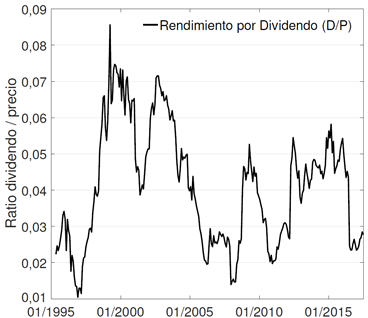




 tenemos que ρ ≈ 0; 99, que es consistente con un rendimiento por dividendo mensual de 0,34 %. A partir de la aproximación de primer orden, el logaritmo de los retornos se define como:

 . De la ecuación anterior (omitiendo los gorros), podemos escribir el (log) rendimiento por dividendo como la resta de los retornos y el crecimiento de los dividendos más el valor (descontando) del rendimiento por dividendo del siguiente período:

















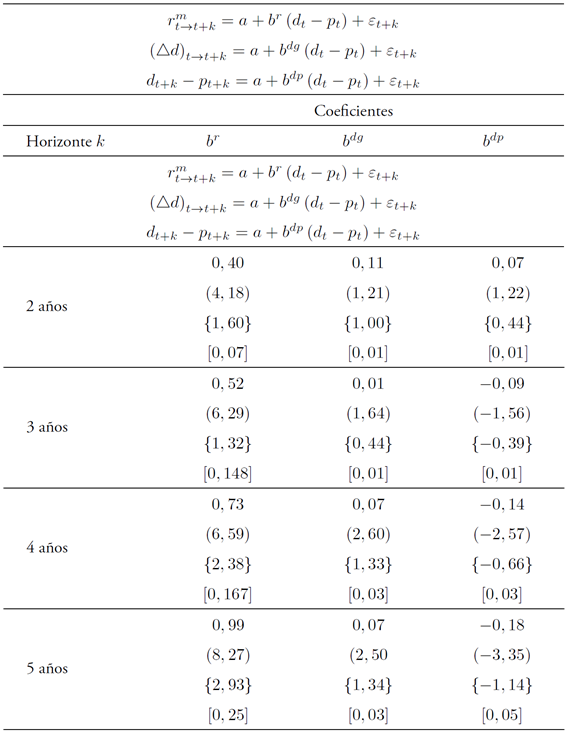
 es el logaritmo del retorno mensual acumulado entre cada período y un horizonte (, descontado del promedio.
dt ( pt
es el logaritmo del rendimiento por dividendo descontando del promedio.
es el logaritmo del retorno mensual acumulado entre cada período y un horizonte (, descontado del promedio.
dt ( pt
es el logaritmo del rendimiento por dividendo descontando del promedio.  es la tasa de crecimiento de dividendos acumulado entre cada período y el horizonte (: Todos los datos son mensuales para el período abril 1995 - julio 2017. El estadístico t es reportado entre paréntesis. Entre llaves está reportado el t-estadístico bajo errores estándar corregidos por autocorrelación y heterocedasticidad (
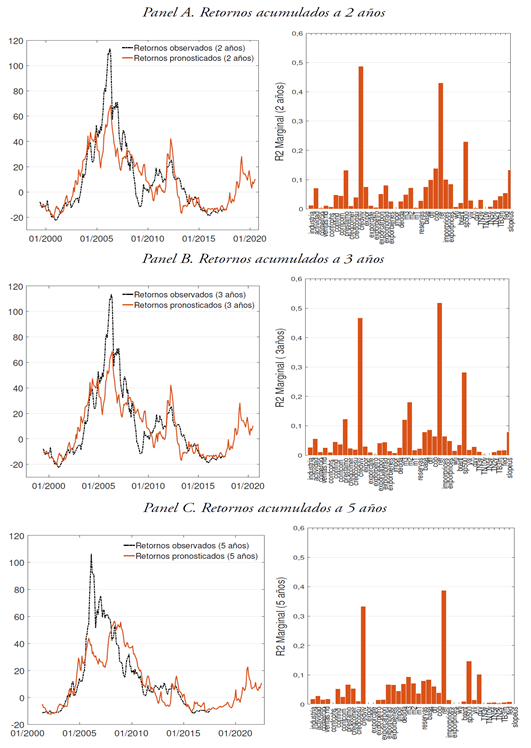

 es el logaritmo del retorno mensual acumulado entre cada período y un horizonte ( descontado del promedio.
dt ( pt
es el logaritmo del rendimiento por dividendo descontando del promedio. Los datos corresponden a observaciones mensuales para el período abril 1995-julio 2017. La significancia estadística de los coeficientes está indicada por *, donde p<0,001***, p<0,05** y p<0,1*.
es el logaritmo del retorno mensual acumulado entre cada período y un horizonte ( descontado del promedio.
dt ( pt
es el logaritmo del rendimiento por dividendo descontando del promedio. Los datos corresponden a observaciones mensuales para el período abril 1995-julio 2017. La significancia estadística de los coeficientes está indicada por *, donde p<0,001***, p<0,05** y p<0,1*.