

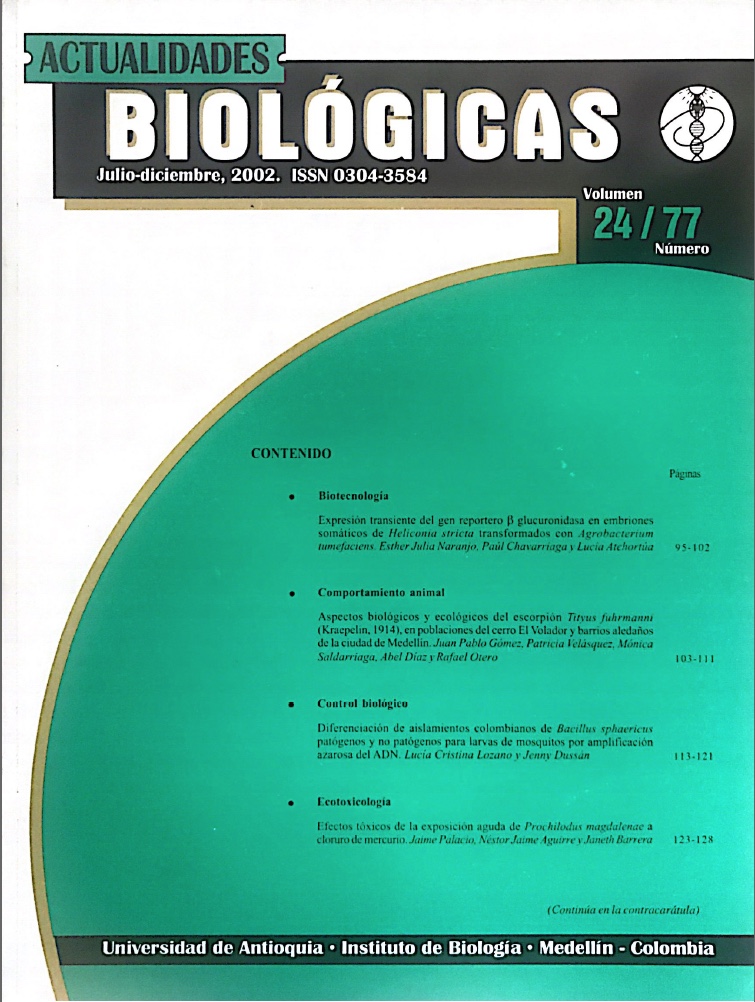
Biological and ecological aspects of the scorpion Tityus fuhrmanni (Kraepelin, 1914), inpopulations from the hill El Volador and adjacent neighborhoods in Medellín
DOI:
https://doi.org/10.17533/udea.acbi.329534Keywords:
scorpions, Tityus fuhrmanni, ecology, biologyAbstract
In 1914, Kraepelin described the species Tityus fuhrmanni from the town of Angelópolis, but currently its distributionalrange includes the municipalities of the Valle de Aburrá. The goal of this investigation was to study certain biological andecological aspects (habitats, microhabitats, postembryonic development) of the scorpion Tityus fuhrmanni obtained fromthe El Volador hill and adjacent neighborhoods in Medellín. The results demonstrated that this species is widely distributed, colonizing habitats with human intervention. However, on the hill it showed preferences for habitats with considerablevegetative cover and for crevices that offer protection. During the collecting period (May to September, 2001) 189 scorpions were captured (61 on the hill, 101 intradomiciliary, 27 peridomiciliary), which were maintained in captivity under identical conditions. Nineteen litters were produced, ranging between one to eighteen offspring per litter (total 154). Larvae were randomly distributed on the mother’s back. The species requires five molts to reach adulthood, which occuron averaged at 6, 74, 119 and 183 days. The fifth instar was not attained during this project. Nymphs descended from the mother’s back from between three to twelve days following ecdysis. Allometric growth was observed for the metasomal segment V and chela, and isometric growth for the carapace (chephalothorax). Sexual dimorphism also was observed, withmales having more developed metasomal spines and pectines.
Downloads
Downloads
Published
How to Cite
Issue
Section
License
The authors exclusively authorize the Actualidades Biológicas journal to edit and publish the submitted manuscript if its publication is recommended and accepted, without this representing any cost to the Journal or the University of Antioquia.
All the ideas and opinions contained in the articles are sole responsibility of the authors. The total content of the issues or supplements of the journal is protected under the Creative Commons Attribution-NonCommercial-ShareAlike 4.0 International License, so they cannot be used for commercial purposes, but for educational purposes. However, please mention the Actualidades Biológicas journal as a source and send a copy of the publication in which the content was reproduced.




