

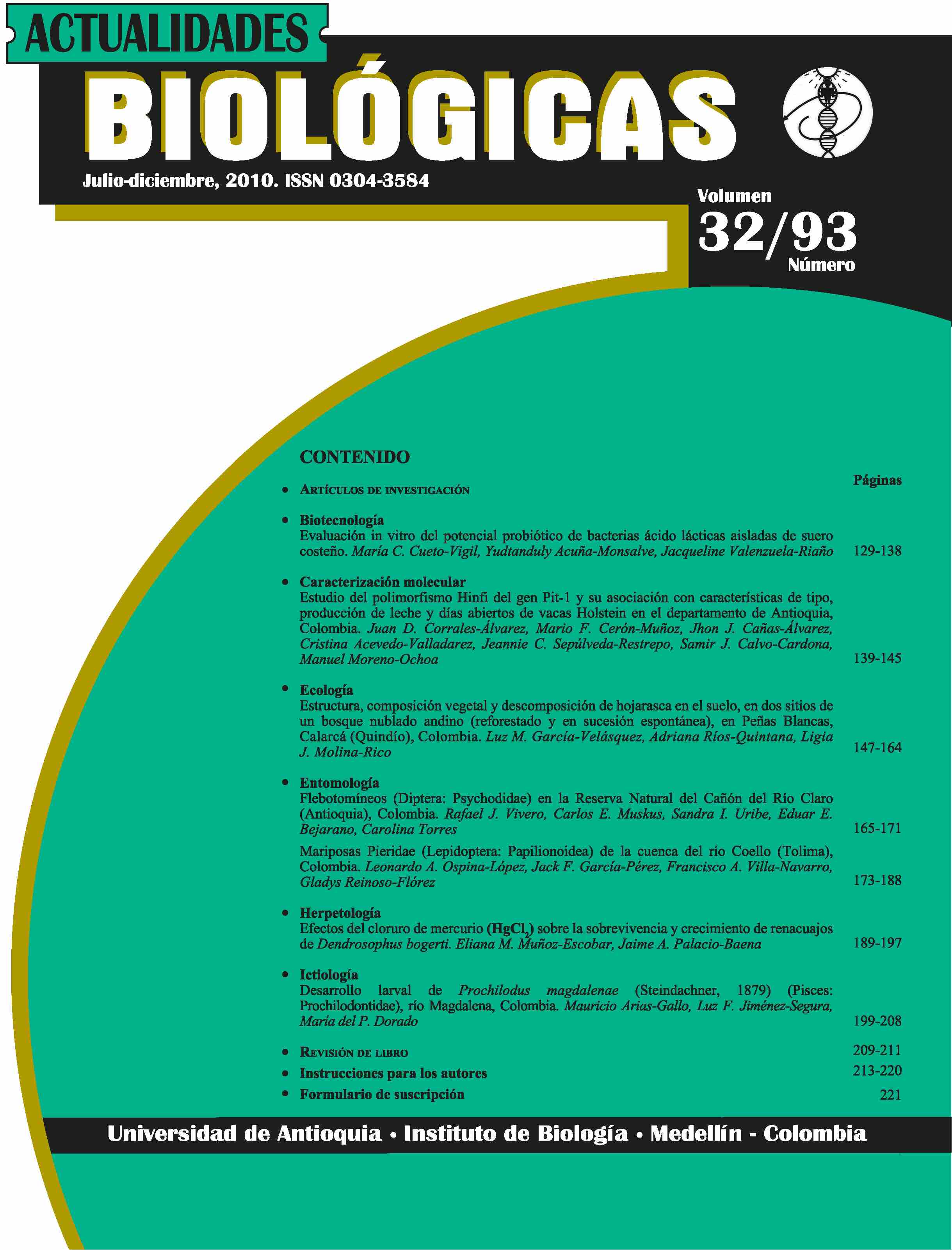
Effects of mercury chloride (HgCl2) on the survival and growth of tadpoles of Dendrosphus bogerti
DOI:
https://doi.org/10.17533/udea.acbi.13814Keywords:
Dendrosophus bogerti, growth, mercuric chloride, metamorphosis, tadpolesAbstract
Frog larvae (Dendrosophus bogerti) were exposed to five lethal (0.25, 0.3, 0.36, 0.43, and 0.51 mg/l) and four sublethal concentrations (0.02, 0.04, 0.08, and 0.10 mg/l) of mercury chloride (HgCl2), in order to determine the LC50 and effects on growth and development rates. The LC50 at 96 h of HgCL2 was 0.41 mg/l. There was evidence for an effect of Hg on growth (weight and length) at 10 and 20 days of exposure to 0.04, 0.08, and 0.1 mg/l HgCL2 with a P < 0.001. In contrast, weight and length of tadpoles exposed to 0.02 mg/l HgCL2 showed no significant differences with the negative control (P = 0.77 and P = 0.1, respectively). The highest growth inhibition was observed at 30 days (P < 0.001). The time to reach Gosner stage 36 was significantly different in all specimens treated with Hg compared to controls (H = 35.4, P < 0.001). The delay in development may be related to an enzymatic alteration and in nature may have a negative impact on the survival of tadpoles due to rapid drying of temporary ponds and increased vulnerability to predators. The species D. bogerti is sensitive to mercury exposure in aquatic environments, with adverse effects on growth and development rate.
Downloads
References
Albrecht J, Abalos M, Rice TM. 2007. Heavy metal levels in ribbon snakes (Thamnophis sauritus) and anuran larvae from the Mobil-Tensaw river Delta, Alabama, U. S. A. Archives of Environmental Contamination and Toxicology, 53 (4): 647-654. DOI: https://doi.org/10.1007/s00244-006-0175-3
Babbitt KJ, Tanner GW. 1997 Effects of cover and predator identity on predation of Hyla squirella tadpoles. Journal of Herpetology, 31 (1): 128-130. DOI: https://doi.org/10.2307/1565342
Balls M, Clothier RH, Rowles JM, Kiteliey NA, Bennett GW. 1985. TRH distribution, levels and significance during the development of Xenopus laevis. En: Balls M, Bounes M, editores. Metamorphosis 8th Symposium British Society Developmental Biology. Oxford: Clarendon Press. p. 260-271.
Berven KA. 1990. Factors affecting population fluctuations in larval and adult stages of the wood frog (Rana sylvatica). Ecology, 71 (4): 1599-1608. DOI: https://doi.org/10.2307/1938295
Bhattacharya T, Bhattacharya S, Ray AK, Dey S. 1989. Influence of industrial pollutants on thyroid function in Channa punctatus (Bloch). Indian Journal of Experimental Biology, 27 (1): 65-68.
Birge WJ, Black JA. 1980. Aquatic toxicology of nickel. En: Nriagu Jo editor. Nickel in the Environment. New York: J. Wiley and Sons. p. 349-366.
Brand AB, Snodgrass JW, Gallagher MT, Casey RE, Meter RV. 2010. Lethal and sublethal effects of embryonic and larval exposure of Hyla versicolor to stormwater pond sediments. Archives of Environmental Contamination and Toxicology, 58 (2): 325-331. DOI: https://doi.org/10.1007/s00244-009-9373-0
Bridges CC, Zalups Rk. 2005. Molecular and ionic mimicry and the transport of toxic metals. Toxicology and Applied Pharmacology, 204 (3): 274-308. DOI: https://doi.org/10.1016/j.taap.2004.09.007
Britson CA, Threlkeld ST. 1998. Abundance, metamorphosis, developmental and behavioral abnormalities in Hyla chrysoscelis tadpoles following exposure to three agrichemicals and methyl mercury in outdoor mesocosms. Bulletin of Environmental Contamination and Toxicology, 61 (2): 154-161. DOI: https://doi.org/10.1007/s001289900742
Bulog B, Mihajl K, Zvonka J, Mihael JT. 2002. Trace element concentrations in the tissues of proteus anguinus (Amphibia, Caudata) and the surrounding environment. Water, Air, and Soil Pollution, 136 (1-4): 147-163. DOI: https://doi.org/10.1023/A:1015248110142
Burger J, Snodgrass, J. 2001. Metal levels in southern leopard frogs from the Savannah river site: location and body compartment effects. Environmental Research (Section A), 86 (2): 157-166. DOI: https://doi.org/10.1006/enrs.2001.4245
Bush SL, Dyson ML, Halliday TR. 1996. Selective phonotaxis by males in the Majorcan Midwife toad. Proceedings of Biological Sciences, 263 (1372): 913-917. DOI: https://doi.org/10.1098/rspb.1996.0135
Christin MS, Me ́nard L, Gendron AD, Ruby S, Cyr D, Marcogliese DJ, Rollins-Smith L, Fournier M. 2004. Effects of agricultural pesticides on the immune system of Xenopus laevis and Rana pipiens. Aquatic DOI: https://doi.org/10.1016/j.aquatox.2003.11.007
Toxicology, 67 (1): 33-43.
Collins JP, Storfer A. 2003. Global amphibian declines: Sorting the hypotheses. Diversity and Distribution, 9: 89-98. DOI: https://doi.org/10.1046/j.1472-4642.2003.00012.x
Collins JP. 1979. Intrapopulation variation in the body size at metamorphosis and timing of metamorphosis in the bullfrog, Rana catesbeiana. Ecology, 60 (4): 738-749. DOI: https://doi.org/10.2307/1936611
Cummins CP. 1986. Temporal and spatial variation in egg size and fecundity in Rana temporaria. Journal of Animal Ecology, 55 (1): 303-316. DOI: https://doi.org/10.2307/4710
Denver RJ. 1997. Proximate mechanisms of phenotypic plasticity in amphibian metamorphosis. American Zoologist, 37 (2): 172-184. DOI: https://doi.org/10.1093/icb/37.2.172
Esclapés M. 1999. Protocolos estándares para bioensayos de toxicidad con especies acuáticas y terrestres. Versión 2.0. Caracas (Venezuela): PDVSA. INTEVEP. p. 215.
Facemire CF, Gross TS, Guillette LJ. Jr. 1995. Reproductive impairment in the Florida panther: nature or nuture? Environmental Health Perspectives, 103 (4): 79-86. DOI: https://doi.org/10.1289/ehp.103-1519283
Fort DJ, Rogers RL, Morgan LA, Miller MF, Clark PA, White JA, Paul RR, Stover EL. 2000. Preliminary validation of a short term morphological assay to evaluate adverse effects on amphibian metamorphosis and thyroid function using Xenopus laevis. Journal of DOI: https://doi.org/10.1002/1099-1263(200009/10)20:5<419::AID-JAT708>3.0.CO;2-A
Applied Toxicology, 20 (5): 419-425.
Fort DJ, Rogers RL, Thomas JH, Hopkins WA, Schleka C. 2006. Comparative developmental toxicity of nickel to Gastrophryne carolinensis, Bufo terrestris, and Xenopus laevis. Archives of Environmental Contamination and Toxicology, 51: 703-710. DOI: https://doi.org/10.1007/s00244-005-0217-2
Gallo-D SM, Palacio J, Gutiérrez-C PD. 2006. Efectos del insecticida clorpirifos sobre la tasa de crecimiento y la metamorfosis de Smilisca phaeota (Cope, 1862) (Anura: Hylidae). Actualidades Biológicas, 28 (84): 51-58. DOI: https://doi.org/10.17533/udea.acbi.329408
Gosner K.L. 1960. A simplified table for staging anuran embryos and larvae with notes on identification. Herpetologica, 16 (3): 183-190.
Guisande C, Barreiro A, Maneiro I, Riveiro I, Vergara R, Vaamonde A. 2006. Tratamiento de datos. Madrid (España): Editorial Díaz de Santos. p. 355.
Hayes N, Haston K, Tsui M, Hoang A, Haeffele C, Vonk A. 2002. Herbicides: Feminization of male frogs in the wild. Nature, 419: 895-896. DOI: https://doi.org/10.1038/419895a
Kalish LA. 1990. Efficient desing for stimation of median lethal dose and quantal dose-response curves. Biometric, 46 (3): 737-748. DOI: https://doi.org/10.2307/2532092
Kaplan RH, Salthe SN. 1979. The allometry of reproduction: an empirical view in salamanders. American Naturalist, 113 (5): 671-689. DOI: https://doi.org/10.1086/283425
Klump GM, Gerhardt HC. 1987. Use of non arbitrary acoustic criteria in mate choice by female Gray Tree frogs. Nature, 326: 286-288. DOI: https://doi.org/10.1038/326286a0
Lefcort H, Meguire RA, Wilson LH, Ettinger WF. 1998. Heavy metals alter the survival, growth, metamorphosis and antipredatory behavior of Columbia spotted frog (Rana luteiventris) tadpoles. Archives of Environmental Contamination and Toxicology, 35 (3): 447-456. DOI: https://doi.org/10.1007/s002449900401
Loumbourdis N, Danscher G. 2008. Autometallographic tracing of Hg-S quantum dots in foros exponed to inorganic mercury. Biometals, 21: 311-319. DOI: https://doi.org/10.1007/s10534-007-9120-9
Malm O, Pfeiffer W, Souza C, Reuther R. 1990. Mercury pollution due to gold mining in the Madeira River. Journal of the Human Environment, 19: 1-8.
Marrugo-Negrete JL, Lans E. 2006. Impacto ambiental por contaminación con níquel, mercurio y cadmio en aguas, peces y sedimentos en la cuenca del río San Jorge, en el departamento de Córdoba. Montería (Córdoba): Centro de Investigaciones (CIUC), Universidad de Córdoba. Marrugo-Negrete J, Benítez LN, Olivero-Verbel J. 2008.
Distribution of mercury in several environmental compartments in an aquatic ecosystem impacted by gold mining in Northern Colombia. Archives of Environmental Contamination and Toxicology, 55 (2): 305-316. DOI: https://doi.org/10.1007/s00244-007-9129-7
Mcgeer JC, Szebedinsky C, McDonald DG, Wood CMd. 1999. Effects of chronic sublethal exposure to waterbone Cu, Cd, or Zn, in rainbow trout. 1: Iono- regulatory disturbance and metabolic costs. Aquatic DOI: https://doi.org/10.1016/S0166-445X(99)00105-8
Toxicology, 50 (3): 231-243.
McGregor AJ, Mason HJ. 1991. Occupational mercury vapour exposure and testicular, pituitary, and thyroid endocrine function. Human and Experimental Toxicology, 10 (3): 199-203. DOI: https://doi.org/10.1177/096032719101000309
Nishisaka N. 1994. Sensitivity of of inmature regenerating proximal tubular cell in Rabbit kidney to mercuric-chloride a light and electron microscopic analysis. Nippon Jinzo Gakkasi Shi, 36 (4): 298-306.
Palacio J, Muñoz E, Gallo S, Rivera M. 2006. Anfibios y reptiles del Valle de Aburrá. Medellín (Colombia): Editorial Zuluaga p. 174.
Palacio J, Aguirre N, Barrera J. 2002. Efectos tóxicos de la exposición aguda de Prochilodus magdalenae a cloruro de mercurio. Actualidades Biológicas, 24 (77): 123-128. DOI: https://doi.org/10.17533/udea.acbi.329536
Peterson JD, Peterson VA, Mendonca MT. 2008. Growth and Developmental Effects of Coal Combustion Residues on Southern Leopard Frog (Rana sphenocephala) Tadpoles Exposed throughout Metamorphosis. Copeia, 2008 (3): 499-503. DOI: https://doi.org/10.1643/CG-07-047
Ray J, Madhyastha MN. 1987. Toxicities of some heavy metals to the tadpoles of frog, Microhyla ornata (Dumeril y Bibron). Toxicology Letters, 36 (2): 205-208. DOI: https://doi.org/10.1016/0378-4274(87)90186-X
Reish D, Oshida P. 1987. Manual of methods in aquatic environment research. Part 10 - Short-term static bioassays. Roma (Italia): FAO. p. 62.
Rouhani Rankouhi T, Sanderson JT, Van Holsteijn I, Van Kooten P, Bosveld ATC, Van den Berg M. 2005. Effects of environmental and natural estrogens on vitellogenin production in hepatocytes of the brown frog (Rana temporaria). Aquatic Toxicology, 71 (1): 97-101. DOI: https://doi.org/10.1016/j.aquatox.2004.09.009
Rowe CL, Kinney OM, Nagle RD, Congdon JD. 1998.Elevated maintenance cost in anuran (Rana catesbeiana) exposed to a mixture of trace elements during the embryonic and early larval periods. Physiological and Biochemical Zoolology, 71 (1): 27-35. DOI: https://doi.org/10.1086/515885
Rowe CL, Kinney OM, Fiori AP, Congdon JD. 1996. Oral deformities in tadpoles (Rana catesbeiana) associated with coal ash deposition: effects on grazing ability and growth. Freshwater Biology, 36 (3): 723-730. DOI: https://doi.org/10.1046/j.1365-2427.1996.00123.x
Semlitsch RD, Gibbons JW. 1988. Fish predation in size-structured populations of treefrog tadpoles. Oecologia, 81 (3): 100-103. DOI: https://doi.org/10.1007/BF00376932
Semlitsch RD. 1987. Relationship of pond drying to the reproductive success of the salamander Ambystoma talpoideum. Copeia, 61 (1): 61-69. DOI: https://doi.org/10.2307/1446038
Sin YM, Teh CI. 1992. Effect of long-term uptake of mercuric sulphide on thyroid hormones and glutathione in mice. Bulletin of Environmental Contamination and Toxicology, 49 (3): 847-854. DOI: https://doi.org/10.1007/BF00203157
Smith D. 1987 Adult recruitment in chorus frogs: effects of size and date at metamorphosis. Ecology, 68 (2): 344-350. DOI: https://doi.org/10.2307/1939265
Snodgrass JW, Jagoe CH, Bryan AL, Brant HA, Burger J. 2000. Effects of trophic status and wetland morphology, hydroperiod and water chemistry on mercury concentration in fish. Canadian Journal of Fisheries and Aquatic Sciences, 57 (1): 171-180. DOI: https://doi.org/10.1139/f99-199
Sparling DW, Krest S, Ortiz-Santaliestra, M. 2006. Effects of Lead-Contaminated Sediment on Rana sphenocephala tadpoles. Archives of Environmental Contamination and Toxicology, 51 (3): 458-466. DOI: https://doi.org/10.1007/s00244-005-0243-0
Sullivan BK. 1992. Sexual selection and calling behavior in the American toad (Bufo americanus). Copeia, 1992 (1): 1-7. DOI: https://doi.org/10.2307/1446530
TFG (Taylor y Francis Group). 2006. Lethal and sublethal effects of mercury under controlled conditions. CRCnetBASE. Fecha de acceso: 07 de enero de 2010. Disponible en: <http://www.environetbase.com/books/4576/9212ch8.pdf>.
Unrine JM, Hopkins WA, Romanek CS, Jackson, BP. 2007. Bioaccumulation of trace elements in omnivorous amphibian larvae: Implications for amphibian health and contaminant transport. Environmental Pollution, 149 (2): 182-192. DOI: https://doi.org/10.1016/j.envpol.2007.01.039
Unrine JM, Jagoe C, Hopkins WA, Brant HA. 2004. Aderse effects of ecologically relevant dietary mercury exposure in southern leopard frog (Rana sphenocephala) larvae. Environmental Toxicology and DOI: https://doi.org/10.1897/03-696.1
Chemistry, 23 (12): 2964-2970.
Unrine JM, Jagoe C. 2004. Dietary mercury exposure and bioaccumulation in southern leopard frog (Rana sphenocephala) larvae. Environmental Toxicology and Chemistry, 23 (12): 2956-2963. DOI: https://doi.org/10.1897/03-695.1
Unrine JM, Jagoe C. Brinton HA, Brant NT. 2005. Dietary mercury exposure and bioaccumulation in amphibian larvae inhabiting Carolina bay Wetlands. Environmental Pollution, 135 (2): 245-253. DOI: https://doi.org/10.1016/j.envpol.2004.11.003
Valle BL, Ulmer DD. 1972. Biochemical effects of mercury, cadmium and lead. Annual Review of Biochemistry, 41: 91-128. DOI: https://doi.org/10.1146/annurev.bi.41.070172.000515
Werner EE. 1991. Nonlethal effects of a predator on competitive interactions between two anuran larvae. Ecology, 72 (5): 1709-1720. DOI: https://doi.org/10.2307/1940970
Wilbur HM, Collins JP. 1973. Ecological aspects of amphibian metamorphosis: nonnormal distributions of competitive ability reflect selection for facultative metamorphosis. Sciences, 182 (4119): 1305-1314. DOI: https://doi.org/10.1126/science.182.4119.1305
Downloads
Published
How to Cite
Issue
Section
License
The authors exclusively authorize the Actualidades Biológicas journal to edit and publish the submitted manuscript if its publication is recommended and accepted, without this representing any cost to the Journal or the University of Antioquia.
All the ideas and opinions contained in the articles are sole responsibility of the authors. The total content of the issues or supplements of the journal is protected under the Creative Commons Attribution-NonCommercial-ShareAlike 4.0 International License, so they cannot be used for commercial purposes, but for educational purposes. However, please mention the Actualidades Biológicas journal as a source and send a copy of the publication in which the content was reproduced.




