

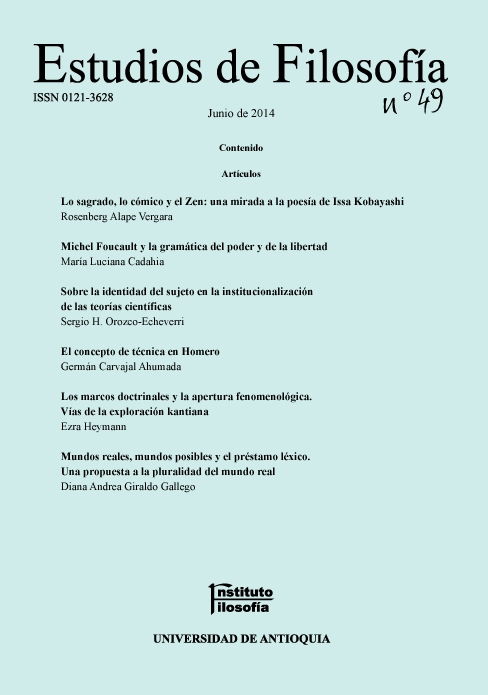
On the identity of the subject in the institutionalisation of scientific theories
DOI:
https://doi.org/10.17533/udea.ef.19430Keywords:
Sociology of scientific knowledge, identity, epistemology, individualism, scientific community, subject of knowledgeAbstract
The social studies of science and in particular the sociology of scientific knowledge (SSK), have criticized the philosophies of science because they are based on epistemologies centered on the individual as a subject of knowledge, at the expense of an analysis that accounts for scientific communities, an explanation of scientific knowledge focused on the individual is unable to account for the traditions and current state of science. This article argues, however, that SSK does not dilute the subject in the scientific community but, on the contrary, allows us to define it in their interaction with others, the interpretation and organization of knowledge of nature. This is done using the notion of identity of the subject as a practitioner of science.
Downloads
References
BLOOR, D. (1991) Knowledge and social imagery. Chicago, Chicago University Press.
BLOOR, D. (1999) Anti-Latour. Studies in History and Philosophy of Science. Vol. 30, No. 1, pp.81-112. DOI: https://doi.org/10.1016/S0039-3681(98)00038-7
BLOOR, D. (2004) Sociology of scientific knowledge. En: Niinilouto, M and Wolenski, J. (eds) Handbook of epistemology. Dordrecht, Kluwer, pp. 919-962. DOI: https://doi.org/10.1007/978-1-4020-1986-9_25
BLOOR, D. & Barnes, B (1982) Relativism, Rationalism and the Sociology of Knowledge. En: Hollis, M. & Lukes, S. Rationality and relativism. Oxford, Blackwell, pp. 21-47.
BLUMER, H. (1969) Symbolic interactionism. Englewood Cliffs, Prentice- Hall.
BURKE, P. & STETS, J. (2009) Identity theory. Oxford, Oxford University Press. DOI: https://doi.org/10.1093/acprof:oso/9780195388275.001.0001
COLLINS, H. M. (2010) Tacit and explicit knowledge. Chicago, Chicago University Press. DOI: https://doi.org/10.7208/chicago/9780226113821.001.0001
DEAR, P. (2001) Science studies as epistemography. En: Labinger, J. and Collins, H. The one culture? A conversation about science. Chicago, Chicago University Press, pp. 128-141. DOI: https://doi.org/10.7208/chicago/9780226467245.003.0010
FEYERABEND, P. (1981) Realism, rationalism and scientific method. Philosophical Papers Vol 1. Cambridge, Cambridge University Press. DOI: https://doi.org/10.1017/CBO9781139171526
GOLINSKI, J. (1987) Making natural knowledge: constructivism and the history of science. Cambridge: Cambridge University Press.
HENRY, J. (2012) A short history of scientific thought. New York, Palgrave MacMillan. DOI: https://doi.org/10.1007/978-0-230-35646-7
KUHN, T. (1963) The function of dogma in scientific research. En: Crombie, A.C. (ed). Scientific Change (pp. 347-369). New York and London: Basic Books and Heineman.
KUHN, T. (1970) Reflections on my critics. En: Lakatos, I. & Musgrave, A. Criticism and the growth of knowledge. Cambridge, Cambridge University Press, pp. 231-278. DOI: https://doi.org/10.1017/CBO9781139171434.011
KUHN, T. (1977) The essential tension. Selected studies in scientific tradition and change. Chicago, Chicago University Press. DOI: https://doi.org/10.7208/chicago/9780226217239.001.0001
KUHN, T. (1978) Black-body theory and the quantum discontinuity 1894- 1912. Oxford, Oxford University Press.
KUHN, T. (2000) The road since structure. Philosophical essays, 1970-1993. Edited by James Conant and John Haugeland. Chicago, Chicago University Press.
LATOUR, B. (1993) We have never been modern. Cambridge, Mass., Harvard University Press.
LAUDAN, L. (1996) Beyond positivism and relativism: theory, method and evidence. Boulder, Westview Press.
LAKATOS, I. (1970) Falsification and the methodology of scientific research programmes. En: Lakatos, I. and Musgrave, A. Criticism and the growth of knowledge. Cambridge, Cambridge University Press, pp. 91-196. DOI: https://doi.org/10.1017/CBO9781139171434.009
MACKENZIE, D. (1999) Inventing accuracy: a historical sociology of nuclear missile guidance. Cambridge, MIT Press.
MCCABE, R. L. (1976) Theodorus’ Irrationality Proofs. Math Magazine, vol. 49, No. 4, pp. 201-203. DOI: https://doi.org/10.1080/0025570X.1976.11976579
PINCH, T (1985) Towards an Analysis of Scientific Observation: The Externality and Evidential Significance of Observational Reports in Physics. Social Studies of Science, vol 15, n. 1, pp. 3-36. DOI: https://doi.org/10.1177/030631285015001001
POLANTY, M (1966) The tacit dimension. New York, Doubleday.
PLATÓN (2006) Teeteto. Introducción, traducción y notas de Marcelo Boeri. Buenos Aires, Losada.
POPPER, K. (2002) Conjectures and refutations. The growth of scientific knowledge. London: Routledge.
SHAPIN, S. (1980) Social uses of science. En: Rousseau, G.S. and Porter, R. The ferment of knowledge. Cambridge, Cambridge University Press, pp. 93-139. DOI: https://doi.org/10.1017/CBO9780511572982.004
SHAPIN, S. (1992) Discipline and bounding: the history and sociology of science as seen thourgh the externalism-internalism debate. History of science. 30, pp. 333-369. DOI: https://doi.org/10.1177/007327539203000401
SHAPIN, S. (1994) A social history of truth. Civility and science in Seventeenth-century England. Chicago, Chicago University Press. DOI: https://doi.org/10.7208/chicago/9780226148847.001.0001
SHAPIN, S. (2010) Never pure. Historical studies of science as if it was produced by people with bodies, situated in time, space, culture, and society, and struggling for credibility and authority. Baltimore, Johns Hopkins University Press.
SHAPIN, S. and SCHAFFER, S. (1985) Leviathan and the air-pump. Hobbes, Boyle and the experimental life. Princeton, Princeton University Press.
STRYKER, S (2002) Symbolic interactionism: a social structural version. Caldwell, Blackburn Press.
WESTMAN, R. (2011) The Copernican Question. Prognostication, skepticism and celestial order. Berkeley, University of California Press. DOI: https://doi.org/10.1525/9780520948167
WITTGENSTEIN, L. (1967) Remarks on the foundations of mathematics. Oxford, Blackwell.
Downloads
Published
How to Cite
Issue
Section
Categories
License
Copyright (c) 2014 Sergio H. Orozco Echeverri

This work is licensed under a Creative Commons Attribution-NonCommercial-ShareAlike 4.0 International License.
Authors who publish with this journal agree to the following terms:
1. The Author retains copyright in the Work, where the term "Work" shall include all digital objects that may result in subsequent electronic publication or distribution.
2. Upon acceptance of the Work, the author shall grant to the Publisher the right of first publication of the Work.
3. The Author shall grant to the Publisher a nonexclusive perpetual right and license to publish, archive, and make accessible the Work in whole or in part in all forms of media now or hereafter known under a Creative Commons Attribution-NoCommercia-ShareAlike (CC BY-NC-SA 4.0), or its equivalent, which, for the avoidance of doubt, allows others to copy, distribute, and transmit the Work under the following conditions: (a) Attribution: Other users must attribute the Work in the manner specified by the author as indicated on the journal Web site;(b) Noncommercial: Other users (including Publisher) may not use this Work for commercial purposes;
4. The Author is able to enter into separate, additional contractual arrangements for the nonexclusive distribution of the journal's published version of the Work (e.g., post it to an institutional repository or publish it in a book), as long as there is provided in the document an acknowledgement of its initial publication in this journal;
5. Authors are permitted, and Estudios de Filosofía promotes, to post online the preprint manuscript of the Work in institutional repositories or on their Websites prior to and during the submission process, as it can lead to productive exchanges, as well as earlier and greater citation of published work (see The Effect of Open Access). Any such posting made before acceptance and publication of the Work is expected be updated upon publication to include a reference to the Estudios de Filosofía's assigned URL to the Article and its final published version in Estudios de Filosofía.




