

Cien años de la conciencia: “una larga formación en el absurdo”
DOI:
https://doi.org/10.17533/udea.ef.n59a02Palabras clave:
Conciencia, Conductismo, Materialismo, Fisicalismo, Eliminativismo, IlusionismoResumen
Uno de los episodios más notables en la historia del pensamiento humano ocurrió en el siglo XX. Varios pensadores negaron la existencia de algo que sabemos con certeza que existe: la conciencia o la experiencia consciente. Otros, aunque se contuvieron de llegar al punto de la Negación —como podemos llamarlo—, afirmaron que podría ser cierta —una tesis no menos notable que la Negación. Este texto documenta algunos aspectos de este episodio, con particular referencia a dos cosas. En primer lugar, el desarrollo de dos puntos de vista que son formas de la Negación —el conductismo filosófico y el funcionalismo en la filosofía de la mente— a partir de una perspectiva que no implica de ninguna manera la Negación: el conductismo psicológico metodológico. En segundo lugar, el surgimiento de una forma de entender el naturalismo —el naturalismo materialista o fisicalista— que interpreta erróneamente que el naturalismo implica la Negación.
Descargas
Citas
Antony, L. (2007). Everybody Has Got It: A Defense of Non-Reductive Materialism. In Brian P. McLaughlin and Jonathan D. Cohen (Eds.), Contemporary Debates in the Philosophy of Mind (pp. 143-159). Oxford: Blackwell.
Bacon, F. (1620/2000). The New Organon (L. Jardine and M. Silverthorne, Trans.). Cambridge: Cambridge University Press. https://doi.org/10.1017/CBO9781139164030
Bain, A. (1865). The Emotions and the Will, 2nd edition. London: Longmans, Green and Co. https://doi.org/10.1037/12264-000
Berlin, I. (1933). Letter to Elizabeth Bowen, 30 November. In H. Hardy (Ed.), Flourishing: Letters 1928-1946. London: Chatto & Windus.
Berlin, I. (1933). Letter to Elizabeth Bowen, 30 November. In H. Hardy (Ed.), Flourishing: Letters 1928-1946. London: Chatto & Windus.
Berlin, I. (1999/2013). The Roots of Romanticism. Princeton, NJ: Princeton University Press. Block, N. (1978). Troubles with Functionalism. In Minnesota Studies in the Philosophy of Science, 9, 261-325.
Block, N. (1978). Troubles with Functionalism. In Minnesota Studies in the Philosophy of Science, 9, 261-325.
Boring, E. G. (1948). The Nature of Psychology. In E. G. Boring, H. S. Langfeld, and H. P. Weld (Eds.), Foundations of psychology. New York: Wiley.
Broad, C. D. (1925). The Mind and Its Place in Nature. London: Kegan Paul.
Brown, T. (1806). Observations of the Nature and Tendency of the Doctrine of Mr. Hume, Concerning the Relation of Cause and Effect (2nd edition). Edinburgh: Mundell and Son.
Carroll, L. (1871). Through the Looking Glass. London: Macmillan.
Cavendish, M. (1664). Philosophical letters: Or, modest reflections upon some opinions in natural philosophy. London.
Chalmers, D. (1996). The Conscious Mind. Oxford: Oxford University Press.
Churchland, P. M. (1979). Scientific Realism and the Plasticity of Mind. New York: Cambridge University Press. https://doi.org/10.1017/CBO9780511625435
Churchland, P. M. (1984). Matter and Consciousness. Cambridge, MA: MIT Press.
Cicero, M. T. (c 50bce/1923). De Divinatione. In De Senectute de Amicitia de Divinatione (W.Falconer, Trans.). London: Heinemann. https://doi.org/10.4159/DLCL.marcus_tullius_cicero-de_divinatione.1923
Collins, A. (1707-08). Reflections on Mr. Clarke's Second Defense of his Letter to Mr. Dodwell. In W. Uzgalis (Ed.), The Clarke-Collins Correspondence of 1707-08. Peterborough, ON: Broadview Press.
Comte, A. (1830-42/1855). Cours de philosophie positive (H. Martineau, Trans.). The Positive Philosophy. New York: Blanchard.
De Broglie, L. (1931). Interviews with Great Scientists: no. 8. -Prince de Broglie. The Observer, February 8, 15.
Demopoulos, W., and Friedman, M. (1985). Critical Notice: Bertrand Russell's The Analysis of Matter and its Historical Context and Contemporary Interest. Philosophy of Science, 52, 621-39. https://doi.org/10.1086/289281
Dennett, D. (1988). Quining Qualia. In A. J. Marcel and E. Bisiach (Eds.), Consciousness in Contemporary Science (pp. 42-77). Oxford: Oxford University Press. https://doi.org/10.1093/acprof:oso/9780198522379.003.0003
Dennett, D. (1991). Consciousness Explained. Boston: Little, Brown.
Dennett, D. (1993a). Précis of Consciousness Explained. Philosophy and Phenomenological Research, 53, 889-892. https://doi.org/10.2307/2108259
Dennett, D. (1993b). The Message is: There is no Medium. Philosophy and Phenomenological Research, 53, 919-931. https://doi.org/10.2307/2108264
Dennett, D. (1995/1998). The Unimagined Preposterousness of Zombies: Commentary on Moody, Flanagan, and Polger. In D. Dennett, Brainchildren. Essays on designing minds (pp. 171-177). Cambridge, MA: MIT Press. https://doi.org/10.7551/mitpress/1663.001.0001
Dennett, D. (2001). Are We Explaining Consciousness Yet? Cognition, 79, 221-37. https://doi.org/10.1016/S0010-0277(00)00130-X
Dennett, D. (2013a). Intuition Pumps and Other Tools for Thinking. London: Penguin.
Dennett, D. (2013b). Philosopher Daniel Dennett on Matter, Meaning, and Mind podcast. The 7th Avenue Project. https://itunes.apple.com/us/podcast/the-7th-avenue-project/id302407665
Dennett, D. (2013c). Interview, in The New York Times, April 29. https://www.nytimes. com/2013/04/30/books/daniel-dennett-author-of-intuition-pumps-and-other-tools-for-thinking.html
Dennett, D. (2018). Magic, Illusions, and Zombies: An Exchange. https://www.nybooks. com/ daily/2018/04/03/magic-illusions-and-zombies-an-exchange/
Descartes, R. (1618-28/1985). Rules for the Direction of the Mind. In The Philosophical Writings of Descartes, Volume. 1 (J. Cottingham et al, Trans.). Cambridge: Cambridge University Press.
Descartes, R. (1637/1985). Discourse on the Method in The Philosophical Writings of Descartes, Volume 1 (J. Cottingham et al, Trans) Cambridge: Cambridge University Press. https://doi.org/10.1017/CBO9780511818998
Descartes, R. (1641-2/1985). Meditations and Objections and Replies. In The Philosophical Writings of Descartes, Volume 2 (J. Cottingham et al, Trans). Cambridge: Cambridge University Press.
Dewey, J. (1905). The Postulate of Immediate Empiricism. The Journal of Philosophy, 2(15), 393-99. https://doi.org/10.2307/2011400
Du Bois-Reymond, E. (1872/1874). On the Limits of Scientific Knowledge. Popular Science Monthly, 5, 17-32.
Eddington, A. (1928). The Nature of the Physical World. New York: Macmillan. https://doi.org/10.5962/bhl.title.5859
Eddington, A. (1930). Interviews with Great Scientists: no. 1. -A. S. Eddington. The Observer, January 11, 15-16.
Einstein, A., Murphy, J., & Planck, M. (1932). Epilogue: A Socratic Dialogue. Planck-Einstein-Murphy. In M. Planck, Where is Science Going? New York: Norton.
Farrell, B. (1950). Experience. Mind, 49, 170-198. https://doi.org/10.1093/mind/LIX.234.170
Feigl, H. (1958/1967). The 'mental' and the 'physical': The Essay and a Postscript. Minneapolis, MN: University of Minnesota Press.
Feyerabend, P. (1962/1981). Explanation, Reduction and Empiricism. In Realism, rationalism and scientific method: Philosophical papers Volume I (pp. 44-96). Cambridge: Cambridge University Press. https://doi.org/10.1017/CBO9781139171526.005
Feyerabend, P. (1963a/1981). Materialism and the mind-body problem. In Realism, rationalism and scientific method: Philosophical papers Volume 1 (pp. 161-75). Cambridge: Cambridge University Press. https://doi.org/10.1017/CBO9781139171526.011
Feyerabend, P. (1963b). Comment: Mental Events and the Brain. Journal of Philosophy, 60, 295-296. https://doi.org/10.2307/2023030
Fodor, J. (2008). LOT2. Oxford: Oxford University Press.
Frankish, K. (2016) Illusionism as a Theory of Consciousness. Journal of Consciousness Studies, 23/11-12: 11-39.
Garfield, J. (2016). Illusionism and Givenness. Journal of Consciousness Studies, 23(11-12), 73-82.
Hawking, S. (1988). A Brief History of Time. New York: Bantam Books. https://doi.org/10.1063/1.2811637
Hayek, F. (1952). The Sensory Order. Chicago: Chicago University Press.
Heidbreder, E. (1933). Seven Psychologies. New York, NY: The Century Company.
Hobbes, T. (1645/1999). Treatise of Liberty and Necessity. In V. Chappell (Ed.), Hobbes and Bramhall on Liberty and Necessity. Cambridge: Cambridge University Press. https://doi.org/10.1017/CBO9781139164207
Huizinga, J. (1938/1949). Homo Ludens. London: Routledge and Kegan Paul.
Hume, D. (1739-40/1978). A Treatise of Human Nature (L. A. Selby-Bigge and P. H. Nidditch, Eds.). Oxford: Oxford University Press. https://doi.org/10.1093/oseo/instance.00046221
Jackson, F. (1982). Epiphenomenal Qualia. Philosophical Quarterly, 32, 127-136. https://doi.org/10.2307/2960077
Jackson, F. (1993). Appendix A (For Philosophers). Philosophy and Phenomenological Research, 32, 899-903. https://doi.org/10.2307/2108261
Jacobs, N. (1937). Physicalism and Sensation Sentences. Journal of Philosophy, 34, 602-611. https://doi.org/10.2307/2017698
James, W. (1890/1981) The Principles of Psychology. Cambridge, MA: Harvard University Press.
James, W. (1896/1992). The Will to Believe. In New World, and in Writings 1878-1899: Psychology, Briefer Course / The Will to Believe / Talks to Teachers and Students / Essays. New York, NY: Library of America.
James, W. (1904/1912). Does Consciousness Exist? In W. James, Essays in Radical Empiricism (pp. 1-38). London: Longmans, Green and Co.
James, W. (1908). The Pragmatist Account of Truth and Its Misunderstanders. The Philosophical Review, 17(1), 1-17. https://doi.org/10.2307/2177695
Kahneman, D. (2011). Thinking, Fast and Slow. New York: Farrar, Strauss, Giroux.
Kant, I. (1784/1923). Idea for a Universal History with a Cosmopolitan Purpose. In I. Kant, Gesammelte Schriften, vol. 8. Berlin: de Gruyter.
Kirk, R. (1974). Zombies v. Materialists. PASSV, 48, 135-163. https://doi.org/10.1093/aristoteliansupp/48.1.135
Kruglanski, A., & Webster, D. (1996). Motivated closing of the mind: "seizing" and "freezing". The Psychological Review, 96(2), 263-83. https://doi.org/10.1037/0033-295X.103.2.263
Lange, F. A. (1865-75/1925). The History of Materialism and Criticism of its Present Importance (E. C. Thomas, Trans.; with an introduction by Bertrand Russell). London: Routledge and Kegan Paul.
Lashley, K. (1923). The Behavioristic Interpretation of Consciousness 1. The Psychological Review, 30, 237-272. https://doi.org/10.1037/h0073839
Leopardi, G. (1827/2013). Entry of 9 March, 1827. In M. Caesar and F. D'Intino (Ed.), Zibaldone: The Notebooks of Leopardi (K. Baldwin et al, Trans.). London: Penguin.
Lewis, C. I. (1929). Mind and the World Order. New York: Scribner.
Lewis, D. (1994/1999). Reduction of Mind. In D. Lewis, Papers in Metaphysics and Epistemology (pp. 291-324). Cambridge: Cambridge University Press. https://doi.org/10.1017/CBO9780511625343.019
Lewis, D. (1995). Should a Materialist Believe in Qualia? Australasian Journal of Philosophy, 73(1), 140-144. https://doi.org/10.1080/00048409512346451
Locke, J. (1689-1700/1975). An Essay concerning Human Understanding (P. Nidditch, Ed.). Oxford: Clarendon Press. https://doi.org/10.1093/oseo/instance.00018020
Lockwood, M. (1989). Mind, Brain, and the Quantum. Oxford: Blackwell.
Lockwood, M. (1993). The grain problem. In H. Robinson (Ed.), Objections to Physicalism (pp. 271-91). Oxford: Clarendon Press. https://doi.org/10.1093/oso/9780198242567.003.0013
Lockwood, M. (2003). Consciousness and the Quantum World: Putting Qualia on the Map. In Q. Smith and A. Jokic (Eds.), Consciousness: New Philosophical Perspectives (pp. 447-467). Oxford: Oxford University Press. https://doi.org/10.1093/oso/9780199241286.003.0017
Maxwell, G. (1978). Rigid Designators and Mind-Brain Identity. In C. Wade Savage (Ed.), Perception and Cognition: Issues in the Foundations of Psychology (pp. 365-403). Minneapolis: University of Minnesota Press.
Maudsley, H. (1867). The Physiology and Pathology of the Mind. London: Macmillan. McEwan, I. (2005). Saturday. London: Cape. https://doi.org/10.1037/12216-000
McEwan, I. (2005). Saturday. London: Cape.
Nagel, T. (1974/1979). What Is It Like To Be a Bat? In Mortal Questions. Cambridge: Cambridge University Press.
Newman, M. (1928). Mr. Russell's 'Causal Theory of Perception'. Mind, 37, 137-148. https://doi.org/10.1093/mind/XXXVII.146.137
Papineau, D. (2001). The Rise of Physicalism. In C. Gillett and B. Loewer (Eds.), Physicalism and its Discontents (pp. 3-36). Cambridge: Cambridge University Press. https://doi.org/10.1017/CBO9780511570797.002
Place, U. T. (1956). Is consciousness a brain process? British Journal of Psychology, 47, 44-50. https://doi.org/10.1111/j.2044-8295.1956.tb00560.x
Planck, M. (1931). Interviews with Great Scientists: no. 6. -Max Planck. The Observer, January 25, 17.
Pratt, J. (1936). The Present Status of the Mind-Body Problem. The Philosophical Review, 45, 144-166. https://doi.org/10.2307/2180307
Quine, W. V. (1981). Theories and Things. Cambridge, MA: Harvard University Press.
Regius, H. (1647/1985). An Account of the Human Mind, or Rational Soul, which explains what it is and what it can be. In The Philosophical Writings of Descartes, Volume 1 (J. Cottingham et al, Trans.). Cambridge: Cambridge University Press.
Reid, T. (1764/2000). An Inquiry into the Human Mind (D. Brookes, Ed.). Edinburgh: Edinburgh University Press.
Reid, T. (1785/2002). Essays on the Intellectual Powers of Man (D. Brookes, Ed.). Edinburgh: Edinburgh University Press. https://doi.org/10.1515/9781474428125
Rorty, R. (1965). Mind-Body Identity, Privacy, and Categories. Review of Metaphysics, 19, 24-54.
Rorty, R. (1979). Philosophy and the Mirror of Nature. Princeton, NJ: Princeton University Press.
Rosenberg, A. (2011). The Atheist's Guide to Reality: Enjoying Life without Illusions. New York, NY: Norton.
Russell, B. (1921). The Analysis of Mind. London: George Allen and Unwin.
Russell, B. (1927a/1992). The Analysis of Matter. London: Routledge.
Russell, B. (1927b/1995). An Outline of Philosophy. London: Routledge.
Russell, B. (1928/2009). Letter of April 24 to Newman. In Autobiography (pp. 393-394). London: Routledge.
Russell, B. (1940). An Inquiry into Meaning and Truth. London: George Allen and Unwin.
Russell, B. (1948/2009). Human Knowledge: Its Scope And Limits. London: Routledge. https://doi.org/10.4324/9780203875353
Russell, B. (1950/1995). Mind and Matter. In Portraits from Memory. Nottingham: Spokesman.
Santayana, G. (1923). Scepticism and Animal Faith. New York: Scribner.
Schopenhauer, A. (1819-1859/2010). The World as Will and Representation (J. Norman et al, Trans.). Cambridge: Cambridge University Press.
Schrödinger, E. (1931). Interviews with Great Scientists: no. 4. -Prof. Schrödinger. The Observer, January 11, 15-16.
Sellars, R. W. (1927). Why Naturalism and not Materialism? The Philosophical Review, 36, 216-225. https://doi.org/10.2307/2179336
Sellars, R. W. (1938). An Analytic Approach to the Mind-Body Problem. The Philosophical Review, 47, 461-487. https://doi.org/10.2307/2181199
Sellars, R. W. (1944). Does Naturalism Need Ontology? Journal of Philosophy, 41(25), 686-694. https://doi.org/10.2307/2019823
Sellars, R. W., McGill, V. J., & Farber, M. (1949). Foreword. In R. W. Sellars et al. (Eds.), Philosophy for The Future: The Quest of Modern Materialism. New York: Macmillan. https://doi.org/10.2307/125507
Sellars, W. F. (1981). The Lever of Archimedes. The Monist 64/1, 3-36. https://doi.org/10.5840/monist19816412
Shakespeare, W. (1600-01/2016). Hamlet, in The New Oxford Shakespeare: Modern Critical Edition: The Complete Works. Oxford: Oxford University Press.
Shaw, B. (1903). Man and Superman. Westminster: Constable & Co.
Singer, E. A. (1911). Mind as an observable object. Journal of Philosophy, Psychology, and Scientific Methods, 8, 180-186. https://doi.org/10.2307/2012627
Skinner, B. (1953). Science and Human Behavior. New York: The Macmillan Company.
Smart, J. J. C. (1959). Sensations and Brain Processes. The Philosophical Review, 68, 141-156. https://doi.org/10.2307/2182164
Souriau, P. (1886). La conscience de soi. Revue Philosophique de la France et de l'Étranger, 22, 449-472.
Strawson, G. (1989). The Secret Connexion. Oxford: Clarendon Press.
Strawson, G. (1999). Realistic Materialist Monism. In S. Hamero , A. Kaszniak & D. Chalmers (Ed.), Towards a Science of Consciousness III (pp. 23-32). Cambridge, MA: MIT.
Strawson, G. (2003/2015). Real materialism. In T. Alter and Y. Nagasawa (Ed.), Consciousness in the Physical World: Perspectives on Russellian monism (pp. 161-208). New York: Oxford University Press.
Strawson, G. (2005/2008). Intentionality and Experience: Terminological Preliminaries. In G. Strawson, Real Materialism and Other Essays (pp. 255-280). Oxford: Oxford University Press. https://doi.org/10.1093/acprof:oso/9780199267422.003.0011
Strawson, G. (2017a). Conceivability and the silence of physics. Journal of Consciousness Studies, 24(11-12), 167-192.
Strawson, G. (2017b). Consciousness never left. In K. Almqvist and A. Haag (Ed.), The Return of Consciousness (pp. 89-103). Stockholm: Axel and Margaret Ax:son Johnson. https://doi.org/10.23943/princeton/9780691161006.003.0005
Strawson, G. (2018a). The Consciousness Deniers. NYR Daily. https://www.nybooks.com/daily/2018/03/13/the-consciousness-deniers/.
Strawson, G. (2018b). The Silliest Claim. In Things That Bother Me (pp. 130-153). New York: New York Review Books.
Strawson, G. (forthcoming 2019). What does "physical" mean? In W. Seager. (Ed.), Routledge Handbook of Panpsychism. London: Routledge.
Twain, M. (1906/2013). Entry for June 22, in Autobiography of Mark Twain, volume 2. Berkeley, CA: University of California Press. https://doi.org/10.1525/9780520952447
Tyndall, J. (1868/1877). Scientific Materialism. In Fragments of Science: A Series of Detached Essays, Addresses and Reviews (pp. 409-422). Fifth Edition. New York: Appleton & Co.
Tyndall, J. (1874). Address Delivered Before the British Association Assembled at Belfast, With Additions. London: Longmans, Green, and Co.
Wallace, D. (2013). A Prolegomenon to the Ontology of the Everett Interpretation. In A. Ney and D. Albert (Ed.), The Wave Function: Essays on the Metaphysics of Quantum Mechanics (pp. 203-222). Oxford: Oxford University Press. https://doi.org/10.1093/acprof:oso/9780199790807.003.0010
Watson, J. (1913). Psychology as the behaviorist views it. Psychological Review, 20, 158-177. https://doi.org/10.1037/h0074428
Webster, D. & Kruglanski, A. (1994). Individual differences in need for closure. Journal of Personality and Social Psychology, 67, 1049-1062. https://doi.org/10.1037/0022-3514.67.6.1049
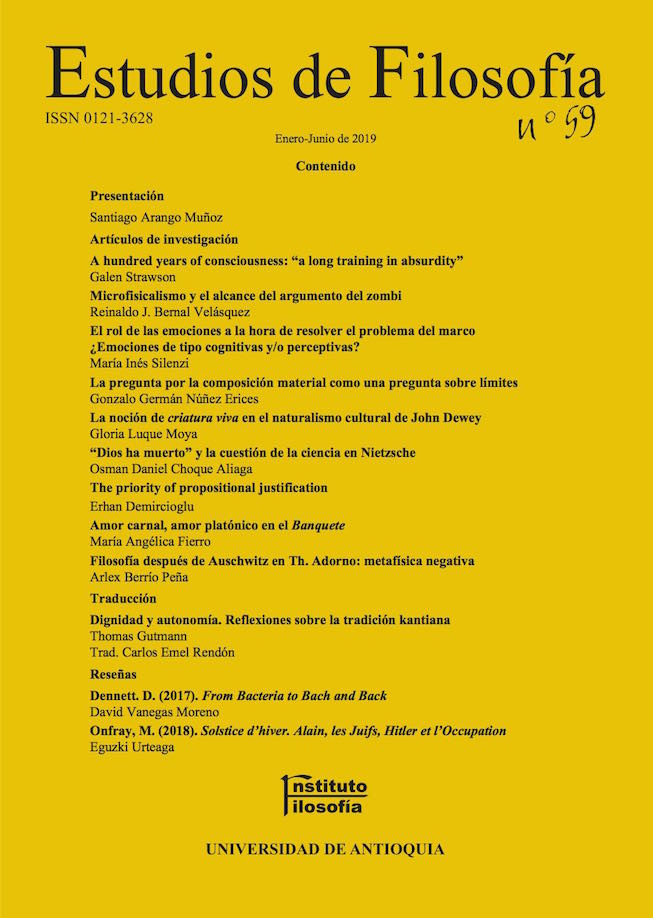
Publicado
Cómo citar
Número
Sección
Categorías
Licencia
Derechos de autor 2019 Galen Strawson

Esta obra está bajo una licencia internacional Creative Commons Atribución-NoComercial-CompartirIgual 4.0.
Los autores que publican en Estudios de Filosofía acuerdan los siguientes términos:
1. El Autor retiene el copyright del "Artículo", por el cual se entiende todos los objetos digitales que pueden resultar de la subsiguiente publicación o distribución electrónica.
2. En conformidad con los términos de este acuerdo, el autor garantizará a Estudios de Filosofía como Editor el derecho de la primera publicación del artículo.
3. El Autor le concederá al Editor un derecho perpetuo y no-exclusivo, así como una licencia de la misma clase, de publicar, archivar y hacer accesible el Artículo parcial o totalmente en todos los medios conocidos o por conocerse, derecho y licencia que se conocen como Creative Commons License Deed. Atribución-No Comercial- Compartir igual CC BY-NC-SA o su equivalente que para efectos de eliminar toda duda, le permite a otros copiar, distribuir, y transmitir el Artículo bajo las siguientes condiciones: (a) Atribución: Se deben reconocer los créditos de la obra de la manera especificada por el Autor a Estudios de Filosofía, pero no de una manera que sugiera que tiene su apoyo o que apoyan el uso que hace de su obra. (b) No Comercial: No se puede utilizar el Artículo para fines comerciales.
4. El Autor puede realizar otros acuerdos contractuales no comerciales para la distribución no exclusiva de la versión publicada del Artículo (v. gr. ponerlo en un repositorio institucional o publicarlo en un libro) con la condición de que haga el debido reconocimiento de su publicación original en Estudios de Filosofía.
5. A los Autores se les permite y Estudios de Filosofía promueve publicar en línea (online) la versión pre-impresa del Artículo en repositorios institucionales o en sus páginas web, antes y durante la publicación, por cuanto que puede producir intercambios académicos productivos, así como una mayor citación del Artículo publicado (ver The Effect of Open Access). Dicha publicación durante el proceso de producción y en la publicación del Artículo se espera que se actualice al momento de salir la versión final, incluyendo una referencia a la URL de Estudios de Filosofía.




