
Clinical characteristics and presence of prolactinoma in women with hyperprolactinemia
DOI:
https://doi.org/10.17533/udea.iatreia.v29n3a04Keywords:
amenorrhea, galactorrhea, hyperprolactinemia, infertility, magnetic resonance imaging, prolactin, prolactinomaAbstract
Objectives: To clinically characterize women with hyperprolactinemia at InSer Pereira (Colombia) and to determine the prevalence of prolactinoma.
Methods: Retrospective description of 45 patients with hyperprolactinemia, and contrasted pituitary magnetic resonance (MR), between January 2008 and July 2013. Clinical manifestations, etiology, serum prolactin level, and MR findings were included.
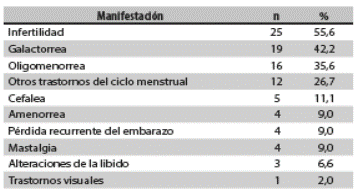
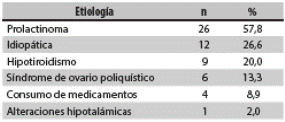
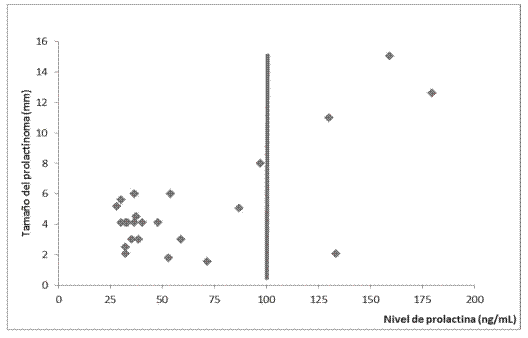
Results: The most frequent clinical manifestations were: infertility, galactorrhea, oligomenorrhea. There were 26 cases of prolactinoma (57.8 %), and 12 of idiopathic hyperprolactinemia (26.6 %). Out of the 26 prolactinomas, 23 were microadenomas (average size 5.1 mm; SD ± 3.2 mm). Average serum prolactin level was 74.05 ng/mL (SD ± 13.33 ng/mL). 78 % of patients with prolactinoma had serum prolactin level under 70.0 ng/mL. No significant association was found between serum prolactin level and the presence of prolactinoma.
Conclusion: Prolactinomas are the main cause of hyperprolactinemia and they are found mostly with slight rise of serum prolactin. Pituitary MRI is recommended in patients with hyperprolactinemia, regardless of their prolactin level.
Downloads
References
(1.) Prabhakar VKB. Hyperprolactinaemia. Best Pract Res Clin Obstet Gynaecol. 2008 Apr;22(2):341-53.
(2.) Mancini T, Casanueva FF, Giustina A. Hyperprolactinemia and prolactinomas. Endocrinol Metab Clin North Am. 2008 Mar;37(1):67-99, viii.
(3.) Chahal J, Schlechte J. Hyperprolactinemia. Pituitary. 2008;11(2):141-6.
(4.) Tworoger SS, Hankinson SE. Prolactin and breast cancer etiology: an epidemiologic perspective. J Mammary Gland Biol Neoplasia. 2008 Mar;13(1):41-53.
(5.) Halperin Rabinovich I, Cámara Gómez R, García Mouriz M, Ollero García-Agulló D; Grupo de Trabajo de Neuroendocrinología de la SEEN. Guía clínica de diagnóstico y tratamiento del prolactinoma y la hiperprolactinemia. Endocrinol Nutr. 2013 Jun-Jul;60(6):308-19.
(6.) Wang AT, Mullan RJ, Lane MA, Hazem A, Prasad C, Gathaiya NW, et al. Treatment of hyperprolactinemia: a systematic review and meta-analysis. Syst Rev. 2012 Jul;1:33.
(7.) Bernabeu I, Casanueva FF. Metabolic syndrome associated with hyperprolactinemia: a new indication for dopamine agonist treatment? Endocrine. 2013 Oct;44(2):273-4.
(8.) Fritz MA, Speroff L. Neuroendocrinology. In: Seigafuse A, editor. Clinical Gynecologic Endocrinology and Infertility. Philadelphia: Lippincott Williams & Wilkins; 2011. p. 157-97.
(9.) Karasek M, Pawlikowski M, Lewiński A. [Hyperprolactinemia: causes, diagnosis, and treatment]. Endokrynol Pol. 2006 Nov-Dec;57(6):656-62. Polish.
(10.) Glezer A, Bronstein MD. Approach to the patient with persistent hyperprolactinemia and negative sellar imaging. J Clin Endocrinol Metab. 2012 Jul;97(7):2211-6.
(11.) Klibanski A. Clinical practice. Prolactinomas. N Engl J Med. 2010 Apr;362(13):1219-26.
(12.) Colao A. The prolactinoma: Review. Res Clin Endocrinol Metab. 2009 Oct;23(5):575-96.
(13.) Lake MG, Krook LS, Cruz SV. Pituitary adenomas: an overview. Am Fam Physician. 2013 Sep;88(5):319-27.
(14.) Kim YM, Choi JH, Lee B, Yoo HW. Clinical course and endocrinological characteristics of prolactinoma in children and adolescents. Int J Pediatr Endocrinol. 2013(Suppl 1):197.
(15.) Zargar AH, Laway BA, Masoodi SR, Bhat MH, Wani AI, Bashir MI, et al. Clinical and etiological profile of hyperprolactinemia-data from a tertiary care centre. J Assoc Physicians India. 2005 Apr;53:288-90.
(16.) Bayrak A, Saadat P, Mor E, Chong L, Paulson RJ, Sokol RZ. Pituitary imaging is indicated for the evaluation of hyperprolactinemia. Fertil Steril. 2005 Jul;84(1):181-5.
(17.) Vilar L, Freitas MC, Naves LA, Casulari LA, Azevedo M, Montenegro R Jr, et al. Diagnosis and management of hyperprolactinemia: results of a Brazilian multicenter study with 1234 patients. J Endocrinol Invest. 2008 May;31(5):436-44.
(18.) Cortet-Rudelli C, Sapin R, Bonneville JF, Brue T. Etiological diagnosis of hyperprolactinemia. Ann Endocrinol (Paris). 2007 Jun;68(2-3):98-105.
(19.) Ormachea Salcedo P, Sánchez Enriquez R, Callisaya Huahuamullo J, Salcedo Ortiz L. Frecuencia de adenoma hipofisiario en relación a la determinación de prolactina, Hospital Obrero Nº 1. Noviembre-Febrero de 2008, Bolivia. BIOFARBO. 2008 Dic;16:61-6.
(20.) Molitch ME. Prolactin in Human Reproduction. In: Strauss J, Barbieri R, editors. Yen & Jaffe’s Reproductive Endocrinology. 6ª ed. Philadelphia: W.B. Saunders; 2009. p. 57-78.
(21.) Souter I, Baltagi LM, Toth TL, Petrozza JC. Prevalence of hyperprolactinemia and abnormal magnetic resonance imaging findings in a population with infertility. Fertil Steril. 2010 Aug;94(3):1159-62.
(22.) Crosignani PG. Current treatment issues in female hyperprolactinaemia. Eur J Obstet Gynecol Reprod Biol. 2006 Apr;125(2):152-64.
(23.) Bussone G, Usai S, Moschiano F. How to investigate and treat: headache and hyperprolactinemia. Curr Pain Headache Rep. 2012 Aug;16(4):365-70.
Published
How to Cite
Issue
Section
License
Copyright (c) 2016 Iatreia

This work is licensed under a Creative Commons Attribution-ShareAlike 4.0 International License.
Papers published in the journal are available for use under the Creative Commons license, specifically Attribution-NonCommercial-ShareAlike 4.0 International.
The papers must be unpublished and sent exclusively to the Journal Iatreia; the author uploading the contribution is required to submit two fully completed formats: article submission and authorship responsibility.