
Plastination technique Antioquia University: an adaptation of the german standard method
DOI:
https://doi.org/10.17533/udea.iatreia.v31n3a01Keywords:
anatomical models, conservation, laboratory, morphology , teachingAbstract
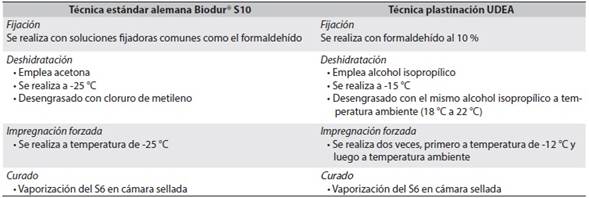
Introduction: Plastination is a preservation method of anatomical components; which consists of replacing the water molecules with a polymer, this is achieved in four stages (fixation, dehydration, forced impregnation and curing), based on this our objective was to adapt the plastination technique known as the German standard technique, to the conditions of the Laboratory of Plastination of the UDEA.
Materials and methods: We adapted the standard German plastination method by replacing the original dehydrating agent, acetone, with isopropyl alcohol; it was necessary to modify the temperature of the forced impregnation step in the standard German technique completely done in cold; requiring in our technique to perform a second impregnation at room temperature.
Results: A total of 343 plastinated pieces were obtained, 150 with the plastination protocol UDEA, with the characteristics described in the standard German method: dry, odorless, natural looking and durable.
Discussion: The plastination technique of the UDEA, although it increases the consumption of polymers, the cost / benefit ratio is still favorable, since it reduces the costs with respect to the application of standard German techniques in our environment. Employing plastinated pieces for teaching have different advantages, in turn it allows to replace the use of the conservation of pieces with base of formaldehyde, avoiding the exposure to the same and their harmful effects for the health; so the use of it has helped to strengthen various academic programs in our faculty.
Downloads
References
(1.) Beltrán Guerra JA. Historia de la preservación de cadáveres humanos. Morfolia. 2009;1(3):5-10.
(2.) Pashaei S. A brief review on the history, methods and applications of platination. Int J Morphol [Internet]. 2010; 28(4):1075-9. Available from: https://pdfs.semanticscholar.org/045e/65129819f365260a3bad87fd769326e8f716.pdf
(3.) von Hagens G. Heidelberg plastination folder: Collection of al technical leaflets for plastination. 2nd ed. Heidelberg: Biodur Products; 1986.
(4.) Bickley HC, von Hagens G, Townsend FM. An improved method for the preservation of teaching specimens. Arch Pathol Lab Med. 1981 Dec;105(12):674-6.
(5.) Latorre R, Vásquez JM, Gil F, Ramirez G, López-Albors O, Orenes M, et al. Teaching anatomy of the distal equine thoracic limb whit plastined slices. J Int Soc Plastination [Internet]. 2001;16:23-30. Available from: http://plastination.org/journal/archive/jp_vol.16/jp_vol.16_23-30.pdf
(6.) von Hagens G. Impregnation of soft biological specimens with thermosetting resins and elastomers. Anat Rec. 1979 Jun; 94(2):247-55. DOI 10.1002/ar.1091940206.
(7.) von Hagens G, Tiedemann K, Kriz W. The current potential of plastination. Anat Embryol (Berl). 1987;175(4):411-21.
(8.) Bickley HC, Conner RS, Walker AN, Jackson RL. Preservation of tissue by silicone rubber impregnation. J Int Soc Plastination 1987;1(1):30-9.
(9.) Sora MC, Cook P. Epoxy plastination of biological tissue: E12 technique. J Int Soc Plastination [Internet]. 2007;22:31-9. Available from: http://journal.plastination.org/archive/jp_vol.22/jp_vol.22_31-39.pdf
(10.) Sora MC. Epoxy plastination of biological tissue: E12 ultra-thin technique. J Int Soc Plastination [Internet]. 2007;22:40-5. Available from: https://www.yumpu.com/en/document/view/5151787/epoxy-plastination-of-biological-tissue-e12-ultra-thin-technique
(11.) Latorre R, Henry RW. Polyester plastination of biological tissue: P40 technique for body slices. J Int Soc Plastination. 2007; 22:69-77.
(12.) Henry RW, Latorre R. Polyester plastination of biological tissue: P40 technique for brain slices. J Int Soc Plastination [Internet]. 2007; 22:59-68. Available from: http://journal.plastination.org/archive/jp_vol.22/jp_vol.22_59-68.pdf
(13.) Weber WA, Weiglein A, Latorre R, Henry RW. Polyester plastination of biological tissue: P35 technique. J Int Soc Plastination. 2007;22:50-8.
(14.) Dejong K, Henry RW. Silicone plastination of biological tissue: Cold-temperature technique biodurtm s10/s15 technique and products. J Int Soc Plastination. 2007;22:2-14.
(15.) Raoof A, Henry RW, Reed RB. Silicone plastination of bilogical tissue: room-temperature technique dowtm/corcoran technique and products. J Int Soc Plastination [Internet]. 2007;22:21-5. Available from: http://journal.plastination.org/archive/jp_vol.22/jp_vol.22_21-25.pdf
(16.) Henry RW. Silicone plastination of biological tissue: Cold-temperature technique- North Carolina technique and products. J Int Soc Plastination. 2007;22:26-30.
(17.) Robert H, Larry J, Carol H. Specimen preparation for silicone plastination. J Int Soc Plastination [Internet]. 1997;12(1):13-7. Available from: http://plastination.org/journal/archive/jp_vol.12.1/jp_vol.12.1_13-17.pdf
(18.) Baker EW, Slott PA, Terracio L, Cunningham EP. An innovative method for teaching anatomy in the predoctoral dental curriculum. J Dent Educ. 2013 Nov;77(11):1498-507.
(19.) Pandit S, Kumar S, Mishra BK. Comparative study of anatomical specimens using plastination by araldite HY103, polypropylene resin, 6170H19 Orthocryl and silicone - A qualitative study. Med J Armed Forces India. 2015 Jul;71(3):246-53. DOI 10.1016/j.mjafi.2015.04.014.
(20.) Ottone NE, Cirigliano V, Bianchi HF, Medan CD, Algieri RD, Borges Brum G, et al. New contributions to the development of a plastination technique at room temperature with silicone. Anat Sci Int. 2015 Mar;90(2):126-35. DOI 10.1007/s12565-014-0258-6.
(21.) Miranda F. La plastinación como método de conservación de tejidos biológicos para docencia e investigación en la anatomía humana. Rev Peru Med Exp Salud Publica [Internet]. 2015;32(4):817-24. Disponible en: http://www.scielo.org.pe/pdf/rins/v32n4/a30v32n4.pdf
(22.) Arredondo J, López-Albors O, Recillas S, Victoria M, Castelán O, González-Ronquillo M, et al. Modelo virtual tridimensional de la articulación cubital del perro a partir de cortes plastinados ultradelgados. Int J Morphol [Internet]. 2016;34 (4):1253-8. Disponible en: http://www.scielo.cl/pdf/ijmorphol/v34n4/art13.pdf
(23.) McRae KE, Davies GA, Easteal RA, Smith GN. Creation of plastinated placentas as a novel teaching resource for medical education in obstetrics and gynaecology. Placenta. 2015 Jul; 36(9):1045-51. DOI 10.1016/j.placenta.2015.06.018.
(24.) Zheng TZ, You X, Cai L, Liu J. The history of plastination in china. J Int Soc Plastination [Internet]. 2000;15(1):25-9. Disponible en: http://journal.plastination.org/archive/jp_vol.15/jp_vol.15_25-29.pdf
(25.) Jiménez Mejia R, Isaza Castro O. Plastinación, una técnica moderna al servicio de la anatomía. Iatreia [Internet]. 2005;18(1):99-106. Disponible en: https://aprendeenlinea.udea.edu.co/revistas/index.php/iatreia/article/view/4134/3797
(26.) Colombia. Congreso de Colombia. Ley 919 de 2004 por medio de la cual se prohíbe la comercialización de componentes anatómicos humanos para trasplante y se tipifica como delito su tráfico. Diario Oficial, 45771 (Dic. 23 2004).
(27.) Colombia. Ministro de la Protección Social. Decreto 2493 de 2004 por el cual se reglamentan parcialmente las Leyes 9ª de 1979 y 73 de 1988, en relación con los componentes anatómicos. Diario Oficial, 45631 (Ago. 05 2004).
(28.) Colombia. Ministerio de la Protección Social. Resolución 002640 de 2005 por medio de la cual se reglamentan los artículos 3º, 4º, 6º parágrafo 2º, 7º numeral 10, 25 y 46 del Decreto 2493 de 2004 y se dictan otras disposiciones. Diario Oficial, 46007 (Ago. 21 2005).
(29.) Colombia. Ministerio de Protección Social. Resolución 0042 de 2008, por la cual se modifica el artículo 20 de la Resolución 2640 de 2005. Diario Oficial, 46894 (Feb. 06 2008).
(30.) Pabst R. Exposure to formaldehyde in anatomy: an occupational health hazard? Anat Rec. 1987 Oct;219(2):109-12.
(31.) Viegas S, Ladeira C, Nunes C, Malta-Vacas J, Gomes M, Brito M, et al. Genotoxic effects in occupational exposure to formaldehyde: A study in anatomy and pathology laboratories and formaldehyde-resins production. J Occup Med Toxicol. 2010 Aug;5(1):25. DOI 10.1186/1745-6673-5-25.
(32.) Alcaldía de Medellín [Internet]. Alcaldía: Medellín; 2017 [consultado 2017 agosto 1]. Disponible en: https://www.medellin.gov.co/irj/portal/medellin?navigationtarget=navurl://6488ef50a6787e1fdbc4e42e62a46a67
(33.) Hopwood D. Fixatives and fixation: a review. Histochem J. 1969 May;1(4):323-60.
(34.) Brenner E. Human body preservation - old and new techniques. J Anat. 2014 Mar;224(3):316-44. DOI 10.1111/joa.12160.
(35.) Colombia. Consejo Nacional de Estupefacientes. Resolución 0001 de 2015, por la cual se unifica y actualiza la normatividad sobre el control de sustancia y productos químicos. Bogotá: Consejo Nacional de Estupefacientes; 08 enero de 2015.
(36.) Brown MA, Reed RB, Henry RW. Effects of dehydration mediums and temperature on total dehydration time and tissue shrinkage. J Int Soc Plastination [Internet]. 2002;17:28-33. Available from: http://www.plastination.org/journal/archive/jp_vol.17/jp_vol.17_28-33.pdf
(37.) Chang R. Fuerzas intermoleculares y líquidos y sólidos. En: Química. 10a ed. México D.F: Mc Graw Hill; 2010. p. 460-511.
(38.) Ruthig VA, Labrash S, Lozanoff S, Ward MA. Macroscopic demonstration of the male urogenital system with evidence of a direct inguinal hernia utilizing room temperature plastination. Anatomy. 2016 Dec;10(3):211-20. DOI 10.2399/ana.16.036.
(39.) Riederer BM. Plastination and its importance in teaching anatomy. Critical points for long-term preservation of human tissue. J Anat. 2014 Mar;224(3):309-15. DOI 10.1111/joa.12056.
(40.) Ottone NE, Cirigliano V, Lewicki M, Bianchi HF, Aja-Guardiola S, Algieri RB, et al. Plastination Technique in Laboratory Rats: an Alternative Resource for Teaching, Surgical Training and Research Development. Int J Morphol. 2014;32(4):1430-5. Available from: http://www.scielo.cl/pdf/ijmorphol/v32n4/art48.pdf
(41.) Aronson JK. Formaldehyde. In: Lisa Tickner. Meyler’s side effects of drugs. 6th ed. Amsterdam: Elsevier; 2016. p. 437-43.
Published
How to Cite
Issue
Section
License
Copyright (c) 2018 Iatreia

This work is licensed under a Creative Commons Attribution-ShareAlike 4.0 International License.
Papers published in the journal are available for use under the Creative Commons license, specifically Attribution-NonCommercial-ShareAlike 4.0 International.
The papers must be unpublished and sent exclusively to the Journal Iatreia; the author uploading the contribution is required to submit two fully completed formats: article submission and authorship responsibility.