

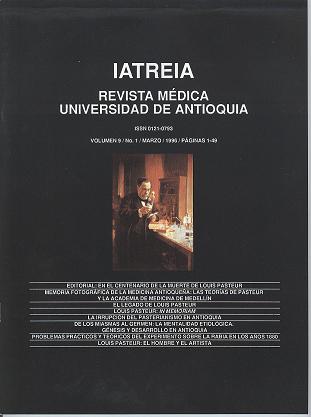
Irruption of pasterian theories in Antioquia, Colombia
DOI:
https://doi.org/10.17533/udea.iatreia.3600Keywords:
Pasterian, Urban Medicine, Public health, MiasmsAbstract
Medicine in Antioquia, Colombia, during the XIX century arose as the official proposal for an urban scheme, based on the french model of that century and the previous one. Such scheme promoted an authoritarian medical intervention on every aspect of the city organization. At the end of the XIX century there appeared In Medellín sanitary policies administered by an official centralist institution in which doctors played an Important role. Several prominent physicians, trained in France or inspired on french medicine (either pasterian or prepasterian), promoted hygiene concepts based on a mixture of theories to explain the cause of endemic and epidemic diseases. During the last decade of the century Pasteur's theories were fully accepted in this city and, consequently, the newly born science of bacteriology was a protagonist of both medical practice and urban organization.
Downloads
Downloads
Published
How to Cite
Issue
Section
License
Papers published in the journal are available for use under the Creative Commons license, specifically Attribution-NonCommercial-ShareAlike 4.0 International.
The papers must be unpublished and sent exclusively to the Journal Iatreia; the author uploading the contribution is required to submit two fully completed formats: article submission and authorship responsibility.




