

Reduction of amine and biological antioxidants on NOx emissions powered by mango seed biodiesel
DOI:
https://doi.org/10.17533/udea.redin.n84a06Keywords:
biodiesel, NOx reduction, DPPD, mango seed oil, prompt NOAbstract
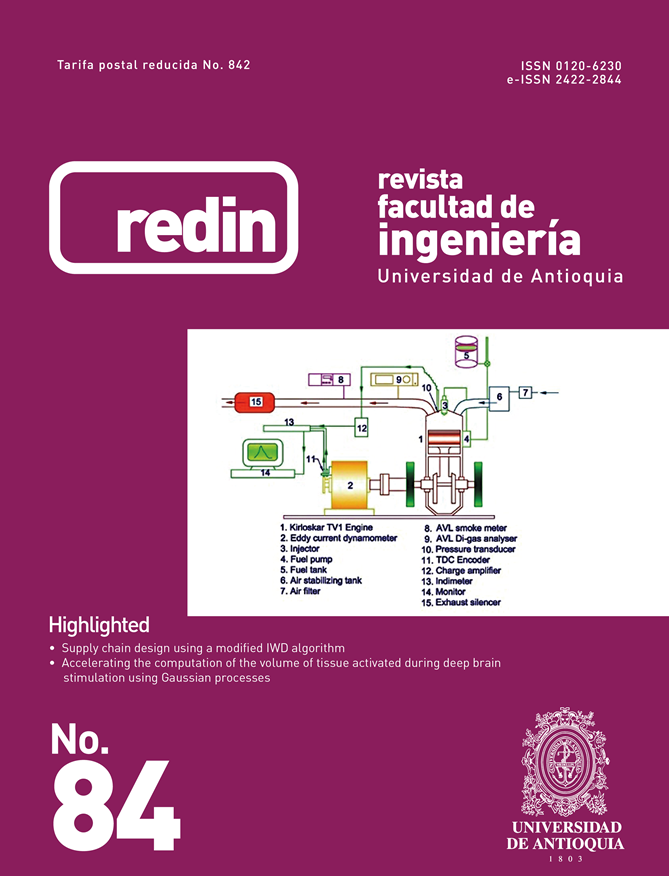
This study scrutinizes the influence of amine and biological antioxidants on reduction of NOx emissions in a diesel engine fueled with B100 (100vol.% mango seed methyl ester) and B20 (20 vol.% mango seed methyl ester and 80 vol.% diesel fuel blend). Three amine antioxidants, p-phenylenediamine (PPD), Ethylendiamine (EDA) and N,N’-diphenyl- 1,4-phenylenediamine (DPPD) and three biological antioxidants, dichloromethane (DCM), alpha tocopherol acetate (α-T) and L-ascorbic acid (L-asc.acid) are tested in a kirloskar-make single cylinder four-stroke water cooled diesel engine of 5.9 KW rated power. There are five concentrations used in the antioxidant mixture of biodiesel blends. i.e., 0.005%-m, 0.010%-m, 0.025%-m, 0.05%-m and 0.1%-m. Where, %-m is the molar concentration employed in the antioxidant mixture. Results show that consequential reduction in NOx could be acquired by the accession of antioxidant additive DPPD with the 0.025% concentration from B20 fuel by 15.4% and B100 fuel by 39%. The DPPD additive increased the CO emissions over 7.42% for B100 fuel and 6.44% for B20 fuel. The biological antioxidant DCM exhibits 0.235 g/kWhr for B100 fuel and 0.297 g/kWhr for B20 fuel. Smoke emission is found to have increased with the addition of antioxidants. Slight increase in brake thermal efficiency (0.91%) is accomplished with the addition of antioxidants at full load. The experimental results are compared with analysis of variance and the result is merely the same as to that of experimentation.
Downloads
References
S. Garner, R. Sivaramakrishnan, and K. Brezinsky, “The high-pressure pyrolysis of saturated and unsaturated C7hydrocarbons,” Proc. Combust. Inst., vol. 32, no. 1, pp. 461-467, 2009.
S. M. Palash et al., “Impacts of biodiesel combustion on NOx emissions and their reduction approaches,” Renewable and Sustainable Energy Reviews, vol. 23, pp. 473-490, 2013.
S. Fernando, C. Hall, and S. Jha, “NOx reduction from biodiesel fuels,” Energy Fuels, vol. 20, no. 1, pp. 376- 382, 2006.
C. J. Mueller, A. L. Boehman, and G. C. Martin, “An experimental investigation of the origin of increased NOx emissions when fueling a heavy-duty compression-ignition engine with soy biodiesel,” SAE International Journal of Fuels and Lubricants, vol. 2, no. 1, pp. 789- 816, 2009.
E. İleri and G. Koçar, “Experimental investigation of the effect of fuel injection advance on engine performance and exhaust emission parameters using canola oil methyl ester in a turbocharged direct-injection diesel engine,” Energy Fuels, vol. 23, no. 10, pp. 5191-5198, 2009.
R. L. McCormick, J. R. Alvarez, and M. S. Graboski, “NOx solutions for biodiesel,” National Renewable Energy Laboratory, Golden, USA, Final Rep. NREL/SR- 510-31465, Feb. 2003.
S. Gan and H. K. Ng, “Effects of antioxidant additives on pollutant formation from the combustion of palm oil methyl ester blends with diesel in a non-pressurised burner,” Energy Conversion and Management, vol. 51, no. 7, pp. 1536-1546, 2010.
K. Varatharajan, M. Cheralathan, and R. Velraj, “Mitigation of NOx emissions from a jatropha biodiesel fuelled DI diesel engine using antioxidant additives,” Fuel, vol. 90, no. 8, pp. 2721-2725, 2011.
H. Sies, “Oxidative stress: oxidants and antioxidants,” Experimental Physiology, vol. 82, no. 2, pp. 291-295, 1997.
D. Chaithongdee, J. Chutmanop, and P. Srinophakun, “Effect of antioxidants and additives on the oxidation stability of jatropha biodiesel,” Kasetsart J (Nat. Sci.), vol. 44, pp. 243-250, 2010.
M. Rios, S. N. Santiago, A. Sanders, and S. E. Mazzetto, “Antioxidative Activity of 5-n-Pentadecyl-2-tert-butylphenol Stabilizers in Mineral Lubricant Oil,” Energy Fuels, vol. 24, no. 5, pp. 3285-3291, 2010.
E. İleri and G. Koçar, “Effects of antioxidant additives on engine performance and exhaust emissions of a diesel engine fueled with canola oil methyl ester-diesel blend,” Energy Conversion and Management, vol. 76, pp. 145-154, 2013.
H. Tang et al., “Quality survey of biodiesel blends sold at retail stations,” Fuel, vol. 87, no. 13-14, pp. 2951- 2955, 2008.
E. İleri, A. D. Karaoglan, and A. Atmanli, “Response surface methodology based prediction of engine performance and exhaust emissions of a diesel engine fuelled with canola oil methyl ester,” J. Renew. Sust. Energy, vol. 5, no. 3, 2013.
K. Varatharajan and M. Cheralathan, “Effect of aromatic amine antioxidants on NOx emissions from a soybean biodiesel powered DI diesel engine,” Fuel Processing Technology, vol. 106, pp. 526-532, 2013.
R. Dunn, “Effect of antioxidants on the oxidative stability of methyl soyate (biodiesel),” Fuel Processing Technology, vol. 86, no. 10, pp. 1071-1085, 2005.
C. Fenimore, “Formation of nitric oxide in premixed hydrocarbon flames,” Symposium (International) on Combustion, vol. 13, no. 1, pp. 373-380, 1971.
K. Ryu, “The characteristics of performance and exhaust emissions of a diesel engine using a biodiesel with antioxidants,” Bioresource Technology, vol. 101, no. 1, pp. 78-82, 2010.
C. Y. Lin and H. A. Lin, “Effects of NOx –inhibitor agent on fuel properties of three-phase biodiesel emulsions,” Fuel Processing Technology, vol. 89, no. 11, pp. 1237- 1242, 2008.
K. Velmurugan and A. P. Sathiyagnanam, “Impact of antioxidants on NOx emissions from a mango seed biodiesel powered DI diesel engine,” Alexandria Engineering Journal, vol. 55, no. 1, pp. 715-722, 2016.
Downloads
Published
How to Cite
Issue
Section
License
Copyright (c) 2017 Revista Facultad de Ingeniería Universidad de Antioquia

This work is licensed under a Creative Commons Attribution-NonCommercial-ShareAlike 4.0 International License.
Revista Facultad de Ingeniería, Universidad de Antioquia is licensed under the Creative Commons Attribution BY-NC-SA 4.0 license. https://creativecommons.org/licenses/by-nc-sa/4.0/deed.en
You are free to:
Share — copy and redistribute the material in any medium or format
Adapt — remix, transform, and build upon the material
Under the following terms:
Attribution — You must give appropriate credit, provide a link to the license, and indicate if changes were made. You may do so in any reasonable manner, but not in any way that suggests the licensor endorses you or your use.
NonCommercial — You may not use the material for commercial purposes.
ShareAlike — If you remix, transform, or build upon the material, you must distribute your contributions under the same license as the original.
The material published in the journal can be distributed, copied and exhibited by third parties if the respective credits are given to the journal. No commercial benefit can be obtained and derivative works must be under the same license terms as the original work.




 Twitter