

Semi-automatic construction of video game design prototypes with MaruGen
DOI:
https://doi.org/10.17533/udea.redin.20200369Keywords:
video game design, videogames, automatic game design, game prototyping, procedural content generationAbstract
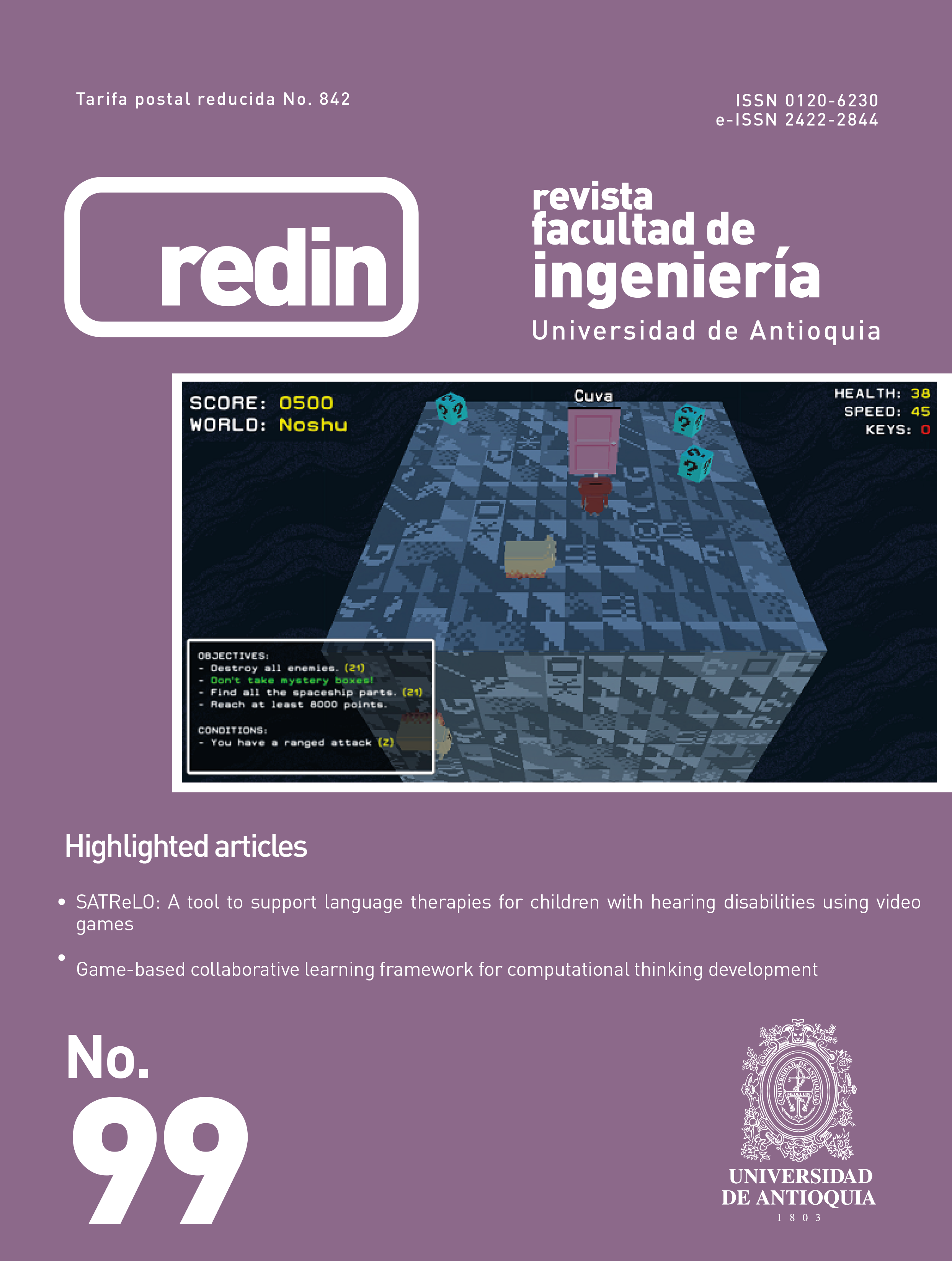
Machinations Ruleset Generator (MaruGen) is a semi-automatic system for the generation of mechanics, rules, spaces (environments), and missions for video games. The objective of this system is to offer an expression mechanism for the video game designer role based on the definition of rules, and the ability to explore the concepts of progression and emergence in video games by using a formal, usable, and defined tool to design games with innovative and complex elements, and behaviors defined from combinations of basic elements. Based on the expressed designs and with the participation of programmers and video game artists, MaruGen allows the generation of agile video game prototypes in the Unity game engine. These prototypes can be analyzed by the entire workgroup to look for games with diverse complexities that make them attractive to their users. MaruGen is based on the expression of rules on elements of interest in video games and the rewriting mechanism using L-Systems for the generation of procedural content. MaruGen was evaluated in the construction of the Cubic Explorer video game and tested by gamers and video game developers during the Game Jam Ludum Dare 38.
Downloads
References
A. Järvinen, “Games without frontiers: Theories and methods for game studies and design,” Ph. D. dissertation, University of Tampere, Tampere, Finland, 2006.
C.Crawford.(1984)TheArtofComputerGameDesign.[McGraw-Hill Osborne Media]. [Online]. Available: https://bit.ly/2T1Y9gW
T. Fullerton, C. Swain, and S. Hoffman. (2008) Game design workshop – A playcentric approach to creating innovative games. [Elsevier & Morgan Kaufmann Publishers]. [Online]. Available: https://bit.ly/2T24hpt
J. Schell. (2008) The art of game design – A book of lenses. [Elsevier & Morgan Kaufmann Publishers]. [Online]. Available: https://bit.ly/3c6OInQ
G. Costikyan, “I have no words & i must design: Toward a critical vocabulary for games,” in Computer Games and Digital Cultures Conference Proceedings , Tampere, Finland, 2002, pp. 9–33.
R. Hunicke and M. LeBlanc and R. Zubek, “MDA: A formal approach togamedesignandgameresearch,”in ProceedingsoftheChallenges in Games AI Workshop, Nineteenth National Conference of Artificial Intelligence , Menlo Park, USA, 2004, pp. 1–5.
R. Koster, A Theory of Fun for Game Design , 1st ed. O’Reilly Media, 2004.
D. Church. (1999, Jul. 16) Formal abstract design tools. [Gamasutra The Art & Business of Making Games]. Accessed Sep. 28, 2019. [Online]. Available: https://bit.ly/32vegGM
R. Koster. (2005) Game design atoms: Can game designs be diagrammed? [GDC Vault]. Accessed Sep. 28, 2019. [Online]. Available: https://bit.ly/2HXjsdg
R.Koster. (2012) Atheoryoffun10yearslater.[GDCVault].Accessed Sep. 28, 2019. [Online]. Available: https://bit.ly/2wcYqVa
D. Cook. (2012, Apr. 30) Loops and arcs. [Lostgarden]. Accessed Sep. 28, 2019. [Online]. Available: https://bit.ly/2PvSaii
A.AnthropyandN.Clark,Eds., AGameDesignVocabulary ,ser.Game Design/Usability. Addison Wesley, 2014.
N. Falstein and H. Barwood. (2001) The 400 project. [Finite Arts]. Accessed Sep. 28, 2019. [Online]. Available: https://bit.ly/2VurulM
S. Björk and J. Holopainen, Ed., Patterns in Game Design , ser. Game Development Series. Charles River Media, 2004.
J. Dormans, “Engineering emergence: Applied theory for game design,” Ph. D. dissertation, University of Amsterdam, Amsterdam, Netherlands, 2012.
K. Burgun, Clockwork Game Design , 1st ed. CRC Press Taylor & Francis Group, 2015.
D. Cook. (2007) The chemistry of game design. [Gamasutra The Art & Business of Making Games]. Accessed Sep. 28, 2019. [Online]. Available: https://bit.ly/2T84hV7
J. Dormans. (2017) Unexplored. [Ludomotion]. Accessed Feb. 28, 2020. [Online]. Available: https://bit.ly/32I8aDj
P. Prusinkiewicz and A. Lindenmayer. (1990) The algorithmic beauty of plants. [Springer-Verlag]. [Online]. Available: https: //bit.ly/2wSRuNu
SideFX. (2013) Houdini engine. [SideFX]. Accessed Oct. 8, 2019. [Online]. Available: https://bit.ly/2we8SM5
SpeedTree. (2002) SpeedTree – 3D Vegetation modeling and middleware. [Interactive Data Visualization, Inc.]. Accessed Oct. 8, 2019. [Online]. Available: https://bit.ly/2Tp4XnA
L. Lapré. About Lsystems and Lparser. [laurenslapre]. Accessed Oct. 8, 2019. [Online]. Available: https://bit.ly/3974SMb
I. F. Capasso. (2017) Ludum Dare 38 Cubic Explorer. [Ldjam]. Accessed Oct. 8, 2019. [Online]. Available: https://bit.ly/2TijJN4
Published
How to Cite
Issue
Section
License
Copyright (c) 2021 Revista Facultad de Ingeniería Universidad de Antioquia

This work is licensed under a Creative Commons Attribution-NonCommercial-ShareAlike 4.0 International License.
Revista Facultad de Ingeniería, Universidad de Antioquia is licensed under the Creative Commons Attribution BY-NC-SA 4.0 license. https://creativecommons.org/licenses/by-nc-sa/4.0/deed.en
You are free to:
Share — copy and redistribute the material in any medium or format
Adapt — remix, transform, and build upon the material
Under the following terms:
Attribution — You must give appropriate credit, provide a link to the license, and indicate if changes were made. You may do so in any reasonable manner, but not in any way that suggests the licensor endorses you or your use.
NonCommercial — You may not use the material for commercial purposes.
ShareAlike — If you remix, transform, or build upon the material, you must distribute your contributions under the same license as the original.
The material published in the journal can be distributed, copied and exhibited by third parties if the respective credits are given to the journal. No commercial benefit can be obtained and derivative works must be under the same license terms as the original work.




 Twitter