

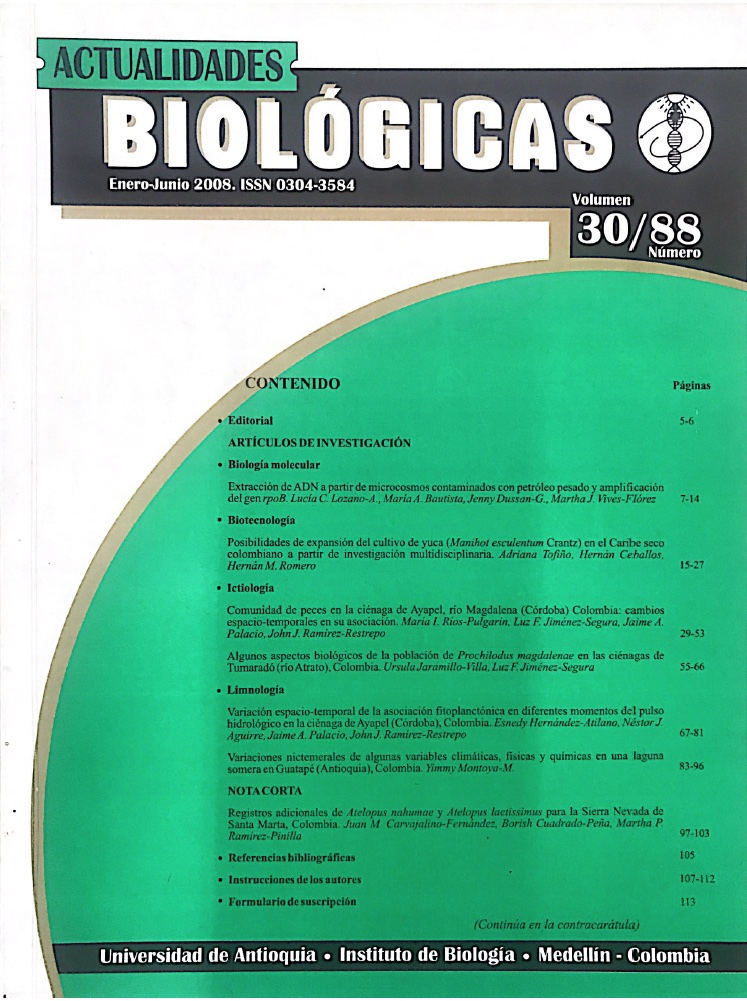
Spatial and temporal variation of the phytoplankton assemblage in different moments of hydrological flood in the Ayapel swamp (Córdoba), Colombia
DOI:
https://doi.org/10.17533/udea.acbi.329332Keywords:
phytoplankton, hydrological pulse, Ayapel swamp, ColombiaAbstract
This investigation analyzed the variation of the phytoplanktonic assemblage in the main water body of the swamp system of Ayapel (Córdoba), Colombia in different periods from the hydrological pulse. The results in six field periods between September 2004 and June 2005 and in five sampling stations showed that the structure and dynamics of the assemblage and physical and chemical variables vary in relation to the hydrological pulse. In general terms 37 taxa were registered, being Cylindrospermopsis raciborskii and Lyngbya cf. limnetica the most important taxa. The variations in the structure of the assemblage, presented greater in the dry periods and in the transition to rain period.
Downloads
References
Aguirre NJ, Palacio JA, Flórez MT, Wills A, Caicedo O,Jiménez LF, Villegas NE, Palacio CA, Toro M, VélezJI. 2005. Informe final del proyecto COLCIENCIAS:Análisis de la relación río-ciénaga y su efecto so-bre la producción pesquera en el sistema cenagosode Ayapel, Colombia. Grupo de Investigación enGestión y Modelación Ambiental GAIA, Facultad deIngeniería, Universidad de Antioquia. Medellín, Co-lombia.
Bartram J, Ballance R. 1996. Water quality monitoring: apractical guide to the design and implementationof freshwater quality studies and monitoringprogrammes. UNEP, WHO. Londres, Inglaterra.
Bourrelly P. 1966. Les algues d’eau douce. Initiation à lasystématique. Tome I: Les Algues Vertes. N. Boubéey Cie. París, Francia.
Bourrelly P. 1968. Les algues d’eau douce. Initiation à lasystématique. Tome II: Les Algues jaunes et brunes.Chrysophycées, Phéophycées, Xanthophycées etDiatomées. N. Boubée y Cie. París, Francia.
Bourrelly P. 1985. Les algues d’eau douce. Initiation à lasystématique. TomeIII: Les Algues bleues et rouges.Les Euglénoides, Peridinies et Cryptomonadines.N. Boubée y Cie. París, Francia.
Bouvy M, Pagano M, Troussellier M. 2001. Effects of aCyanobacterial bloom (Cylindrospermopsisraciborskii)on bacteria and zooplanktoncommunities in Ingazeira reservoir (northeast Brazil).Aquatic Microbial Ecology, 25:215-227.
Bouvy M, Falcão D, Marinho M, Pagano M, Moura A. 2000.Occurrence of Cylindrospermopsis (Cyanobacteria)Hernández-Atilano et al.Actual Biol 30 (88): 67-81, 2008in 39 Brazilian tropical reservoirs during the 1998drought. Aquatic Microbial Ecology, 23:13-27.
Chapman D. 1996. Water quality assessments: a guide tothe use of biota, sediments and water inenvironmental monitoring. Second edition.UNESCO, WHO, UNEP. Londres, Inglaterra.
Desikachary TV. 1959. Cyanophyta. Indian Council ofAgricultural Research New Delhi, Department ofBotany, University of Madras. India.
Ecoestudios y CVS. 1989. Estudio del manejo integral dela Ciénaga Ayapel. Montería (Córdoba), Colombia.
Esteves F. 1998. Fundamentos de limnología.Segundaedición. Interciencia. Río de Janeiro, Brasil.
O’Farrell I, Tell G, Podlejski A. 2001. Morphologicalvariability of Aulacoseira granulata (Ehr.) Simonsen(Bacillariophyceae) in the Lower Paraná River (Ar-gentina). Limnology, 2(2):65-71.
Gopal B. 1994. The role of ecotones (transiton zones) inthe conservation and management of tropical inlandwaters. Mitteilungen Internationale Vereinigung fürLimnologie, 24:17-25.
Hillebrand H, Dürselen CD, Kirschtel D, Tamar UP.1999. Biovolume calculation for pelagic andbenthic microalgae.Journal of Phycology,35:403-424.
Huber-Pestalozzi G. 1938. Das Phytoplankton desSüßwassers. Sistematik und Biologie. AllgemeinerTeil: Blaualgen, Bakterien, Pilze. Band XVI, Teil 1,Hälfte 1. En: Thienemann A, Elster HJ, Ohle W(eds.). Die Binnengewässer. Schweizerbart.Stuttgart, Alemania.
Huber-Pestalozzi G. 1955. Das Phytoplankton desSüßwassers. Sistematik und Biologie.Euglenophyceen. Band XVI, Teil 4. En: ThienemannA, Elster HJ, Ohle W (eds.). Die Binnengewässer.Schweizerbart. Stuttgart, Alemania.
Huber-Pestalozzi G. 1961. Das Phytoplankton desSüßwassers. Sistematik und Biologie. Chlorophyceae(Grünalgen). Ordnung: Volvocales. Band XVI, Teil 5.En: Thienemann A, Elster HJ, Ohle W (eds.). DieBinnengewässer. Schweizerbart. Stuttgart, Alemania.Huber-Pestalozzi G. 1976. Das Phytoplankton desSüßwassers. Sistematik und Biologie.Chrysophyceen. Farblose Flagellaten. Heterokonten.Band XVI, Teil 2, Hälfte 1. En: Thienemann A, ElsterHJ, Ohle W (eds.). Die Binnengewässer.Schweizerbart. Stuttgart, Alemania.
Huber-Pestalozzi G. 1983. Das Phytoplankton desSüßwassers. Sistematik und Biologie. Chlorophyceae(Grünalgen) Ordnung: Chlorococcales. Band XVI,Teil 7, Hälfte 1. En: Thienemann A, Elster HJ, Ohle W(eds.). Die Binnengewässer. Schweizerbart. Stuttgart,Alemania.
Huszar VLM, Da Silva LH. 1999. A estructura dacomunidade fitoplanctônica no Brasil: cinco déca-das de estudos. En: Sociedade Brasileira deLimnologia (ed.). LIMNOtemas. Río de Janeiro, Bra-sil.
Huszar VLM. 2003. Memorias del curso de ecología delfitoplancton continental. Universidad Nacional deColombia. Bogotá, Colombia.
IGAC. 1986. Estudio general de suelos de los municipiosde Ayapel, Buenavista, Planeta Rica y Pueblo Nue-vo (Departamento de Córdoba). Instituto Geográfi-co Agustín Codazzi, Subdirección Agrológica. Bo-gotá, Colombia.Junk WJ, Bayley PB, Sparks RE. 1989. The “flood pul-se” concept in river floodplain systems. CanadianSpecial Publication of Fisheries and AquaticSciences, 106:110-127.
Lagos N, Onodera H, Zagatto PA, Andrinolo D, AzevedoSM, Oshima Y. 1999. The first evidence of paralyticshellfish toxins in the freshwater cyanobacteriumCylindrospermopsis raciborskii, isolated from Brazil.Toxicon, 37:1359-1373.
Margalef, R. 1983. Limnología. Omega S. A. Barcelona,España.
Mitsch W, Gosselink JG. 1993. Wetlands. Van NostrandReinhold. Nueva York, Estados Unidos.
Mur RL, Skulberg OM, Utkilen H. 1999. Cyanobacteriain the Environment. En: Chorus I and Bartram J(eds.).Toxic Cyanobacteria in water: A guide to theirpublic health consequences. St. Edmundsbury Press,Bury St Edmunds, Suffolk. Londres, Inglaterra.
Nascimento SM, Molica RJ, Bouvy M, Ferreira A, SilvaLH, Huszar V, Azevedo S. 2000. Toxic cyanobacterialblooms in the Tapacurá reservoir, Northeast Brazil.9th International Conference on Harmful AlgalBlooms, 7-11 February 2000. Hobart, Tasmania.
Neiff JJ. 1999. El régimen de pulsos en ríos y grandeshumedales de Sudamérica. Pág. 99 En: Málvarez AI(ed.). Tópicos sobre humedales subtropicales y tem-plados de Sudamérica. Impreso por la Oficina Re-gional de Ciencia y Tecnología de la UNESCO paraAmérica Latina y el Caribe –ORCYT. Montevideo,Uruguay.
Ohtani I, Moore R, Runnegar MTC. 1992.Cylindrospermopsin: a potent hepatotoxin from theblue-green alga Cylindrospermopsis raciborskii.Journal of the American Chemical Society, 114:7941-7942.
Ortega E, Rojo C. 2000. Fitoplancton del Parque NacionalLas Tablas de Daimiel. II. Diatomeas y clorofitas.Anales del Jardín Botánico de Madrid, 58(1):17-37.
Padisák J. 1997. Cylindrospermopsis raciborskii(Woloszynska) Seenayya et Subba Raju, anexpanding, hightly adaptive cyanobacterium:worldwide distribution and review of its ecology.Archiv für Hydrobiologie, Supplement, 4:563-593.
Pielou EC. 1969. Shannons formula as a measure of specificdiversity-its use and disuse. American Naturalist,100:463-465.
Prescott GW, Bicudo CE, Vinyard WC. 1982.Desmidiaceae: Placodermae. Part II. Section 4. En:Prescott GW, Bicudo CE, Vinyard WC. A Synopsis ofNorth American Desmids. University of NebraskaPress, Lincoln and London.
Ramírez A, Viña G. 1998. Limnología colombiana: apor-tes a su conocimiento y estadísticas de análisis. Pri-mera edición. Editorial Panamericana. Bogotá, Co-lombia.
Ramírez JJ. 2000. Fitoplancton de agua dulce: aspectosecológicos, taxonómicos y sanitarios. Editorial Uni-versidad de Antioquia. Medellín, Colombia.
Reynolds CS. 1998. What factors influence the speciescomposition of phytoplankton in lakes of differenttrophic status? Hydrobiologia, 369:11-26.Reynolds CS, Huszar V, Kruk C, Flores LN, Melo S. 2002.Towards a functional classification of the freshwaterphytoplankton. Journal of Plankton Research,24(5):417-428.
Ros J. 1979. Prácticas de ecología. Ediciones Omega S.A. Barcelona, España.
Shannon CE, Weaver W. 1949.The Mathematical Theoryof Communication. University of Illinois Press. Ur-bana, Estados Unidos.
Simpson EH. 1949. Measurement of diversity. Nature,163:688.
Sioli H. 1984. The Amazon and its main affluents:Hydrography, morphology, of the river courses,and river types. Pp. 127-165. En: Sioli H (ed.). TheAmazon: limnology and lanscape of a mighty tro-pical river and its basin. Dr. W. Junk. Dordrecht,Holanda.
Strebel H, Krauter D. 1988. Das Leben im Wassertropfen.Mikroflora und Mikrofauna des Süßwassers.Franckh-Kosmos Naturführer. Stuttgart, Alemania
Tell G, O’Farrell I , Lombardo G. 2005. Euglenoidmorphospecies replacement along a hydraulicgradient of the Lower Paraná Basin (Argentina).Freshwater Biology, 50:616.
Zapata JF. 2005. Dinámica hidrológica en la ciénaga deAyapel, modelación del balance hídrico y simulaciónhidrodinámica. Tesis de maestría. Maestría en Re-cursos Hidráulicos. Universidad Nacional de Colom-bia, Medellín, Colombia.
Downloads
Published
How to Cite
Issue
Section
License
Copyright (c) 2017 Actualidades Biológicas

This work is licensed under a Creative Commons Attribution-NonCommercial-ShareAlike 4.0 International License.
The authors exclusively authorize the Actualidades Biológicas journal to edit and publish the submitted manuscript if its publication is recommended and accepted, without this representing any cost to the Journal or the University of Antioquia.
All the ideas and opinions contained in the articles are sole responsibility of the authors. The total content of the issues or supplements of the journal is protected under the Creative Commons Attribution-NonCommercial-ShareAlike 4.0 International License, so they cannot be used for commercial purposes, but for educational purposes. However, please mention the Actualidades Biológicas journal as a source and send a copy of the publication in which the content was reproduced.




