

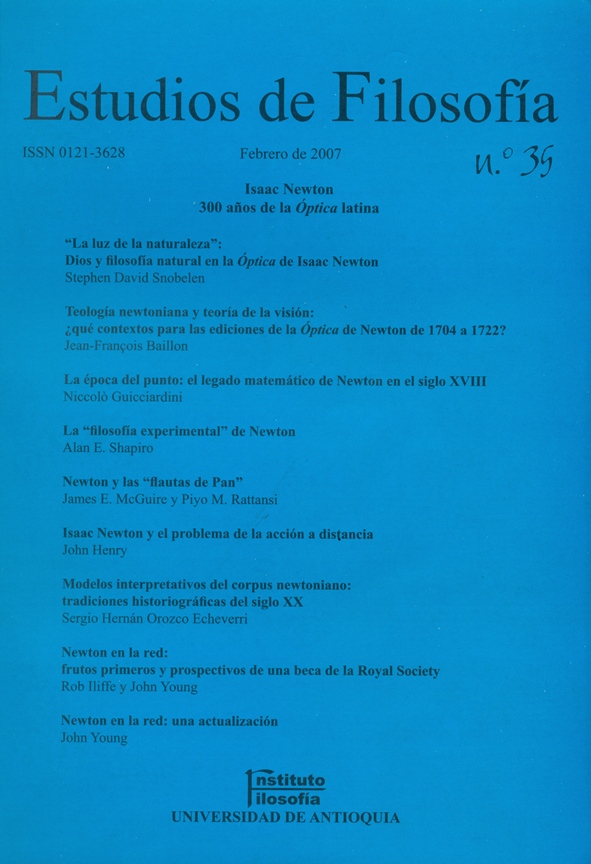
Dot-Age: Newton’s Mathematical Legacy in Eighteenth Century
DOI:
https://doi.org/10.17533/udea.ef.12756Keywords:
Isaac Newton, uxions, history of mathematics, mathematics, Colin MaclaurinAbstract
According to the received view, eighteenth-century British mathematicians were responsible for a decline of mathematics in the country of Newton; a decline attributed to chauvinism and a preference for geometrical thinking. This paper challenges this view by first describing the complexity of Newton’s mathematical heritage and its reception in the early decades of the eighteenth century. A section devoted to Maclaurin’s monumental Treatise of Fluxions (1742) describes its attempt to reach a synthesis of the different strands of Newton’s mathematical legacy, and compares it with contemporary Continental work. It is shown that in the middle of the eighteenth century academic Continental mathematicians such as Euler and Lagrange were driven by local cultural assumptions in directions which sensibly diverged from the ones followed by Maclaurin and his fellow countrymen.
Downloads
References
Ackerberg-Hastings, Amy. “Analysis and Synthesis in John Playfair’s Elements of Geometry”, en: British Journal for the History of Science, 35, 2002, pp. 43-72. DOI: https://doi.org/10.1017/S0007087401004575
Barrow-Green, June. “‘A Correction to the Spirit of Too Exclusively Pure Mathematics’: Robert Smith (1689-1768) and his Prizes at Cambridge University”, en: Annals of Science, 56, 1999, pp. 271-316. DOI: https://doi.org/10.1080/000337999296418
Becher, Harvey. “Radicals, Whigs, and Conservatives: The Middle and Lower Classes in the Analytical Revolution at Cambridge in the Age of Aristocracy”, en: British Journal for the History of Science 28, 1995, pp. 405-426. DOI: https://doi.org/10.1017/S0007087400033471
Blay, Michel. La naissance de la mécanique analytique: la science du mouvement au tournant des XVIIe et XVIIIe siècles. París, 1992.
Bos, Henk J. M. Rede ning Geometrical Exactness: Descartes’ Transformation of the Early Modern Concept of Construction. NewYork, Berlín, Heidelberg, 2001.
Brian,E. La mesure del’état: administrateurs et géomètres au XVIII e siècle. París, 1994.
Cajori, Florian. A History of the Conceptions of Limits and Fluxions in Great Britain from Newton to Woodhouse. Chicago y Londres, 1919. DOI: https://doi.org/10.5962/bhl.title.18728
Cohen, I. Bernard. “The Case of the Missing Author: the Title Page of Newton’s Opticks (1704), with Notes on the Title Page of Huygens’s Traité de la lumière”, en: Buchwald, J. Z. y Cohen, I. B. (eds.). Isaac Newton’s Natural Philosophy. Cambridge (Mass), Londres, 2001, pp. 15-45.
Cotes, Roger. “Logometria”, en: Philosophical Transactions, 39, 1714, pp. 5-45.
Charles Babbage. Passages from the Life of a Philosopher. Londres, 1864.
Chasles, Michel. Aperçu historique sur l’origine et le développement des méthodes en géométrie, particulièrement de celles qui se rapportent à la géométrie moderne. París, 1837. DOI: https://doi.org/10.3406/marb.1837.1033
Davie, George E. The Democratic Intellect: Scotland and Her Universities in the Nineteenth Century. Edimburgo, 1964.
Demidov, S. S. “The Study of Partial Differential Equations of the First Order in the 18th and 19th Centuries”, en: Archive for the History of the Exact Sciences, 26, 1982, pp. 325-350. DOI: https://doi.org/10.1007/BF00418753
Descartes, René. Geometria a Renato Descartes. 2da edición Latina. Frans van Schooten (trad). Ámsterdam, 1659-1661.
____________. The Geometry of René Descartes with a Facsimile of the First Edition, ed. D. E. Smith and M. L. Latham. New York, 1954.
Emerson, William. The Doctrine of Fluxions: Not Only Explaining the Elements Thereof, But Also Its Application and Use in the Several Parts of Mathematics and Natural Philosophy. Londres, 1743.
Engelsman, S. B. Families of Curves and the Origins of Partial Differentiation. Ámsterdam, 1984.
Enros, Philip C. “The Analytical Society (1812-1813): Precursor of the Renewal of Cambridge Mathematics”, en: Historia Mathematica 10, 1983, pp. 24-47. DOI: https://doi.org/10.1016/0315-0860(83)90031-9
Euler, Leonhard. Opera omnia. Lausanne, 1954. Feingold, Mordechai. “Mathematicians and Naturalists: Sir Isaac Newton and the Royal Society”, en: Buchwald, J. Z. y Cohen, I. B. (eds.). Isaac Newton’s Natural Philosophy. Cambridge (Mass), Londres, 2001, pp. 77-102. DOI: https://doi.org/10.7551/mitpress/3979.003.0007
Fraser, Craig. “D’Alembert’s Principle: the Original Formulation and Application in Jean d’Alembert’s Traité de dynamique (1743)”, en: Centaurus, 28, 1985, pp. 31-61, pp. 145-159. DOI: https://doi.org/10.1111/j.1600-0498.1985.tb00834.x
____________. “J. L. Lagrange’s Changing Approach to the Calculus of Variations”, en: Archive for the History of the Exact Sciences, 32, 1985, pp. 151-191. DOI: https://doi.org/10.1007/BF00329871
____________. “The Calculus as Algebraic Analysis: Some Observations on Mathematical Analysis in the 18th Century”, en: Archive for the History of the Exact Sciences, 39, 1989, pp. 317-335. DOI: https://doi.org/10.1007/BF00348445
Gascoigne, John. “Mathematics and Meritocracy: The Emergence of the Cambridge Mathematical Tripos”. Social Studies of Science, 14, 1984, pp. 547-584. Reimpreso como el capítulo 5 de John Gascoigne, Science, Politics, and Universities in Europe, 1600-1800. Ashgate, 1998. DOI: https://doi.org/10.1177/030631284014004003
____________. Cambridge in the Age of Enlightenment: Science, Religion, and Politics from the Restoration to the French Revolution. Cambridge, 1992.
____________. Joseph Banks and the English Enlightenment: Useful Knowledge and Polite Culture. Cambridge, 1994.
Goldstine, H. H. A History of the Calculus of Variations from the 17th Through the 19th Century. New York, 1980. DOI: https://doi.org/10.1007/978-1-4613-8106-8
Grabiner, Judith V. “Was Newton’s Calculus a Dead End? The Continental Influence of Maclaurin’s Treatise of Fluxions”, en: American Mathematical Monthly, 104, 1997, pp. 393-410. DOI: https://doi.org/10.1080/00029890.1997.11990657
____________. “Maclaurin and Newton: the Newtonian Style and the Authority of Mathematics”, en: Withers, C. W. J. and Wood, P. (eds.). Science and Medicine in the Scottish Enlightenment. Londres, 2002, pp. 143-171.
Grattan-Guinness, Ivor. “The Varieties of Mechanics by 1800”, en: Historia Mathematica, 17, 1990, pp. 313-338. DOI: https://doi.org/10.1016/0315-0860(90)90025-9
Greenberg, J. L. “Alexis Fontaine’s Integration of Ordinary Differential Equations and the Origins of the Calculus of Several Variables”, en: Annals of Science, 39, 1982, pp. 1-36. DOI: https://doi.org/10.1080/00033798200200101
Gregory, David. Exercitatio geometrica de dimensione gurarum. Edimburgo, 1684.
Guicciardini, Niccolò. “Isaac Newton and the Publication of His Mathematical Manuscripts”, en: Studies in the History and Philosophy of Science, 35, 2004, pp. 455-470. DOI: https://doi.org/10.1016/j.shpsa.2004.06.002
____________. Reading the Principia: the Debate on Newton’s Mathematical Methods for Natural Philosophy from 1687 to 1730. Cambridge, 1999.
Hall, A. Rupert. “Correcting the Principia”, en: Osiris 13, 1958, pp. 291-326. DOI: https://doi.org/10.1086/368619
____________. Philosophers at War: the Quarrel between Newton and Leibniz. Cambridge, 1980.
Heilbron, John L. “A Mathematicians’ Mutiny, with Morals”, en: Horwich, P. (ed.).World Changes: Thomas Kuhn and the Nature of Science. Cambridge (Mass)/Londres, 1993, pp. 81-129.
Hermann, Jacob. Phoronomia, sive de viribus et motibus corporum solidorum et uidorum libri duo. Amsterdam, 1716. Mazzone
Hiscock, W. G. David Gregory, Isaac Newton and Their Circle: Extracts from David Gregory’s Memoranda, 1677-1708. Oxford, 1937.
Howson, Albert. A History of Mathematics Education in England. Cambridge, 1982. DOI: https://doi.org/10.1017/CBO9780511897481
Jesseph, Douglas M. Berkeley’s Philosophy of Mathematics. Chicago, 1993. DOI: https://doi.org/10.7208/chicago/9780226398952.001.0001
Kitcher, Philip. The Nature of Mathematical Knowledge. New York y Oxford, 1983. Kline, Morris. Mathematical Thought from Ancient to Modern Times. New York, 1972.
Kuhn, Thomas. “Mathematical versus Experimental Traditions in the Development of Physical Science”, en: The Essential Tension: Selected Readings in Scientific Tradition and Change, Chicago, 1977, pp. 31-65.
Maclaurin, Colin. A Treatise of Fluxions, in Two Books (Edimburgo, 1742), 2da ed. (Londres, 1801).
Machin, John. “De motu nodorum lunae”, en: Isaac Newton, Philosophiæ Naturalis Principia Mathematica, 3ra ed. Londres, 1726, pp. 451-454.
Maglo, Kof. “The Reception of Newton’s Gravitational Theory by Huygens, Varignon, and Maupertuis: How Normal Science May Be Revolutionary”, en: Perspectives on Science, 11, 2003, pp. 135-169. DOI: https://doi.org/10.1162/106361403322495876
Mandelbrote, Scott. “Newton and Eighteenth-Century Christianity”, en: Cohen I. Bernard y Smith, George E. (eds.). The Cambridge Companion to Newton. Cambridge, Cambridge University Press, 2002, pp. 409-430. DOI: https://doi.org/10.1017/CCOL0521651778.015
Mazzone, Silvia y Roero, Clara S. Jacob Hermann and the Diffusion of the Leibnizian Calculus in Italy. Florence, 1997.
Murdoch, Patrick. Neutoni genesis curvarum per umbras, seu perspectivae universalis elementa; exemplis coni sectionum et linearum tertii ordinis illustrata. Londres, 1746.
Newton, Isaac. Analysis per quantitatum series, fluxiones, ac differentias: cum enumeratione linearum tertii ordinis. Londres, 1711.
____________. Opticks or, a Treatise of the Reflexions, Refractions, In exions and Colours of Light. Also two Treatises of the Species and Magnitude of Curvilinear Figures. Londres, 1704.
____________. The Mathematical Papers of Isaac Newton. D. T. Whiteside (ed.). 8 vols. Cambridge, Cambridge University Press, 1967-1981.
____________. The Principia, Mathematical Principles of Natural Philosophy: a New Translation by I. Bernard Cohen and Anne Whitman, Assisted by Julia Budenz, Preceded by a Guide to Newton’s Principia by I. Bernard Cohen. Berkeley, Los Angeles, Londres, 1999.
Panteki, Maria. “William Wallace and the Introduction of Continental Calculus to Britain: a Letter to George Peacock”, en: Historia Mathematica 14, 1987, pp. 119-132. DOI: https://doi.org/10.1016/0315-0860(87)90016-4
Playfair, John. “Traité de Mechanique Celeste”, The Edinburgh Review, 22, 1808, pp. 249-284.
Pycior, Helena M. Symbols, Impossible Numbers, and Geometric Entanglements: British Algebra through the Commentaries on Newton’s Universal Arithmetick. Cambridge, 1997. DOI: https://doi.org/10.1017/CBO9780511895470
Schofield, Robert E. “An Evolutionary Taxonomy of Eighteenth-Century Newtonianisms”, en: Studies in Eighteenth Century Culture 7, 1978, pp. 175-92. DOI: https://doi.org/10.1353/sec.1978.0011
Shank, J. B. “‘There was no such Thing as the ‘Newtonian Revolution’, and the French Initiated it.’ Eighteenth-Century Mechanics in France Before Maupertuis”, en: Early Science and Medicine, 9 (3), pp. 257-292. DOI: https://doi.org/10.1163/1573382042176263
Shapiro, Alan E. Fits, Passions, and Paroxysms: Physics, Method, and Chemistry and Newton’s Theories of Colored Bodies and Fits of Easy Reflection. Cambridge, 1993.
Schaffer. Simon. “Newtonianism”, en: Olby, R. C. et al. (eds.). Companion to the History of Modern Science. Londres, 1990, pp. 610-626. DOI: https://doi.org/10.4324/9781003070818-46
Simpson, Thomas. The Doctrine and Application of Fluxions. Containing (Beside What is Common on the Subject) a Number of New Improvements in the Theory. And the Solution of a Variety of New, and Very Interesting, Problems in Different Branches of the Mathematicks, 2 vols. Londres, 1750.
Simson, Robert. “Pappi Alexandrini propositiones duæ generales”, en : Philosophical Transactions, 32, 1723, pp. 330-40. DOI: https://doi.org/10.1098/rstl.1722.0065
____________. Opera quaedam reliqua. Glasgow, 1776.
Smith, George E. “The Newtonian Style in Book II of the Principia”, en: Buchwald, J. Z. y Cohen, I. B. (eds.). Isaac Newton’s Natural Philosophy. Cambridge Mass., Londres, 2001, pp. 249-298. DOI: https://doi.org/10.7551/mitpress/3979.003.0013
Stewart, Matthew. “Pappi Alexandrini collectionum mathematicarum libri quarti propositio quarta generalior facta, cui propositiones aliquot eodem spectantes adjicuntur”, en: Essays and Observations Physical and Literary, Read before a Society in Edinburgh, and Published by Them, 2 vols. Edimburgo, 1754.
____________. Propositiones geometricae, more veterum demonstratae, ad geometriam antiquam illustrandam et promovendam idoneae. Edimburgo, 1763.
Terrall, Mary. “Metaphysics, Mathematics, and the Gendering of Science in Eighteenth-Century France”, en: W. Clark, J. Golinski and S. Schaffer (eds.). The Sciences in Enlightened Europe. Chicago y
Londres, 1999, pp. 246-271. DOI: https://doi.org/10.1016/S0022-3115(98)00743-0
Tweddle, Ian. James Stirling’s Methodus Differentialis. An Annotated Translation of Stirling’s Text. Londres, 2003. DOI: https://doi.org/10.1007/978-1-4471-0021-8
____________. Simson on Porisms: an Annotated Translation of Robert Simson’s Posthumous Treatise on Porisms and Other Items on This Subject. New York, Berlin, Heidelberg, 2000.
Wallis, John. A Treatise of Algebra: both Historical and Practical. Londres, 1685. DOI: https://doi.org/10.1098/rstl.1685.0053
____________. Opera mathematica, 3 vols. Oxford, 1693-1699.
Wallis, Meter y Wallis, Ruth. Newton and Newtoniana 1672-1975: A Bibliography. Londres, 1977.
Warwick, Andrew. Masters of Theory: Cambridge and the Rise of Mathematical Physics. Chicago y Londres, 2003. DOI: https://doi.org/10.7208/chicago/9780226873763.001.0001
Westfall, Richard S. Never at Rest: a Biography of Isaac Newton. Cambridge, 1980. DOI: https://doi.org/10.1017/CBO9781107340664
Whewell, William. History of the Inductive Sciences, Cambridge. University Press, 1837.
Downloads
Published
How to Cite
Issue
Section
Categories
License
Copyright (c) 2007 Niccolò Guicciardini

This work is licensed under a Creative Commons Attribution-NonCommercial-ShareAlike 4.0 International License.
Authors who publish with this journal agree to the following terms:
1. The Author retains copyright in the Work, where the term "Work" shall include all digital objects that may result in subsequent electronic publication or distribution.
2. Upon acceptance of the Work, the author shall grant to the Publisher the right of first publication of the Work.
3. The Author shall grant to the Publisher a nonexclusive perpetual right and license to publish, archive, and make accessible the Work in whole or in part in all forms of media now or hereafter known under a Creative Commons Attribution-NoCommercia-ShareAlike (CC BY-NC-SA 4.0), or its equivalent, which, for the avoidance of doubt, allows others to copy, distribute, and transmit the Work under the following conditions: (a) Attribution: Other users must attribute the Work in the manner specified by the author as indicated on the journal Web site;(b) Noncommercial: Other users (including Publisher) may not use this Work for commercial purposes;
4. The Author is able to enter into separate, additional contractual arrangements for the nonexclusive distribution of the journal's published version of the Work (e.g., post it to an institutional repository or publish it in a book), as long as there is provided in the document an acknowledgement of its initial publication in this journal;
5. Authors are permitted, and Estudios de Filosofía promotes, to post online the preprint manuscript of the Work in institutional repositories or on their Websites prior to and during the submission process, as it can lead to productive exchanges, as well as earlier and greater citation of published work (see The Effect of Open Access). Any such posting made before acceptance and publication of the Work is expected be updated upon publication to include a reference to the Estudios de Filosofía's assigned URL to the Article and its final published version in Estudios de Filosofía.




