

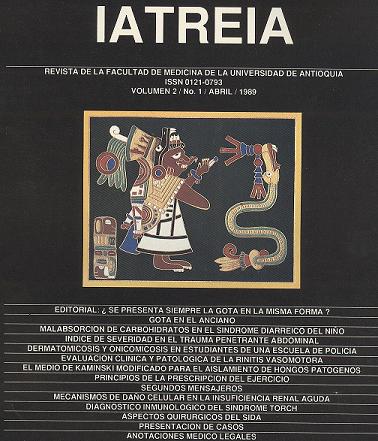
Gout in the elderly
DOI:
https://doi.org/10.17533/udea.iatreia.3340Abstract
Textbooks and general rheumatologic literature emphasize the classic clinical presentation of the patient with gout as well as his or her treatment. Quite often however, this presentation does not occur in the elderly patient or the diagnosis is missed or Is erroneously formulated. In women 60 years of age and older, gout can be polyarticular, can have an insidious, nonacute onset and may Involve the small joints of the hands, all of which may lead to diagnose rheumatoid or degenerative arthritis. Careful examination of synovial fluid along with identification of monosodium urate crystals are mandatory for an accurate diagnosis of gout. Possible drug interactions between anti-inflammatory and hypouricemic drugs with other medications have to be kept in mind. Asymptomatic hyperuricemia should not be treated. Once the diagnosis of gout is confirmed a strict follow-up is required to detect the frequent side effects of non- steroid anti-inflammatory drugs, colchicines and allopurinol that tend to take place in the elderly patients.
Downloads
Downloads
Published
How to Cite
Issue
Section
License
Papers published in the journal are available for use under the Creative Commons license, specifically Attribution-NonCommercial-ShareAlike 4.0 International.
The papers must be unpublished and sent exclusively to the Journal Iatreia; the author uploading the contribution is required to submit two fully completed formats: article submission and authorship responsibility.




