Effect of Zein edible coatings on the postharvest quality of minimally processed papaya fruits fortified with ascorbic acid
DOI:
https://doi.org/10.17533/udea.vitae.v32n3a361330Keywords:
Fresh cuts,, Edible coatings, Papaya, Ascorbic acid, Shelf life.Abstract
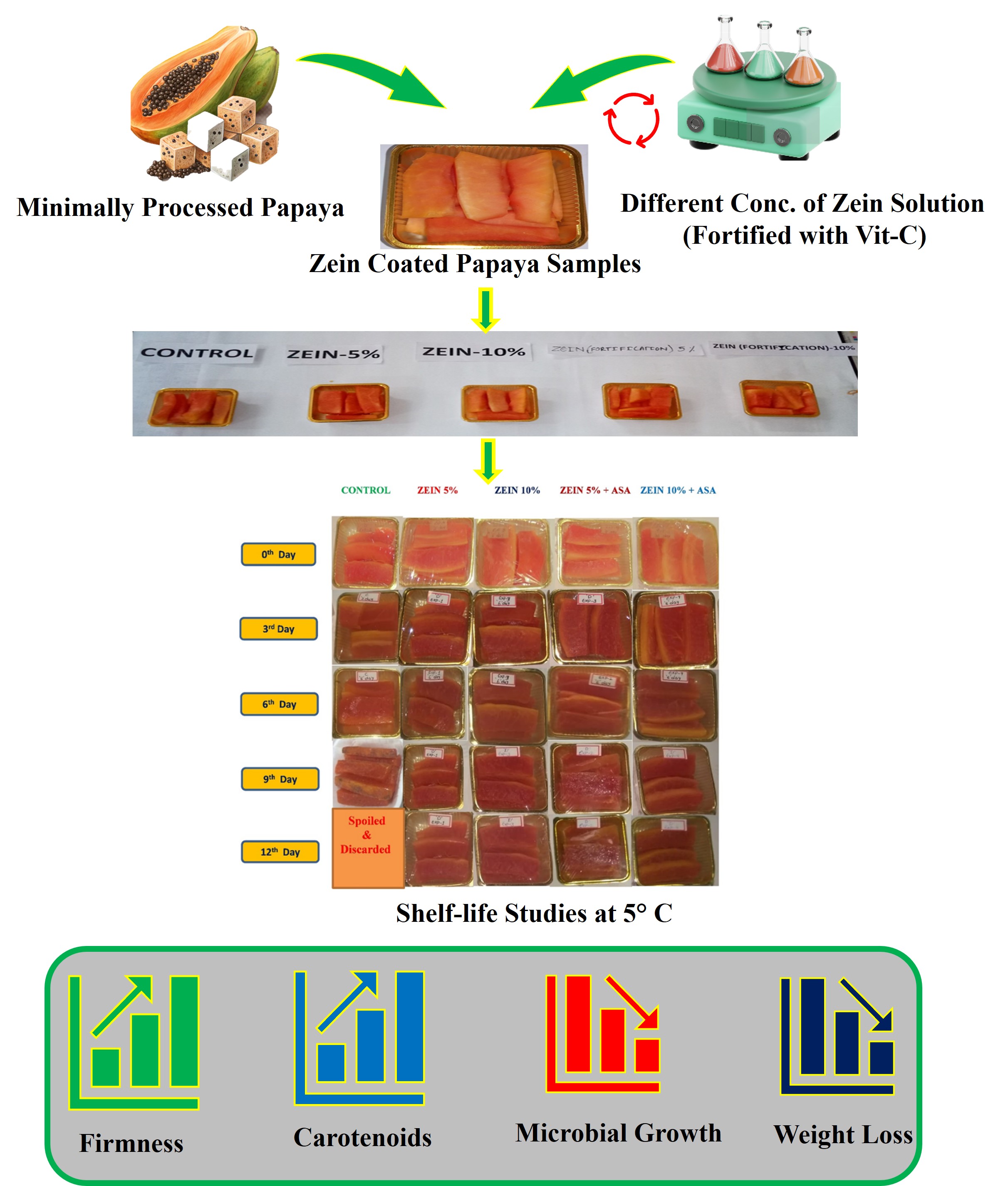
Background: Fresh and minimally processed fruits and vegetables are one of the major growth segments in the food retail industry. Fresh-cut fruits are physically altered from their original state (trimmed, peeled, washed, and/or cut), but remain in a fresh state, and maintaining fresh like keeping quality is a tough task. Edible coatings are a new promising technology that helps in maintaining the quality and extending the shelf-life of minimally processed fresh-cut fruits. Objectives In the Present study various physicochemical and nutritional, sensory characteristics, microbial quality analysis, and micro-structural studies were tested on fresh-cut papaya fruits to evaluate the impact of coatings on freshness and their shelf-life progress during storage. Methods: Fresh-cut papaya cubes were coated by brushing with different concentrations of zein protein biopolymer (5% and 10%) along with ascorbic acid as a fortifying agent. Ascorbic acid (10%) was added as a fortifying external agent into the zein coating solution to improve the nutritional importance of vitamin C. All the experimental and control sample analyses were carried out in triplicates and stored at refrigerated conditions (5±1°C). The experimental data output was subjected to a one-way analysis of variance (ANOVA) followed by Duncan’s multiple range test and Tukey’s test for comparing the mean values between pair of samples. Differences were calculated to compare significant effects at p≤0.05 level with the use of IBM SPSS statistic version 22 software. Results: The findings of the study revealed that the results showed significant differences (P<0.05) in the overall acceptability of the zein-coated samples compared with the control sample and delayed the decline in sensory quality and extended the shelf life. The addition of ascorbic acid to the coatings helped to preserve the natural ascorbic acid content in fresh-cut papaya fruits and found retention in fruits. Conclusions: Zein coatings delayed the color change, lower weight loss, and firmness retention, maintained the carotenoids content, and inhibited the growth of microorganisms as well as showed a potential impact as commercial coatings in preserving and extending the shelf-life of minimally processed fresh-cut papaya fruits for 12 days of storage period.
Downloads
References
Mukhametzyanov RR, Ostapchuk TV, Dzhancharov TM, Ivantsova NN, Vasileva EN. Changes in global production and trade of major tropical fruits. In: Digital agriculture for food security and sustainable development of the agro-industrial complex. Cham: Springer International Publishing; 2023. p. 147–53. doi: https://doi.org/10.1007/978-3-031-27911-9_17
Munira ZA, Rosnah S, Zaulia O, Russly AR. Effect of postharvest storage of whole fruit on physico-chemical and microbial changes of fresh-cut cantaloupe (Cucumis melo L. reticulatus cv. Glamour). Int Food Res J. 2013;20(1).
Goyal MR, Mishra SK, Kumar S, editors. Nanotechnology horizons in food process engineering: Volume 3: trends, nanomaterials, and food delivery. CRC Press; 2023.
Vivek K, Singh SS, RC P. A review on postharvest management and advances in the minimal processing of fresh-cut fruits and vegetables. J Microbiol Biotechnol Food Sci. 2019;8(5):1178–87. DOI: 10.15414/jmbfs.2019.8.5.1178-1187
Hossain MA, Karim MM, Juthee SA. Postharvest physiological and biochemical alterations in fruits: a review. Fundam Appl Agric. 2020;5(4):453–69.
Umeohia UE, Olapade AA. Physiological processes affecting postharvest quality of fresh fruits and vegetables. Asian Food Sci J. 2024;23(4):115915. . DOI: 10.9734/AFSJ/2024/v23i4706
De Corato U. Improving the shelf-life and quality of fresh and minimally-processed fruits and vegetables for a modern food industry: A comprehensive critical review. Crit Rev Food Sci Nutr. 2020;60(6):940–75. DOI: https://doi.org/10.1080/10408398.2018.1553025
Yousuf B, Wu S, Siddiqui MW. Incorporating essential oils into edible coatings: Effect on quality and shelf life of fresh produce. Trends Food Sci Technol. 2021;108:245–57. doi: https://doi.org/10.1016/j.tifs.2021.01.016
Ghidelli C, Pérez-Gago MB. Recent advances in MAP and edible coatings for fresh-cut fruits and vegetables. Crit Rev Food Sci Nutr. 2018;58(4):662–79. doi: https://doi.org/10.1080/10408398.2016.1211087
Kumar L, Ramakanth D, Akhila K, Gaikwad KK. Edible films and coatings for food packaging applications: A review. Environ Chem Lett. 2022;20(1):875–900. DOI: https://doi.org/10.1007/s10311-021-01339-z
Hoque M, Gupta S, Santhosh R, Syed I, Sarkar P. Biopolymer-based edible films and coatings for food applications. In: Food, medical, and environmental applications of polysaccharides. Elsevier; 2021. p. 81–107. DOI: https://doi.org/10.1016/B978-0-12-819239-9.00013-0
Martin-Polo MO. Biopolymers in the fabrication of edible and biodegradable materials for food preservation. In: Food preservation moisture control fundamentals and application. 1995.
Lan X, Zhang X, Wang L, Wang H, Hu Z, Ju X, et al. A review of food preservation based on zein. Food Chem. 2023;424:136403. DOI: https://doi.org/10.1016/j.foodchem.2023.136403
Mesfin FM, Abera S, Neme G. Effects of calcium lactate dipping and corn zein–aloe vera gel coating on quality and storability of strawberry. Doctoral dissertation. Haramaya University; 2024. http://ir.haramaya.edu.et//hru/handle/123456789/7695
Pillai AR, Eapen AS, Zhang W, Roy S. Polysaccharide-based edible biopolymer coatings for fruit preservation: A review. Foods. 2024;13(10):1529. DOI: https://doi.org/10.3390/foods13101529
Armghan Khalid M, Niaz B, Saeed F, Afzaal M, Islam F, Hussain M, et al. Edible coatings for enhancing safety and quality attributes of fresh produce: A review. Int J Food Prop. 2022;25(1):1817–47. DOI: https://doi.org/10.1080/10942912.2022.2107005
Park HJ, Rhim JW, Lee HY. Edible coating effects on respiration rate and storage life of Fuji apples and Shingo pears. Food Sci Biotechnol. 1996;5(1):59–63.
Bai J, Alleyne V, Hagenmaier RD, Mattheis JP, Baldwin EA. Formulation of zein coatings for apples. Postharvest Biol Technol. 2003;28(2):259–68. DOI: https://doi.org/10.1016/S0925-5214(02)00182-5
Beulah AM, Sucharitha KV, Dheeraj S, Prameela P. Effect of casein edible coating on postharvest quality of guava. Carpathian J Food Sci Technol. 2021;13(2). DOI: https://doi.org/10.34302/crpjfst/2021.13.2.1
Narsaiah K, Jha SN, Wilson RA, Mandge HM, Manikantan MR. Optimizing microencapsulation of nisin with sodium alginate and guar gum. J Food Sci Technol. 2014;51:4054–9. doi: https://doi.org/10.1007/s13197-012-0886-6
Kumari J, Nikhanj P. Evaluation of edible coatings for maintaining quality of fresh-cut papaya. J Food Process Preserv. 2022;46(10):e16790. DOI: https://doi.org/10.1111/jfpp.16790
Dotto GL, Vieira ML, Pinto LA. Use of chitosan solutions for microbiological shelf life extension of papaya. LWT. 2015;64(1):126–30. DOI: https://doi.org/10.1016/j.lwt.2015.05.042
Maqbool M, Ali A, Alderson PG, Mohamed MT, Siddiqui Y, Zahid N. Postharvest application of gum arabic and essential oils for banana and papaya. Postharvest Biol Technol. 2011;62(1):71–6. DOI: https://doi.org/10.1016/j.postharvbio.2011.04.002
Joshi AV, Baraiya NS, Vyas PB, Rao TR. Gum ghatti edible coating with clove oil improves papaya storage. Int J Curr Microbiol Appl Sci. 2017;6(5):160–74. DOI: https://doi.org/10.20546/ijcmas.2017.605.019
Pavani Y, Kumar RU, Reddy GG, Smith D. Edible film coating of fresh-cut papaya. Int J Multidiscip Adv Res Trends. 2017;4:1–4.
Tapia MS, Rojas-Graü MA, Carmona A, Rodríguez FJ, Soliva-Fortuny R, Martin-Belloso O. Alginate and gellan coatings for fresh-cut papaya. Food Hydrocoll. 2008;22(8):1493–503. DOI: https://doi.org/10.1016/j.foodhyd.2007.10.004
Ali A, Hei GK, Keat YW. Ginger oil + gum arabic on papaya quality. J Food Sci Technol. 2016;53:1435–44. doi: https://doi.org/10.1007/s13197-015-2124-5
Ma Y, Li X, Jia P, Ma Y, Liu N, Zhang H. Zein membranes for ethanol pervaporation. Desalination. 2012;299:70–8. DOI: https://doi.org/10.1016/j.desal.2012.05.024
Kim S, Xu J. Aggregate formation of zein in aqueous ethanol. J Cereal Sci. 2008;47(1):1–5. doi: https://doi.org/10.1016/j.jcs.2007.08.004
Zhang L, Liu Z, Han X, Sun Y, Wang X. Ethanol influence on zein/chitosan films. Int J Biol Macromol. 2019;134:807–14. DOI: https://doi.org/10.1016/j.ijbiomac.2019.05.085
Bates J. AOAC. Official Methods of Analysis. Virginia: AOAC; 1994.
Tabassum N, Khan MA. Modified atmosphere packaging of fresh-cut papaya using alginate coating. Sci Hortic. 2020;259:108853. DOI: https://doi.org/10.1016/j.scienta.2019.108853
Islas-Osuna MA, Stephens-Camacho NA, Contreras-Vergara CA, Rivera-Dominguez M, Sanchez-Sanchez E, Villegas-Ochoa MA, et al. Novel postharvest treatment reduces ascorbic acid losses in mango var. Kent. Am J Agric Biol Sci. 2010;342–9. DOI: 10.3844/ajabssp.2010.342.349
Sucharitha KV, Beulah AM, Ravikiran K. Effect of chitosan on tomato storage. Int Food Res J. 2018;25(1):93–9.Harborne J. Phytochemical methods. London: Chapman & Hall; 1973. p. 49–188.
Harringan WF, Mccance ME. Laboratory methods in food microbiology. 1976. p. 1–115.
Valero D, Díaz-Mula HM, Zapata PJ, Guillén F, Martínez-Romero D, Castillo S, Serrano M. Effects of alginate edible coating on preserving fruit quality in four plum cultivars during storage. Postharvest Biol Technol. 2013;77:1–6. DOI: https://doi.org/10.1016/j.postharvbio.2012.10.011
Sancho LE, Yahia EM, González-Aguilar GA. Identification and quantification of phenols, carotenoids, and vitamin C in papaya cv. Maradol by HPLC-DAD-MS/MS-ESI. Food Res Int. 2011;44(5):1284–91. DOI: https://doi.org/10.1016/j.foodres.2010.12.001
Olivas GI, Barbosa-Cánovas GV. Edible coatings for fresh-cut fruits. Crit Rev Food Sci Nutr. 2005;45(7–8):657–70. DOI: https://doi.org/10.1080/10408690490911837
Guo Y, Liu Z, An H, Li M, Hu J. Nano-structure and properties of maize zein studied by AFM. J Cereal Sci. 2005;41(3):277–81. DOI: https://doi.org/10.1016/j.jcs.2004.12.005
Hassani F, Garousi F, Javanmard M. Edible coating based on whey protein concentrate–rice bran oil for kiwifruit. Trakia J Sci. 2012;10(1):26–34.
Bai RK, Huang MY, Jiang YY. Selective permeabilities of chitosan-acetic acid and chitosan-polymer membranes for O₂ and CO₂. Polym Bull. 1988;20:83–8. DOI: https://doi.org/10.1007/BF00262253
Ali A, Muhammad MT, Sijam K, Siddiqui Y. Effect of chitosan coatings on physicochemical characteristics of Eksotika II papaya during cold storage. Food Chem. 2011;124(2):620–6. DOI: https://doi.org/10.1016/j.foodchem.2010.06.085
Cipolatti EP, Kupski L, Rocha MD, Oliveira MD, Buffon JG, Furlong EB. Protein–phenolic coating on tomatoes. Food Sci Technol. 2012;32:594–8. DOI: https://doi.org/10.1590/S0101-20612012005000081
Yusoff NH, Seng TC, Zainal Z. Alginate formulation enriched with essential oil for ripening delay of Sekaki papaya. 2022;12(2):1–?. ISSN 2462-1757.
Allam N, Mostafa YS. Impact of edible coating on fresh-cut papaya during cold storage. Egypt J Hortic. 2025;52(1):101–12. DOI: https://dx.doi.org/10.21608/ejoh.2025.378047.1285
Gorny JR, Hess-Pierce B, Kader AA. Effects of fruit ripeness and storage temperature on deterioration of fresh-cut peach and nectarine slices. 1998;110–3.
González-Aguilar GA, Ayala-Zavala JF, Ruiz-Cruz S, Acedo-Félix E, Díaz-Cinco ME. Effect of temperature and MAP on quality of fresh-cut bell peppers. LWT. 2004;37(8):817–26. DOI: https://doi.org/10.1016/j.lwt.2004.03.007
Singh M, Kumar N, Gupta A, Palai I, Kumari A, Arshi AM. A comprehensive review on utilization of agricultural waste for reinforced structural products: a sustainable perspective.
Chien PJ, Sheu F, Yang FH. Effects of chitosan coating on quality and shelf life of sliced mango. J Food Eng. 2007;78(1):225–9. DOI: https://doi.org/10.1016/j.jfoodeng.2005.09.022
Teixeira GH, Durigan JF, Mattiuz BH, Rossi Júnior OD. Processamento mínimo de mamão ‘Formosa’. Food Sci Technol. 2001;21:47–50. DOI: https://doi.org/10.1590/S0101-20612001000100011
Pila N, Gol NB, Rao TR. Effects of post-harvest treatments on physicochemical characteristics and shelf life of tomato. Am Eurasian J Agric Environ Sci. 2010;9(5):470–9.
Jahan S, Gomasta J, Hassan J, Rahman H, Kader MA, Kayesh E. Fruit quality retention and shelf-life extension of papaya through organic coating. Heliyon. 2025;11(1).
Farina V, Passafiume R, Tinebra I, Scuderi D, Saletta F, Gugliuzza G, et al. Aloe vera gel-based edible coating for fresh-cut papaya. J Food Qual. 2020;2020:8303140. DOI: https://doi.org/10.1155/2020/8303140
Olivas GI, Mattinson DS, Barbosa-Cánovas GV. Alginate coatings for minimally processed Gala apples. Postharvest Biol Technol. 2007;45(1):89–96. DOI: https://doi.org/10.1016/j.postharvbio.2006.11.018
Guillén F, Díaz-Mula HM, Zapata PJ, Valero D, Serrano M, Castillo S, Martínez-Romero D. Aloe gels delay postharvest ripening of peach and plum. Postharvest Biol Technol. 2013;83:54–7. DOI: https://doi.org/10.1016/j.postharvbio.2013.03.011
Moalemiyan M, Ramaswamy HS, Maftoonazad N. Pectin-based coating for shelf-life extension of Ataulfo mango. J Food Process Eng. 2012;35(4):572–600. DOI: https://doi.org/10.1111/j.1745-4530.2010.00609.x
Debeaufort F, Quezada-Gallo JA, Voilley A. Edible films and coatings: tomorrow’s packaging. Crit Rev Food Sci Nutr. 1998;38(4):299–313. DOI: https://doi.org/10.1080/10408699891274219
Raju M, Mondal R, Valliath AS, Tejaswi S, Das P. Enhancement of papaya quality and shelf-life by edible coating. 2023;9:10. DOI: https://doi.org/10.14719/pst.2024
Sharma B, Nigam S, Verma A, Garg M, Mittal A, Sadhu SD. Guava-derived edible Cu/Zn oxide nanocoating for food preservation. J Polym Environ. 2024;32(1):331–44. DOI: https://doi.org/10.1007/s10924-023-02972-1
Zuhair RA, Aminah A, Sahilah AM, Eqbal D. Antioxidant activity and physicochemical changes of papaya cv. Hongkong during ripening. Int Food Res J. 2013;20(4).
Ribeiro TT, Barbosa AM, Nunes TP, Costa AS, Oliveira MB, Borges GR, et al. Antifungal packaging based on pectin/gelatin with Azadirachta indica extract for papaya coating. Appl Sci. 2025;15(8):4423. DOI: https://doi.org/10.3390/app15084423
Bahmid NA, Siddiqui SA, Ariyanto HD, Sasmitaloka KS, Rathod NB, Wahono SK, et al. Cellulose-based coating for tropical fruits: method and functionality. Food Rev Int. 2023;1–24. DOI: https://doi.org/10.1080/87559129.2023.2209800
Dubey N, Chitranshi S, Dwivedi SK, Sharma A. Postharvest physiology, value chain advancement, and nanotechnology in fresh-cut fruits and vegetables. In: Nanotechnology horizons in food process engineering. Apple Academic Press; 2023. p. 99–132.
Downloads
Published
How to Cite
Issue
Section
License
Copyright (c) 2025 A M Beulah, Sucharitha K V

This work is licensed under a Creative Commons Attribution-NonCommercial-ShareAlike 4.0 International License.
Copyright Notice and Open Access Statement
The Journal Vitae works under the Open Access license, and the published manuscripts remain available for the public, both on the Journal's website and in databases, under the Creative Commons license, "Noncommercial Attribution" and "Share alike" systems, adopted in Colombia. Hence, when the authors agree to publish in the Journal Vitae, they will not have the right to economic retributions on publications and reproductions through different diffusion media. The documents are freely available to the internet public, permitting users to read, download, copy, distribute, print, search, or link to the full texts and pass them as data to software. The only constraint on reproduction and distribution, should be to give authors control over the integrity of their work and the right to be appropriately acknowledged and cited.
Authors declare that:
-
They are the intellectual property owners and are responsible for all the information stated in the article.
-
This manuscript has not been submitted or published in other printed or digital media. They accept the responsibility for the judgments, opinions, and points of view expressed in the published article and, therefore, they exonerate Universidad de Antioquia and Journal Vitae from any process.
-
They exempt Universidad de Antioquia and Journal Vitae from settling conflicts or disputes related to the authorship of the referred article.
-
They accept the revision of the original manuscript by suitable personnel, and they bind themselves to perform the corrections appointed or suggested by the assessors.
-
Therefore, they know the editorial process and will not bind the Editorial Board of the Journal to assume any obligations regarding the volume and issue in which the article is published.
-
They transfer the rights of publication, reprinting, and distribution of the article from the moment of its approval, in print and digital format, without the right to economic rewards, and under the licensing conditions considered relevant by Journal Vitae.
-
They fully authorize Universidad de Antioquia and Journal Vitae to submit the published material to the diverse databases and indexing systems where the Journal can be found to comply with the requirements of the regulatory authorities to maintain the national classification of journals.
-
They will assume the article publication costs established for the current issue, and they will make the payment as soon as they are informed about the volume and the issue in which the final version of the article is published.
-
After the article is published, you can share digital or printed copies in a noncommercial manner. You will be able to use the paper in your institution or company for educational or research purposes, including the use in course programs.
Conflict of interest: Authors are responsible for recognizing and disclosing any financial or other benefits that could be perceived to bias their work, acknowledging all financial support and any personal connections with potential sponsors. Examples of such conflicts include receiving research funds or honoraria, serving on advisory boards, stock ownership, or employment and consulting arrangements. Authors without such connections should clearly state that they have no financial support or personal relationships that could be perceived to bias their work. All conflicts of interest should be disclosed on the author's identification page of the manuscript.