

Takotsubo cardiomyopathy
DOI:
https://doi.org/10.17533/udea.iatreia.v28n2a11Keywords:
acute coronary syndrome, acute heart failure, Takotsubo cardiomyopathyAbstract
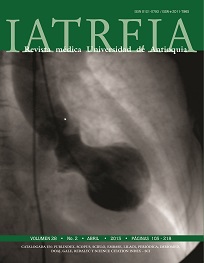
Takotsubo cardiomyopathy or stress-induced cardiomyopathy is often diagnosed as an acute coronary syndrome in postmenopausal women, because its clinical presentation may mimic an acute myocardial infarction: anginal chest pain, changes in the ST segment and T wave in precordial leads and elevated cardiac biomarkers of necrosis. It is characterized by systolic dysfunction with transient ballooning of the apical and middle portions of the left ventricle, in the absence of significant coronary disease. Prognosis is good and complete recovery occurs in days to weeks. We report three cases of postmenopausal women with initial diagnosis of acute myocardial infarction; no significant coronary lesions were found in the coronary angiography; apical ballooning, characteristic of this syndrome, was observed on left ventriculography. On follow-up, the three patients had complete recovery of systolic function at six weeks.
Downloads
References
(1.) Yoshikawa T. Takotsubo cardiomyopathy, a new concept of cardiomyopathy: Clinical features and pathophysiology. Int J Cardiol. 2014 Dec;182C:297-303.
(2.) Núñez I, Méndez M, Garcia-Rubira J. Cardiopatía de estrés o síndrome de Tako-Tsubo: Conceptos actuales. Rev Argent Cardiol. 2009 May-Jun;77(3):218-223.
(3.) Vieweg WV, Hasnain M, Mezuk B, Levy JR, Lesnefsky EJ, Pandurangi AK. Depression, stress, and heart disease in earthquakes and Takotsubo cardiomyopathy. Am J Med. 2011 Oct;124(10):900-7.
(4.) Wittstein IS, Thiemann DR, Lima JA, Baughman KL, Schulman SP, Gerstenblith G, et al. Neurohumoral features of myocardial stunning due to sudden emotional stress. N Engl J Med. 2005 Feb 10;352(6):539-48.
(5.) Ionescu CN, Aguilar-Lopez CA, Sakr AE, Ghantous AE, Donohue TJ. Long-term outcome of Tako-tsubo cardiomyopathy. Heart Lung Circ. 2010 Oct;19(10):601–5.
(6.) Salaverría Garzón I, Villaseñor Navas S, Sánchez Herrera L, Martínez E. Síndrome de Tako-Tsubo (discinesia apical transitoria).Un síndrome que simula un infarto de miocardio. An Med Interna. 2008 Jun;25(1): 20-2.
(7.) Jim MH, Chan AO, Tsui PT, Lau ST, Siu CW, Chow WH, et al. A new ECG criterion to identify takotsubo cardiomyopathy from anterior myocardial infarction: role of inferior leads. Heart Vessels. 2009 Mar;24(2):124-30.
(8.) Prasad A, Lerman A, Rihal CS. Apical ballooning syndrome (Tako- Tsubo or stress cardiomyopathy): a mimic of acute myocardial infarction. Am Heart J. 2008 Mar;155(3):408-17.
(9.) Prasad A. Apical ballooning syndrome: an important differential diagnosis of acute myocardial infarction. Circulation. 2007 Feb;115(5):e56-9.
(10.) Fernández-Pérez GC, Aguilar-Arjona JA, de la Fuente GT, Samartín M, Ghioldi A, Arias JC, et al. Takotsubo cardiomyopathy: assessment with cardiac MRI. AJR Am J Roentgenol. 2010 Aug;195(2):139-45.
(11.) Abe Y, Kondo M. Apical ballooning of the left ventri-cle: a distinct entity? Heart. 2003 Sep;89(9):974-6.
(12.) Bybee KA, Prasad A. Stress-related cardiomyopathy syndromes. Circulation. 2008 Jul;118(4):397-409.
(13.) Ogura R, Hiasa Y, Takahashi T, Yamaguchi K, Fujiwa-ra K, Ohara Y, et al. Specific findings of the standard 12-lead ECG in patients with 'Takotsubo' cardiomyo-pathy: comparison with the findings of acute anterior myocardial infarction. Circ J. 2003 Aug;67(8):687-90 .
(14.) Singh K, Carson K, Shah R, Sawhney G, Singh B, Par-saik A, et al. Meta-analysis of clinical correlates of acute mortality in takotsubo cardiomyopathy. Am J Cardiol. 2014 Apr;113(8):1420-8.
(15.) Komamura K, Fukui M, Iwasaku T, Hirotani S, Masu-yama T. Takotsubo cardiomyopathy: Pathophysio-logy, diagnosis and treatment. World J Cardiol. 2014 Jul;6(7):602-9.
(16.) Kurisu S, Inoue I, Kawagoe T, Ishihara M, Shimatani Y, Nakama Y, et al. Torsade de pointes associated with bradycardia and takotsubo cardiomyopathy. Can J Cardiol. 2008 Aug;24(8):640-2.
Downloads
Published
How to Cite
Issue
Section
License
Copyright (c) 2015 Iatreia

This work is licensed under a Creative Commons Attribution-ShareAlike 4.0 International License.
Papers published in the journal are available for use under the Creative Commons license, specifically Attribution-NonCommercial-ShareAlike 4.0 International.
The papers must be unpublished and sent exclusively to the Journal Iatreia; the author uploading the contribution is required to submit two fully completed formats: article submission and authorship responsibility.




