Effect of tuber starch type on the sensory texture profile of traditional Colombian baked products
DOI:
https://doi.org/10.17533/udea.vitae.v32n2a359587Keywords:
Texture Profile Analysis, sensory evaluation, Colombian baked products, Starch substitution, Gluten-free formulations, Andean tubersAbstract
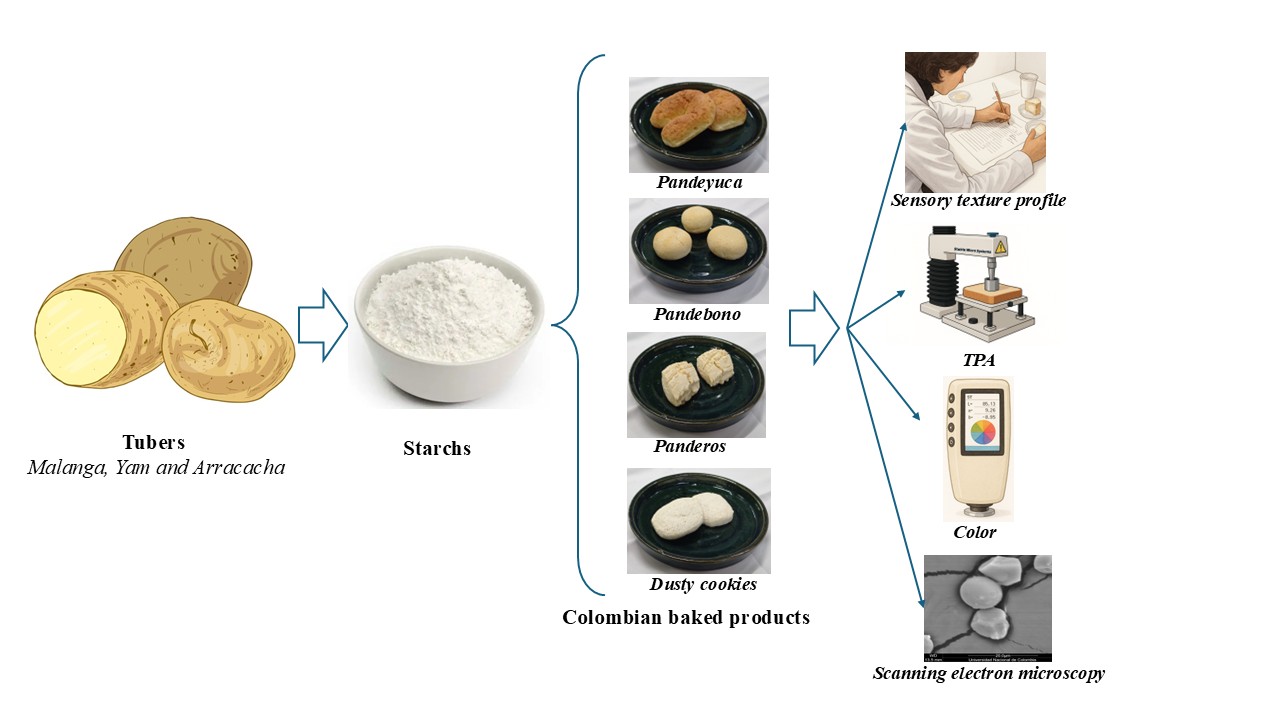
Background: This study evaluated the effect of replacing traditional cassava and maize starches with starches from arracacha, yam, and malanga on the sensory texture profile, instrumental texture parameters (TPA), color, and microstructure of four Colombian baked products: pandebono, pandeyuca, dusty cookies, and panderos. Objective: The aim was to determine how these alternative starches modified texture attributes and product appearance while maintaining acceptable sensory quality through adjustments in formulation and processing. A trained panel evaluated hardness, adhesiveness, fracturability, springiness, cohesiveness, gumminess, and chewiness; color was measured using the CIELAB system; texture was analyzed instrumentally; and microstructure was studied by scanning electron microscopy (SEM). Results: arracacha starch increased cohesiveness, adhesiveness, and chewiness in pandebonos and panderos, yam starch produced higher hardness and changes in gumminess and cohesiveness in pandeyuca, and malanga starch yielded softer and less brittle textures in dusty cookies, consistent with its lower gelatinization temperature. SEM analyses confirmed variations in starch granule distribution and size that explained the observed differences in texture. Conclusions: incorporation of Andean tuber starches makes it possible to diversify traditional recipes, expand the range of naturally gluten-free products, and add value to Colombian gastronomy.
Downloads
References
Aguilar PV, Hernández D. Harinas y almidones de yuca, ñame, camote y ñampí: Propiedades funcionales y posibles aplicaciones en la industria alimentaria. Tecnol Marcha. 2017;25(1):37-45. Available from: https://dialnet.unirioja.es/servlet/articulo?codigo=4835676
Ogunsona E, Ojogbo E, Mekonnen T. Advanced material applications of starch and its derivatives. Eur Polym J. 2018;108:570-81. doi: https://doi.org/10.1016/j.eurpolymj.2018.09.039
Vera NG, Espino Manzano SO, Hernández HM. Use of Oxalis tuberosa in gluten-free baked goods manufacture. In: Holban A, Grumezescu A, editors. Handbook of food bioengineering: Alternative and replacement foods. Cambridge: Elsevier; 2018. p. 167-75. Available from: https://doi.org/10.1016/B978-0-12-811446-9.00006-X
Ordoñez C. Gran libro de la cocina colombiana [Internet]. Bogotá (DC): Ministerio de Cultura; 2012 [cited 2025 Sep 22]. Available from: https://www.mincultura.gov.co/Sitios/patrimonio/bibliotecas-de-cocinas/tomos/tomo09.pdf
Unilever. Galletas polvorosas. Recetas Marca Maizena [Internet]. 2019 [cited 2025 Sep 22]. Available from: http://www.maizena.com.co/articulo/detalle/994996/galletas-polvorosa
Gisslen W. Panadería y repostería para profesionales. México (DF): Editorial Limusa; 2014.
Sañudo A, Lipan L, Cano M, Vélez R, Noguera L, Sánchez L. Texture. In: Yahia E, editor. Postharvest physiology and biochemistry of fruits and vegetables. Cambridge: Elsevier; 2019. p. 293-314. DOI: https://doi.org/10.1016/B978-0-12-813278-4.00014-2
Icontec. Norma Técnica Colombiana NTC 4489. Análisis sensorial. Perfil de textura. Bogotá: Icontec; 1998. 24 p.
Icontec. Norma Técnica Colombiana NTC 4934. Análisis sensorial. Metodología guía general para establecer un perfil sensorial. Bogotá: Icontec; 2001. 13 p.
Meilgaard MC, Carr BT. Sensory evaluation techniques. 4th ed. Boca Raton: CRC Press; 2006. DOI: https://doi.org/10.1201/b16452
Meñano Correa N, Ciarfella Pérez AT, Dorta Villegas AM. Evaluation of chemical and functional properties of native starch of congo yam (Dioscorea bulbifera L.) to predict its possible technological uses. Saber [Internet]. 2014 [cited 2025 Sep 22];26(2):182-8. Available from: http://ve.scielo.org/scielo.php?script=sci_arttext&pid=S1315-01622014000200011
Vivas O, Sangronis E. Perfil de textura instrumental y sensorial de pastas elaboradas con Cajanus cajan fermentada. Rev Fac Farm [Internet]. 2018 [cited 2025 Sep 22];60(1):31-6.
Zhuang Y, Wang Y, Yang H. Characterizing digestibility of potato starch with cations by SEM, X-ray, LF-NMR, FTIR. Food Chem. 2023; 424:136396. DOI: https://doi.org/10.1016/j.foodchem.2023.136396
Dhital S, Shrestha AK, Hasjim J, Gidley MJ. Physicochemical and structural properties of maize and potato starches as a function of granule size. J Agric Food Chem. 2011;59(18):10151-61. DOI: https://doi.org/10.1021/jf202293s
Andrade R, Palacio J, Pacheco W, Betin R. Almacenamiento de trozos de ñame (Dioscorea rotundata) en atmósferas modificadas. Inf Tecnol. 2012;23(4):65-72. DOI: https://doi.org/10.4067/S0718-07642012000400008
Salcedo J, García C, Salcedo D. Propiedades funcionales de almidones de ñame (Dioscorea alata). Biotecnol Sect Agropecu Agroind. 2018;16(2):99-107. DOI: https://doi.org/10.18684/bsaa(16)99-107
Hernández M, Torruco-Uco JG, Chel-Guerrero L, Betancur-Ancona D. Caracterización fisicoquímica de almidones de tubérculos cultivados en Yucatán, México. Cienc Tecnol Aliment. 2008;28(3):718-26. DOI: https://doi.org/10.1590/S0101-20612008000300031
Torres A, Montero P, Durán M. Propiedades fisicoquímicas, morfológicas y funcionales del almidón de malanga (Colocasia esculenta). Rev Lasallista Investig [Internet]. 2013 [cited 2025 Sep 22];10(2):52-6. Available from: https://www.redalyc.org/pdf/695/69529816007.pdf
Alayo B. Caracterización fisicoquímica y reológicas del almidón de la arracacha (Arracacia xanthorrhiza) variedad amarilla procedente de la Provincia de San Ignacio - Departamento de Cajamarca. Innov Desarro [Internet]. 2015 [cited 2025 Sep 22];1(1):1-7. Available from: http://revistas.ucv.edu.pe/index.php/INNOVACION/article/view/887
Rivera FA. Un patrimonio cultural en riesgo: Valoración y divulgación de los oficios de las cocinas tradicionales - amasijos en el municipio de Firavitoba-Boyacá [master’s thesis]. Tunja: Universidad Pedagógica y Tecnológica de Colombia; 2022.
Mora AC. Evaluación de la calidad de cocción y calidad sensorial de pasta elaborada a partir de mezclas de sémola de trigo y harina de quinua [master’s thesis]. Medellín: Universidad Nacional de Colombia; 2012.
Granito M, Valero Y, Zambrano R. Desarrollo de productos horneados a base de leguminosas fermentadas y cereales destinados a la merienda escolar. Arch Latinoam Nutr. 2010;60(1):85-92.
Irigoytia K, Parodi MB, Espósito N, de Escalada Pla M, Genevois C. Sensory profile of gluten-free breads based on alternative commercial flours. Biol Life Sci Forum. 2023;26(124). DOI: https://doi.org/10.3390/Foods2023-15217
Downloads
Published
How to Cite
Issue
Section
License
Copyright (c) 2025 Ana Ruby Correa, Diana Isadora Dix Sotelo, Aycardo Robayo Rodríguez, Marta Cecilia Quicazan Sierra

This work is licensed under a Creative Commons Attribution-NonCommercial-ShareAlike 4.0 International License.
Copyright Notice and Open Access Statement
The Journal Vitae works under the Open Access license, and the published manuscripts remain available for the public, both on the Journal's website and in databases, under the Creative Commons license, "Noncommercial Attribution" and "Share alike" systems, adopted in Colombia. Hence, when the authors agree to publish in the Journal Vitae, they will not have the right to economic retributions on publications and reproductions through different diffusion media. The documents are freely available to the internet public, permitting users to read, download, copy, distribute, print, search, or link to the full texts and pass them as data to software. The only constraint on reproduction and distribution, should be to give authors control over the integrity of their work and the right to be appropriately acknowledged and cited.
Authors declare that:
-
They are the intellectual property owners and are responsible for all the information stated in the article.
-
This manuscript has not been submitted or published in other printed or digital media. They accept the responsibility for the judgments, opinions, and points of view expressed in the published article and, therefore, they exonerate Universidad de Antioquia and Journal Vitae from any process.
-
They exempt Universidad de Antioquia and Journal Vitae from settling conflicts or disputes related to the authorship of the referred article.
-
They accept the revision of the original manuscript by suitable personnel, and they bind themselves to perform the corrections appointed or suggested by the assessors.
-
Therefore, they know the editorial process and will not bind the Editorial Board of the Journal to assume any obligations regarding the volume and issue in which the article is published.
-
They transfer the rights of publication, reprinting, and distribution of the article from the moment of its approval, in print and digital format, without the right to economic rewards, and under the licensing conditions considered relevant by Journal Vitae.
-
They fully authorize Universidad de Antioquia and Journal Vitae to submit the published material to the diverse databases and indexing systems where the Journal can be found to comply with the requirements of the regulatory authorities to maintain the national classification of journals.
-
They will assume the article publication costs established for the current issue, and they will make the payment as soon as they are informed about the volume and the issue in which the final version of the article is published.
-
After the article is published, you can share digital or printed copies in a noncommercial manner. You will be able to use the paper in your institution or company for educational or research purposes, including the use in course programs.
Conflict of interest: Authors are responsible for recognizing and disclosing any financial or other benefits that could be perceived to bias their work, acknowledging all financial support and any personal connections with potential sponsors. Examples of such conflicts include receiving research funds or honoraria, serving on advisory boards, stock ownership, or employment and consulting arrangements. Authors without such connections should clearly state that they have no financial support or personal relationships that could be perceived to bias their work. All conflicts of interest should be disclosed on the author's identification page of the manuscript.