Phoradendron bathyoryctum Eichler relieves acute nociceptive pain stimulus and carrageenan-induced inflammation in mice

Authors

DOI:

https://doi.org/10.17533/udea.vitae.v32n1a356558

Keywords:

Phoradendron bathyoryctum, anti-nociceptive, anti-inflammatory, Randall-Selitto, writhing test, hot plate, plethysmometer.

Abstract

Background: The genus Phoradendron belongs to the Santalaceae family and possesses several species with antitumor, cytotoxic, and immunomodulatory activity, where pain and inflammation are common symptoms. It is used in venereal and liver diseases in Paraguayan folk medicine. In addition, it claims to have tonic properties for the heart and central nervous system. Previous studies have shown that crude extract of Phoradendron bathyoryctum Eichler (Pb) has anxiolytic and antidepressant activity.
Objective: This work aimed to determine the anti-nociceptive and anti-inflammatory activity ofPb using acute models in mice.
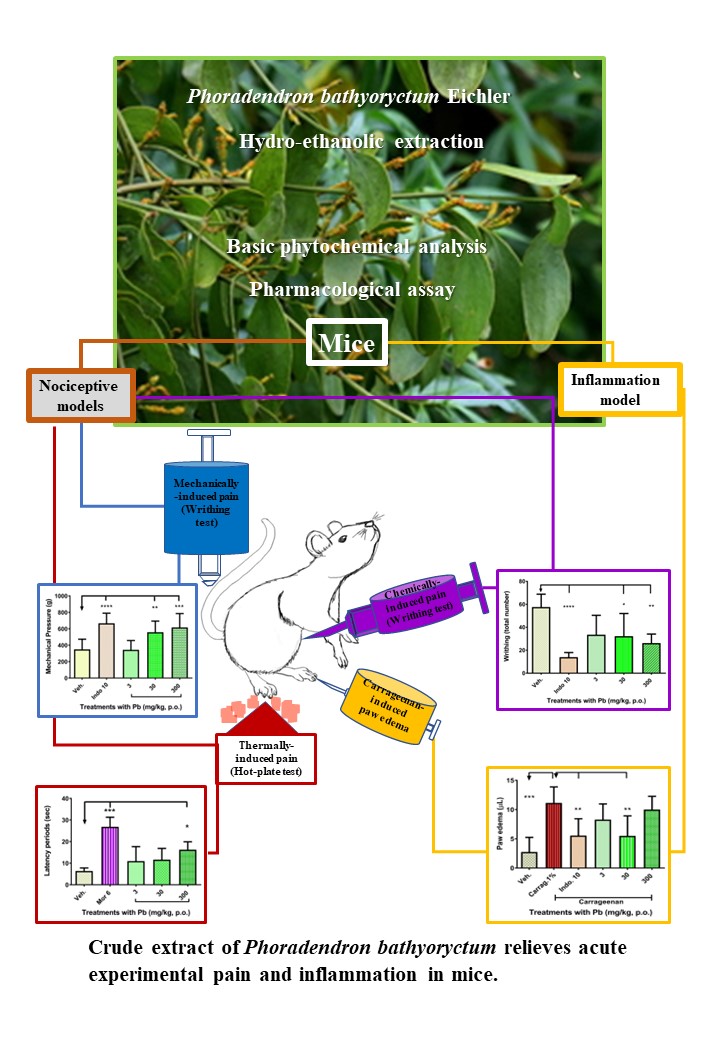
Methods: the anti-nociceptive activity of Pb was evaluated using mechanical pressure (Randall-Selitto test), acetic acid (writhing test), and heat (hot plate test) noxious stimulus in mice. The anti-inflammatory activity was assessed through carrageenan-induced plantar edema in mice previously treated with Pb.
Results: Presences of high polarity alkaloids, steroids/ free triterpenoids, leucoanthocyanidins, and tannins were detected in phytochemical studies. Oral doses of 30 (p<0.01) and 300 (p<0.001) mg/kg of Pb denoted a significant dose-dependent increase in pain threshold, using the Randall-Selitto and Writhing test (30; p<0.05; and 300; p<0.01. In addition, consistent with the above anti-nociceptive effect, an increase in the reaction latency time after oral administration of Pb at a dose of 300 mg/kg (p<0.05) in the hot plate test was denoted. Finally, a significant reduction of edema (30 mg/kg; p<0.01) induced by 1% carrageenan was evidenced, demonstrating a potential anti-inflammatory activity of Pb compared to the positive edema control. Interestingly, the anti-edematous activity of Pb showed a similar intensity response compared to the group treated with 10 mg/kg indomethacin (p<0.01).
Conclusion: This work revealed that the crude extract of Pb can increase pain threshold, be compatible with an analgesic effect, and reduce edema (anti-inflammatory) induced by Carrageenan in mice. Further pharmacological and chemical studies are being conducted to elucidate molecular mechanisms and components involved in the observed effects.

|Abstract
= 222 veces | PDF
= 171 veces| | GRAPHICAL ABSTRACT
= 4 veces| | EPUB
= 19 veces| | HTML
= 0 veces| | XML
= 0 veces|

Downloads

Download data is not yet available.

Author Biographies

Mariela Ortiz Rivas, Facultad de Ciencias Químicas- UNA

Departamento de Farmacología.

Olga Heinichen, Facultad de Ciencias Químicas- UNA

Departamento de Farmacologia. Docente Invesstigador

Wilfrido Arrua, Facultad de Ciencias Químicas- UNA

Departamento de Farmacologìa. Docente Investigador

Rosa Degen de Arrua, Facultad de Ciencias Químicas- UNA

Departamento de Botànica. Docente Investigador

Derlis A. Ibarrola D., Facultad de Ciencias Químicas- UNA

Departamento de Farmacologia. Docente Investigador

References

Woolf CJ. What is this thing called pain? J Clin Invest. 2010;120(11):3742–4. DOI: https://doi.org/10.1172/JCI45178.3742

Rojas-Corrales MO, Casas J, Moreno-Brea MR, Gibert-Rahola J, Micó JA. Anti-nociceptive effects of tricyclic antidepressants and their noradrenergic metabolites. Eur Neuropsychopharmacol. 2003;13(5):355–63. DOI: https://doi.org/10.1016/S0924-977X(03)00017-8

Saarto T, Wiffen PJ. Antidepressants for neuropathic pain: A Cochrane review. J Neurol Neurosurg Psychiatry. 2010;81(12):1372–3. DOI: https://doi.org/10.1136/jnnp.2008.144964

Hellión-Ibarrola MDC, Montalbetti Y, Heinichen OY, Ibarrola DA. Anxiolytic and Antidepressant-like Effect of the Hydro-alcoholic Extract of Phoradendron Bathyoryctum Eichler (santalaceae) (ka’avo Tyre’y) In Mice. J Appl Pharm Sci. 2021;11(6):062–9. DOI: https://doi.org/10.7324/JAPS.2021.110607

Sarker DS, Latif Z, Gray IA. Methods in Biotechnology. Natural Products Isolation. 2da ed. John Walkers, editor. Totowa New Jersey: Humana Press; 2005. 332 p.

Real Decreto M de AP y A, Presidencia CEE. Real decreto 1201/2005. Boe. 2005;252:34367–91.

Singh N, Bansal Y, Bhandari R, Marwaha L, Singh R, Chopra K, et al. Resveratrol protects against ICV collagenase-induced neurobehavioral and biochemical deficits. J Inflamm (United Kingdom). 2017;14(1):1–15. DOI: https://doi.org/10.1186/s12950-017-0158-3

Lapa AJ, Souccar C, Lima-Landman MT, De Lima TC. Métodos de avaliação da atividade farmacológica de plantas medicinais. Programa I. Lapa AJ, editor. Sao Paulo: CYTED; 2002. 60–69 p.

Lucena JEX, Bispo MD, Nunes RS, Cavalcanti SCH, Teixeira-Silvia F, Marçal RM, et al. Efeito antinociceptivo e anti-inflamatório do extrato aquoso da entrecasca de Coutarea hexandra Schum. (Rubiaceae). Brazilian J Pharmacogn. 2006;16(1):67–72. DOI: https://doi.org/10.1590/S0102-695X2006000100012

Qnais EY, Abu-Dieyeh M, Abdulla FA, Abdalla SS. The anti-nociceptive and anti-inflammatory effects of Salvia officinalis leaf aqueous and butanol extracts. Pharm Biol. 2010;48(10):1149–56. DOI: https://doi.org/10.3109/13880200903530763

Porto CRC, Soares LAL, Souza TP, Petrovick PR, Lyra IL, Araújo Júnior RF, et al. Anti-infl ammatory and anti-nociceptive activities of Phyllanthus niruri spray-dried standardized extract. Rev Bras Farmacogn [Internet]. 2013;23(1):138–44. DOI: http://dx.doi.org/10.1590/S0102-695X2013005000004.

Kim HS, Kwon OK, Park JW, Jeong HG, Oh SR, Lee HK, et al. Anti-inflammatory activities of methanol extract of Mastixia arborea c.b. clarke as to mouse macrophage and paw edema. Biosci Biotechnol Biochem. 2013;77(12):2356–61. DOI: https://doi.org/10.1271/bbb.130429

de Moura Sperotto ND, Steffens L, Veríssimo RM, Henn JG, Péres VF, Vianna P, et al. Wound healing and anti-inflammatory activities induced by a Plantago australis hydroethanolic extract standardized in verbascoside. J Ethnopharmacol. DOI: 2018;225(July):178–88. https://doi.org/10.1016/j.jep.2018.07.012

Aydede M. Does the IASP definition of pain need updating? Pain Reports. 2019;4(5):1–7. DOI: https://doi.org/10.1097/PR9.0000000000000777

Maallo AMS, Moulton EA, Sieberg CB, Giddon DB, Borsook D, Holmes SA. A lateralized model of the pain-depression dyad. Neurosci Biobehav Rev [Internet]. 2021;127(June):876–83. DOI: https://doi.org/10.1016/j.neubiorev.2021.06.003

Sudo RT, Neto ML, Monteiro CES, Amaral R V., Resende ÂC, Souza PJC, et al. Anti-nociceptive effects of hydro-alcoholic extract from Euterpe oleracea Mart. (Açaí) in a rodent model of acute and neuropathic pain. BMC Complement Altern Med. 2015;15(1):1–8. DOI: https://doi.org/10.1186/s12906-015-0724-2

Gregory N, Harris A, Robinson C, Dougherty P, Fuchs P, Sluka K. An overview of animal models of pain: disease models and outcome measures. J Pain. 2014;14(11):1–26. DOI: https://doi.org/10.1016/j.jpain.2013.06.008.An

Webb CM, Steeds CE. The anatomy and physiology of pain. Clin Integr care [Internet]. 2022;14(c):100115. DOI: https://doi.org/10.1016/j.intcar.2022.100115

Hryciw G, De Preter CC, Wong J, Heinricher MM. Physiological properties of pain-modulating neurons in rostral ventromedial medulla in female rats, and responses to opioid administration. Neurobiol Pain [Internet]. 2021;10:100075. DOI: https://doi.org/10.1016/j.ynpai.2021.100075

Ontiveros-Rodríguez JC, Rojas-Rojas FU, Alonso-Castro AJ, Salazar-Gómez A. American mistletoes as a promising source of bioactive compounds. Stud Nat Prod Chem. 2023 Jan 1;78:237–53. DOI: https://doi.org/10.1016/B978-0-323-91253-2.00020-0

Bastos IVGA, de Oliveira TB, Rodrigues MD, Militão GCG, da Silva TG, Turatti ICC, et al. Use of GC/MS to identify chemical constituents and cytotoxic activity of the leaves of Phoradendron mucronatum and Phoradendron microphyllum (Viscaceae). An Acad Bras Cienc. 2017;89(2):991–1001. DOI: https://doi.org/10.1590/0001-3765201720160586

Vasconcellos CLC, Vitório KCD, Andrade PA, Cambuí ÉVF, Lira AF, Cavalcante SCH, et al. Anti-nociceptive, anti-inflammatory, and antioxidant properties of Phoradendron piperoides leaves. Pharm Biol. 2009;47(7):645–52. DOI: https://doi.org/10.1080/13880200902917065

Gedalovich E, Kuijt J, Carpita NC. Chemical composition of viscin, an adhesive involved in dispersal of the parasite Phoradendron californicum (Viscaceae). Physiol Mol Plant Pathol. 1988;32(1):61–76. DOI: https://doi.org/10.1016/S0885-5765(88)80006-7

Lutz TM, Kimna C, Casini A, Lieleg O. Bio-based and bio-inspired adhesives from animals and plants for biomedical applications. Mater Today Bio [Internet]. 2022;13(January):100203. DOI: https://doi.org/10.1016/j.mtbio.2022.100203

Rangel-Méndez JA, Valencia-Chan LS, Peraza-Sánchez SR, Moo-Puc RE. Season affects active metabolite composition and cytotoxic effect in Phoradendron wattii methanol extracts. Nat Prod Res [Internet]. 2022;36(17):4466–9. DOI: https://doi.org/10.1080/14786419.2021.1984466.

Yazbek PB, Tezoto J, Cassas F, Rodrigues E. Plants used during maternity, menstrual cycle and other women’s health conditions among Brazilian cultures. J Ethnopharmacol [Internet]. 2016;179:310–31. DOI: http://dx.doi.org/10.1016/j.jep.2015.12.054

Dias KS, Almeida DS, Silva ABL, Marques MS, Menezes, Igor A, Santos TC, et al. Avaliação dos efeitos miorelaxante, antiespasmódico e antinociceptivo do extrato aquoso da Phoradendron piperoides (Kunt.) Trel. (Viscaceae). Brazilian J Pharmacogn. 2007;17(3):373–7. DOI: DOI: https://doi.org/10.1590/S0102-695X2007000300012

McCarson KE. Models of Inflammation: Carrageenan- or Complete Freund’s Adjuvant (CFA)–Induced Edema and Hypersensitivity in the Rat. Curr Protoc Pharmacol. 2015;70(1):5.4.1-5.4.9. DOI: https://doi.org/10.1002/0471141755.ph0504s70

Bannon AW, Malmberg AB. Models of nociception: hot-plate, tail-flick, and formalin tests in rodents. Curr Protoc Neurosci. 2007;Chapter 8:8.9.1-8.9.16. DOI: https://doi.org/10.1002/0471142301.ns0809s41

Petrus M, Peier AM, Bandell M, Hwang SW, Huynh T, Olney N, et al. A role of TRPA1 in mechanical hyperalgesia is revealed by pharmacological inhibition. Mol Pain. 2007;3:1–8. DOI: https://doi.org/10.1186/1744-8069-3-40

Kamau PM, Li H, Yao Z, Han Y, Luo A, Zhang H, et al. Potent CaV3.2 channel inhibitors exert analgesic effects in acute and chronic pain models. Biomed Pharmacother [Internet]. 2022;153(May):113310. DOI: https://doi.org/10.1016/j.biopha.2022.113310

Simões RR, Coelho I dos S, Junqueira SC, Pigatto GR, Salvador MJ, Santos ARS, et al. Oral treatment with essential oil of Hyptis spicigera Lam. (Lamiaceae) reduces acute pain and inflammation in mice: Potential interactions with transient receptor potential (TRP) ion channels. J Ethnopharmacol [Internet]. 2017;200(February):8–15. DOI: http://dx.doi.org/10.1016/j.jep.2017.02.025

Brito TG da S, Silva APSA da, Cunha RX da, Fonseca CSM da, Araújo TF da S, Campos JK de L, et al. Anti-inflammatory, hypoglycemic, hypolipidemic, and analgesic activities of Plinia cauliflora (Mart.) Kausel (Brazilian grape) epicarp. J Ethnopharmacol [Internet]. 2021;268(October 2020):113611. DOI: https://doi.org/10.1016/j.jep.2020.113611

Duarte DB, Vasko MR, Fehrenbacher JC. Models of inflammation: Carrageenan air pouch. Curr Protoc Pharmacol. 2016;72(March):5.6.1-5.6.9. DOI: https://doi.org/10.1002/0471141755.ph0506s72

Fehrenbacher JC, Vasko MR, Duarte DB. Models of inflammation: Carrageenan- or complete freund’s adjuvant (CFA)-induced edema and hypersensitivity in the rat. Curr Protoc Pharmacol. 2012;56(March):5.4.1-5.4.7. DOI: https://doi.org/10.1002/0471141755.ph0504s56

Wang Z, Hwang SH, Guillen Quispe YN, Gonzales Arce PH, Lim SS. Investigation of the antioxidant and aldose reductase inhibitory activities of extracts from Peruvian tea plant infusions. Food Chem [Internet]. 2017;231:222–30. DOI: http://dx.doi.org/10.1016/j.foodchem.2017.03.107

Deuis JR, Dvorakova LS, Vetter I. Methods used to evaluate pain behaviors in rodents. Front Mol Neurosci. 2017;10(September):1–17. DOI: https://doi.org/10.3389/fnmol.2017.00284
Published

04-03-2025

How to Cite

Ortiz Rivas, M., Heinichen, O., Arrua, W., Degen de Arrua, R., Ibarrola D., D. A., & Hellion-Ibarrola, M. del C. (2025). <i>Phoradendron bathyoryctum </i> Eichler relieves acute nociceptive pain stimulus and carrageenan-induced inflammation in mice. Vitae, 32(1). https://doi.org/10.17533/udea.vitae.v32n1a356558

Issue

Section

Natural Products

Most read articles by the same author(s)

Introduction

Pain is a serious problem for many patients in Intensive Care Units, either because of their pathology or because of the number of therapies or diagnostic techniques to which they are subjected. Most acute or chronic inflammatory pathologies in humans involve pain, which, depending on its intensity, can interfere with the patient's well-being or even incapacitate it 1. Pain has been undertreated for years, among other reasons, due to a lack of knowledge of the link between pain and physical and/or emotional damage or fear of possible side effects of drugs, such as respiratory depression or cardiovascular instability, that opioids can induce. At the same time, during the painful illness and the medical procedures it entails, a level of stress can be generated in the patient that leads to relevant organic and/or psychiatric disorders such as depressive conditions. On the other hand, depression generates neuroendocrine, metabolic, and emotional responses and induces a significant reduction of pain threshold that is detrimental to recovery, especially in those patients who are resistant to treatment and worsens their general condition

Antidepressant medications are effective in treating the pain associated with nerve damage (neuropathic pain). At least one-third of patients with neuropathic pain who took traditional antidepressants (such as amitriptyline), among others (venlafaxine), obtained moderate or better pain relief 2. However, about one-fifth of those taking these pain medications discontinue treatment due to adverse effects. Neuropathic pain can be treated with antidepressants, the effect of which is independent of any effect on depression 3.

P. bathyoryctum Eichler is used in venereal and liver diseases in Paraguayan folk medicine. In addition, it claims to have tonic properties for the heart and central nervous system. Against this background, and taking into account previous studies demonstrating the anxiolytic and antidepressant effect of P. bathyoryctum Eichler 4, the idea of exploring its potential analgesic activity in rodents is supported by the fact that antidepressant drugs are used in chronic pain conditions. Therefore, there are academic (generate new knowledge), medical (potential alternative or complementary therapy), socioeconomic (development of new drugs), and innovation support to implement the use of this plant or its derivatives in the generation of well-tolerated and effective phytopharmaceuticals for pain and/or inflammation treatments.

Finally, given the evidence in the scientific literature showing anti-inflammatory activity in several species of the Phoradendron genus, the availability of potent antitumor phytopharmaceuticals, and considering the intricate association of depression, pain, and inflammation, it is rational to investigate the potential anti-nociceptive and antiedema activity of crude extract of P. bathyoryctum (Pb). Therefore, the present work proposes to evaluate the influence of Pb in acute models of pain and inflammation induced experimentally in mice subjected to acute oral treatment in order to determine its potential analgesic and anti-inflammatory activity.

Materials and methods

Plant Material and extract preparation

Whole plants of P. bathyoryctum Eichler growing on branches of "Guajayvi" trees (Cordia americana (L.) Gottschling & J.S.Mill.) were collected in the Acclimatization Garden of Native and Medicinal Plants of the Faculty of Chemical Sciences, at the National University of Asunción, San Lorenzo, Paraguay. All collected plants were authenticated in the Department of Botany at the Faculty of Chemical Sciences, and an identified voucher was deposited in the Herbarium (FCQ), with code number 4.661, R. Degen and M. Ortiz.

The collected fresh material was dried in an oven at 40°C, then ground (leaves and stems together) to obtain a fine powder. Usually, drying a plant in a shade is always the best. However, in our experience, the fleshy leaves of P. bathyoryctum dry very slowly and lead to the growth of fungi (high humidity in Paraguay summer time); therefore, drying by oven at low temperature avoids this inconvenience. A 400 g of this powder was extracted with 2000 mL of a cold mixture of ethanol-water (70:30), sonicated for 15 minutes at 30°C, then allowed to stand for 30 minutes, repeating the process three times, and vacuum filtered. The same procedure was repeated twice more, and the filtrates were pooled, homogenized, and evaporated under reduced pressure by rotary evaporation in a bath at 50°C. The concentrated crude extract of P. bathyoryctum (Pb) was frozen and finally lyophilized for use in all biological studies. A total of 41.1 grams of freeze-dried extract was obtained from the 400 grams of powder with a yield of 10.3 %. In addition, crude extract was subjected to qualitative phytochemical profiling and analytical thin-layer chromatography (TLC) on a silica gel-precoated plastic plate, eluted with a mixture of ethyl acetate: formic acid: acetic acid: water (100:11:11:26) and revealed by spraying with appropriate reagents accordingly, and heating at 100ºC and then exposed to UV light at 254 - 366 nm wavelength to visualize the spots better 5.

Animals

One hundred twenty female Swiss albino mice, weighing between 25 and 35 g, from the biotherium of the Department of Pharmacology of the Faculty of Chemical Sciences were used. All animals were maintained in a room with an air-conditioned controlled environment (22-25ºC temperature and 55 ± 5% relative humidity) and 12/12 hours fluorescent light/dark cycle. The animals were separated randomly into groups of 6 female mice each, and, the night before the experiments, food was withdrawn to keep 8 hours of fasting condition, with free access to water. The experimental procedures, handling, and treatment of animals were conducted following international Animal Welfare Standards established by the European Community Ethics Committee 6. The experimental protocol was submitted to the institutional Ethics Research Committee of the Faculty of Chemical Sciences and approved on April 14, 2021 (code CEI-703/2021).

Drugs

Drugs of analytical quality were used. Carrageenan, Indomethacin, and acetic acid were obtained from Sigma-Aldrich (USA), and sodium chloride was acquired from Wako (Japan). Morphine, ethanol, and propylene glycol for pharmaceutical use were obtained from Lasca Pharmaceutical Company (Paraguay).

Pharmacological assays

P. bathyoryctum extract (Pb) was dissolved in 0.9% saline for oral administration to mice. Indomethacin (10 mg/kg, b.w.) was dissolved in a solution containing 10% ethanol, 40% propylene glycol, 50% distilled water (V/V) and with the addition of 0.05 mL of 1% of sodium bicarbonate buffer. This vehicle is used in pharmaceutical formulations to dissolve low-solubility drugs intended for injectable parenteral therapy in humans (Diazepam, Indomethacin, etc.) and was administered as negative control in all experiments. Morphine, dissolved in saline, was used at a dose of 6 mg/kg. The doses of Pb used were selected from previous work performed in our laboratory 4. The volume of all samples administered was made at a dose of 0.1 mL per 10 g body weight (b.w.).

Assessment of the analgesic activity of Pb.

Determination of the influence of oral administration of Pb on caudal mechanical pressure-induced painful stimulus in mice (Randall-Selitto Test).

Female Swiss albino mice (25-35 g b.w.) were randomly selected into 5 groups of 6 mice each. Group 1 (positive control) received 10 mg/kg of Indomethacin (p.o.); groups 2, 3, and 4 were treated orally with 3, 30, and 300 mg/kg of Pb, respectively. Group 5 (negative control) received the vehicle (0.1 mL/10g of b.w.; p.o.). After one hour of the treatments, the caudal sensitivity to noxious pain stimuli induced by mechanical pressure was measured 7 using an analgesy meter (Randall-Selitto Test). The midpoint of the tail, previously marked with ink, was submitted to increasing mechanical pressure with an automatized device. The maximal applied mechanical pressure was limited to 250 g to avoid caudal injury.

Determination of the influence of oral administration of Pb on chemically induced painful stimulus in mice (Writhing test).

A trial was conducted using female Swiss albino mice (25-35 g b.w.) divided randomly into 5 groups of 6 mice each. Group 1 (positive control) received 10 mg/kg of Indomethacin (p.o.); groups 2, 3, and 4 were treated orally with 3, 30, and 300 mg/kg of Pb, respectively. Group 5 (negative control) received the vehicle (0.1 mL/10g of b.w.; p.o.). All animals were sequentially injected intraperitoneally one hour after the treatments with 0.8% acetic acid diluted in saline. Contortions were counted every 5 minutes for 30 minutes 8,9.

Determination of the influence of oral administration of Pb on the reaction latency to thermally-induced painful stimulus in mice (hot plate).

The experiment was conducted using female Swiss albino mice (25-35 g b.w.) divided aleatorily into five groups of 6 mice each. Group 1 (positive control) received 6 mg/kg of morphine (i.p.); groups 2, 3, and 4 were treated orally with 3, 30, and 300 mg/kg of Pb, respectively. Group 5 (negative control) received the vehicle (0.1 mL/10g of b.w.) by oral route. After 60 minutes, the animals were individually placed on a hot plate (56°C) device in their corresponding sequence 10. The reaction time of the animal to the thermal stimulus is characterized by the licking behavior or raising of the paws, considered a signal either of nociception or time to remove the animal from equipment. The maximum time the animal remained on the hot plate was 30 seconds to avoid injury 8,11.

Evaluation of the anti-inflammatory activity of the Pb

Determination of the influence of oral administration of Pb on carrageenan-induced paw edema in mice.

The experiment was conducted using female Swiss albino mice (25-35 g b.w.) divided arbitrarily into five groups of 6 mice each. Group 1 (positive anti-inflammatory control) received 10 mg/kg of Indomethacin (p.o.); groups 2, 3, and 4 were treated orally with 3, 30, and 300 mg/kg of Pb, respectively. Group 5 (negative control) received the vehicle (0.1 mL/10g of b.w.) by oral route. After 1 h of treatment, the animals were injected in the sub plantar region (s.p.) of the right hind legs with 40 µL of Carrageenan (1 %) except for the saline-treated animals, which constitute the blank group and were therefore not injected with Carrageenan, to validate the method for edema formation 12. Paw volume measurements were recorded immediately before, at 30 minutes, and up to 3 h after carrageenan injection. Briefly, the procedure consisted of immersing the rear legs up to the lateral malleolus inside the digital plethysmograph vessel (LE 7500 Panlab, Harvard Apparatus, Spain). The displaced volume is automatically recorded and tabulated as an individual value and associated with edema 8,11,13. The volume differences between legs were considered the edema value for each animal.

Statistical Analysis

The results obtained in the different experimental groups under study were expressed as mean ± standard deviation. The statistical analysis of the data was performed by applying parametric ANOVA followed by Tukey multiple comparison tests using the software GraphPad Prism 7.0; p< 0.05 was considered statistically significant.

Results

Qualitative phytochemical analysis of crude extract.

The qualitative phytochemical profile of the hydro-alcoholic extract of P. bathyoryctum showed the presence of high polarity alkaloids, steroids/ free triterpenoids, leucoanthocyanidins, and tannins, as seen in Table 1. Data on TLC are not shown.

Table 1:
Preliminary phytochemical analysis of crude extract of P. Bathyoryctum (Pb)
Chemical groups Assay HCl 5% Soluble in CHCl3 Soluble in CHCl3-Et-OH Phenolic alkaloids Quaternary ammonium/ amine oxide
Alkaloids Dragendorff ++ - + + -
Mayer + - + - -
Valser ++ - + - -
Reineckate - - - + -
Flavonoids Cyanidin -
HCl 10% +
Nafto and/or Anthraquinone Borntrager-Kraus -
Tannins Gelatine-salt +
FeCl3 +
Saponins Foam -
Steroids y/o triterpenoids TLC + Liebermann-Burchard. +
Plate W Vanillin Plate X Hydroxamate Plate Y Raymond Plate Z Vanillin
Coumarins - - - -
Cardiotonic
Terpene's lactones

Effect of Pb on mechanical pressure-induced pain response in mice (Randall-Selitto test).

In the Randall-Selitto test, a statistically significant increase in pain threshold to noxious mechanical pressure was observed with doses of 30 (558.0 ± 136.2 g; p<0.01; 60%) and 300 (616.5 ± 169.2 g; p<0.001; 77%) mg/kg of Pb, when compared to the vehicle-treated group (349.1 ±124.2 g) respectively, compatible with a potential analgesic effect and shown in figure 1. The lower sensitivity to a mechanical pain stimulus is dose-dependent, and the higher dose of Pb represents 92% of the maximal intensity of the positive control indomethacin. However, the dose of 3 mg/kg of Pb has no significant effect (343.6 ± 113.1 g) on the mice's pain threshold when compared to the vehicle-treated group. The statistically significant increase in pain threshold caused by 10 mg/kg indomethacin (666.6 ± 122.9 g; p<0.0001), positive control, compared to the blank group, effectively validates the method used.

Effect of Pb on mice submitted to the caudal mechanical pressure test (Randall-Selitto). 1h before the application of mechanical noxious stimuli, the animals were subjected to administration of vehicle (Veh.), Indomethacin (Indo), and doses of crude extract of P. bathyoryctum (Pb). The bars represent the means ± standard deviation. The statistical analysis was performed using one-way ANOVA followed by Tukey's multiple comparisons test. N=6, ****p˂0.0001; ***p˂0.001; **p˂0.01 significantly different from the vehicle-treated group.

Figure 1: Effect of Pb on mice submitted to the caudal mechanical pressure test (Randall-Selitto). 1h before the application of mechanical noxious stimuli, the animals were subjected to administration of vehicle (Veh.), Indomethacin (Indo), and doses of crude extract of P. bathyoryctum (Pb). The bars represent the means ± standard deviation. The statistical analysis was performed using one-way ANOVA followed by Tukey's multiple comparisons test. N=6, ****p˂0.0001; ***p˂0.001; **p˂0.01 significantly different from the vehicle-treated group.

Effect of Pb on chemically-induced painful stimulus with acetic acid in mice (Writhing test).

Figure 2 shows that the groups of animals orally treated with doses of 30 (32.29 ± 19.73; 44%; p˂0.05) and 300 mg/kg (26.25 ± 7.87; 55%; p˂0.01) of Pb showed a significant reduction in the number of abdominal contortions in comparison to the vehicle-treated group (57.67 ± 11.17), compatible with analgesic activity. Likewise, a statistically significant reduction in the number of abdominal contortions of 76% was induced in the group of animals orally treated with 10 mg/kg of Indomethacin (14.0 ± 4.0; p˂0.001) when compared to the vehicle group, which validates the experiment for the detection of substances with a potentially analgesic activity. In contrast, the 3mg/kg dose of Pb did not modify the number of abdominal contortions (33.6 ± 16.9) induced by acetic acid as a noxious stimulus.

Effect of Pb on mice submitted to 0.8% acetic acid-induced abdominal contortions (writhing test). 1h before the application of chemical noxious stimuli, the animals were subjected to administration of vehicle (Veh.), Indomethacin (Indo), and doses of crude extract of P. bathyoryctum (Pb). The bars represent the means ± standard deviation. The statistical analysis was performed using one-way ANOVA followed by Tukey's multiple comparisons test. N=6, ****p˂0.0001; **p˂0.01; *p˂0.05 significantly different from the vehicle-treated group.

Figure 2: Effect of Pb on mice submitted to 0.8% acetic acid-induced abdominal contortions (writhing test). 1h before the application of chemical noxious stimuli, the animals were subjected to administration of vehicle (Veh.), Indomethacin (Indo), and doses of crude extract of P. bathyoryctum (Pb). The bars represent the means ± standard deviation. The statistical analysis was performed using one-way ANOVA followed by Tukey's multiple comparisons test. N=6, ****p˂0.0001; **p˂0.01; *p˂0.05 significantly different from the vehicle-treated group.

Effect of Pb on thermally-induced noxious pain stimulus in mice (Hot Plate Test).

The oral dose of 300 mg/kg Pb showed a significant increase of 155% of the latency time in the reaction to the thermal painful stimulus (16.25 ± 3.67 sec; p<0.05) compared to the vehicle-treated group (6.37 ± 1.44 sec) and is visualized in figure 3. In the same sense, a statistically significant difference was observed between the latency time of the group of animals treated with 6 mg/kg morphine (26.85 ± 4.45 sec; p<0.001; positive analgesic control) increased by 322% compared to the group of animals treated with the vehicle (6.37 ± 1.44 sec; 0.9% saline), validating the method used. However, groups of animals treated orally with 3 (10.96 ± 6.73 sec) and 30 (11.64 ± 5.20 sec) mg/kg of Pb did not induce significant modifications in the latency time of reaction to the thermal painful stimulus when compared to the animals treated with the vehicle (6.373 ± 1.44 sec).

Latency periods variation of mice subjected to the painful thermal stimulus reaction test (hot plate). 1h before the application of thermal noxious stimuli, the animals were subjected to administration of vehicle (Veh.), Morphine (Mor), and doses of crude extract of P. bathyoryctum (Pb). The bars represent the means ± standard deviation. The statistical analysis was performed using one-way ANOVA followed by Tukey's multiple comparisons test. N=6, ***p˂0.001; *p˂0.05 significantly different from the vehicle-treated group.

Figure 3: Latency periods variation of mice subjected to the painful thermal stimulus reaction test (hot plate). 1h before the application of thermal noxious stimuli, the animals were subjected to administration of vehicle (Veh.), Morphine (Mor), and doses of crude extract of P. bathyoryctum (Pb). The bars represent the means ± standard deviation. The statistical analysis was performed using one-way ANOVA followed by Tukey's multiple comparisons test. N=6, ***p˂0.001; *p˂0.05 significantly different from the vehicle-treated group.

Effect of oral Pb administration on carrageenan-induced plantar edema in mice.

After 3 hours of the sub-plantar injection of Carrageenan, the group of animals orally treated with 30 mg/kg Pb (5.50 ± 3.42 µL; **p˂0.01) showed a significant anti-edematous (anti-inflammatory) capacity of 51 % (anti-inflammatory) concerning the positive edema control group (Carrageenan; 11.14 ± 2.73 µL); as can be seen in figure 4. The doses of 3 (8.29 ± 2.69 µL) and 300 (10.00 ± 2.27 µL) mg/kg of Pb did not significantly modify the edematous capacity of Carrageenan. On the other hand, a statistically significant difference between the volume of plantar edema induced by Carrageenan (11.14 ± 2.73 µL; ***p˂0.001) when compared to the vehicle-treated group (2.75 ± 2.50 µL) was observed. The last fact thus validates the edema induction method used. Furthermore, a significant anti-edema difference of 50% between those treated with 10 mg/kg of Indomethacin (5.56 ± 2.88 µL; **p˂0.01) concerning the edema positive control group (Carrageenan-induced) was observed. Thus, validating the anti-edema capacity of Indomethacin and certifying the sensitivity and efficiency of the method for the determination of substances with anti-inflammatory properties.

Variation of the volume, in µL, of plantar edema induced by Carrageenan and determined 3 h after phlogistic stimulation, in groups of animals previously treated (1h before) with vehicle (Veh.), Carrageenan (Carrag. 1%), Indomethacin (Indo), and doses of crude extract of P. bathyoryctum (Pb). The bars represent the means ± standard deviation 3 hours after the administration of the Carrageenan. The statistical analysis was performed using a one-way ANOVA with Tukey's multiple comparison test. N=6, ***p˂0.001, significantly different from the vehicle-treated group, and **p˂0.01, significantly different from the carrageenan-treated group

Figure 4: Variation of the volume, in µL, of plantar edema induced by Carrageenan and determined 3 h after phlogistic stimulation, in groups of animals previously treated (1h before) with vehicle (Veh.), Carrageenan (Carrag. 1%), Indomethacin (Indo), and doses of crude extract of P. bathyoryctum (Pb). The bars represent the means ± standard deviation 3 hours after the administration of the Carrageenan. The statistical analysis was performed using a one-way ANOVA with Tukey's multiple comparison test. N=6, ***p˂0.001, significantly different from the vehicle-treated group, and **p˂0.01, significantly different from the carrageenan-treated group

Discussion

This study evaluates the anti-nociceptive and anti-inflammatory activity of orally administered hydro-alcoholic extract of P. bathyoryctum (Pb), which we have recently reported as safe, well-tolerated, and having antidepressant activity in mice 4.

In spite of some controversy, the International Association for the Study of Pain (IASP) does define pain as "an unpleasant sensory or emotional experience associated with actual or potential tissue damage" 14-16. Pain usually can be considered pragmatically as nociceptive, inflammatory, and pathological pain 17. Nociceptive pain is usually caused by the normal activation of peripheral nociceptors ("alarm") to protect the body against noxious stimuli, characterized by a high threshold to pain, and often accompanied by a withdrawal reflex. The inflammatory pain is caused by tissue damage and is activated by the infiltration of inflammatory mediator cells (macrophages, neutrophilic mast cells, and granulocytes) it is characterized by a low pain threshold. Finally, the pathological pain (neuropathic and dysfunctional) occurs as a consequence of nervous system injury (central or peripheral) or abnormal central processing respectively 1,17. Pain is considered an unpleasant subjective experience that cannot be easily measured. A complex set of pathways transmits pain messages from the periphery to the central nervous system, where control occurs from higher centers. Nociception is the transmission of potentially noxious stimulus to the brain via neural pathways, and signaling systems. Primary afferent pain fibers synapse with second-order neurons in the dorsal horn of the spinal cord. Ascending spinothalamic and spinoreticular tracts convey pain signals to the brain, where they are processed by the thalamus and sent to the cortex. Descending pathways (via the midbrain periaqueductal grey and nucleus raphe magnus) modulate the pain from higher centers, which can both increase or decrease the severity. These mechanisms involve both peripheral and central sensitization and as a whole pain experience is influenced by psychological, biological, and social factors 18. Cells with ON- and OFF properties were recently identified in rostral ventromedial spinal cord circuits for brainstem pain modulation. Functional pain disorders excessively affect women, but most of the preclinical pain research in animals has been conducted in males and very little in females. Furthermore, both ON and OFF cells showed a sensitized response to somatic stimuli in females subjected to persistent inflammation, and ON and OFF cells responded to systemically administered morphine in a dose sufficient to produce behavioral antinociception, and is the rationale for the use of females animals in studies the descending modulation of pain 19.

According to the scientific information accessed, the genus Phoradendron reports the presence, among others, of pentacyclic triterpenic acids, polyphenols, and small proteins known as thoinins20. In addition, triterpenoids (oleananes, lupanes, ursanes, and sterols) and flavonoids are the typical families of compounds in European and American mistletoe and related to its biological activities 21. More than 50 different compounds were detected in samples of P. microphyllum and P. mucronatum from Brazil. Among others, the presence of alkaloids, diterpenes, triterpenes, sterols, alcohols, aldehydes, fatty acids and hydrocarbons were detected 21. Likewise, P. piperoides showed the presence of alkaloids, flavonoids, saponins, tannins, and triterpenes 22. The Phoradendron genus is also in the sights of scientists as a source of new materials such as mucilage viscine (highly branched non-cellulosic polysaccharide) with relevant pharmaceutical potential as a thickener among other properties 23,24. For all the above, it is clear that the complexity of the analysis of biological activities found in the Phoradendron genus is not only due to the different species but also to the diversity of components and their variability according to the seasonal time of collection 25.

A postpartum antihemorrhagic activity is ascribed to Pb by The Caboclo river-dwellers. 26. Pb showed anxiolytic and antidepressant capacity and given the duality between depression/pain or pain/depression, we have considered its pharmacological evaluation appropriate using preclinical models of experimental pain and inflammation in mice. In the Randall and Selitto trial, the influence of oral administration of Pb showed an efficient capacity to increase the pain threshold, concordant with analgesic effect at doses of 30 and 300 mg/kg. The pain threshold was increased by 77% with the highest dose of Pb compared to the vehicle-treated group, and moderate in intensity compared to the effect obtained with Indomethacin (analgesic reference drug). The lower dose of Pb (3 mg/kg) did not modify the pain threshold in mice submitted to mechanical pressure-induced nociceptive pain.

Independently, the significant reduction in the number of abdominal contortions provoked by Pb (30 mg/kg, 44%; and 300 mg/kg, 55%; respectively) to the painful chemical stimulus (acetic acid) concerning the control group (100 %), reinforces that P. bathyoryctum possess the significant anti-nociceptive capacity but of lower intensity compared to reference drug Indomethacin-treated group, which showed a potency of 75% compared to the vehicle. Curiously, methanolic extract of P. piperoides had manifested the same dose-dependent tendency either in mechanical pressure (Randall-Sellito) or chemically-induced pain behavior (Writhing tests) when evaluating the anti-nociceptive capacity in mice 22. Likewise, in the thermally-induced pain behavior (hot plate test), it could be seen that the highest dose of Pb used (300 mg/kg) showed a potent capacity to increase the pain threshold by 155% in comparison to the vehicle-treated group. This was evidenced by an efficient increase of latency time before the jump of the hot plate or plantar licking compatible with the analgesic effect of the maximum dose of Pb (300 mg/kg). However, the effect intensity was lower (48%) when compared to the reference drug used, Morphine (100%). Indeed, Morphine caused an increase in the pain threshold by 322% compared to the vehicle-treated group. It should be noted that Morphine and congeners are agents with the ability to efficiently modulate pain pathways triggered by thermal stimuli and regulate them at the level of the central nervous system, unlike Indomethacin, which only regulates peripheral pain.

In contrast, none of the doses of P. piperoides extract used showed a significant anti-nociceptive effect in mice submitted to the hot plate test 22. Other studies with P. piperoides, disagree with the above results since tests in acute models (chemical and thermal stimuli) and persistent pain model (formalin test) showed a decrease in the pain threshold, pointing to a lack of anti-nociceptive activity 27. Logically, the lack of coincidence may be due to many factors. Among others, we can mention the animal's sensitivity, the extraction procedure, the region and season time of collection, and the type of tree or substrate on which the species under study is growing. The bioavailability of crude extract has never studied and is another factor to consider in future studies. However, it can be accepted that extracts have adequate absorption by the oral route because a relevant effect has been noted in previous and present work. Almost all of the above-mentioned factors may generate variations in the components of the final extracts.

Remarkably, Pb (30 mg/kg) was able to reduce the acute edema caused by sub-plantar injection of Carrageenan 3 h after administration by 51%, being slightly more potent than the reference drug (10mg/kg Indomethacin; 50%). Carrageenan-induced paw edema in the mouse is associated with nociceptive changes in the paw and migration of inflammatory cells to the injection site 17,28 and is sensitive to non-steroidal anti-inflammatory drugs such as Indomethacin. 8,29. Further, this finding is concordant with anti-inflammatory activity of Pb.

The molecular mechanism by which Pb increases the pain threshold and reduces edema is unknown. Considering new and broad scientific advances in pain research, it can be hypothesized that the effects induced by Pb may result from peripheral or central modulation. Certainly, it could be potentially due, among others, to modulation of transient receptor potential channels, inhibiting cyclooxygenase activities (COX-1 and COX-2), regulating oxygenated free radicals' level, or reducing oxidative stress or cellular infiltration. The molecular mechanism of mechano-sensation is not completely understood. Some members of transient receptor potential (TRPA) are probably directly activated by mechanical forces, altering the distribution of ions involved with the mechano-transduction of pain. Interestingly, the release of reactive compounds or intracellular calcium, induced by mechanical damage, could indirectly activate transient receptor potential toward modulation of mechanosensory signaling instead of a mechano-transduction system 30,31. It is known that the nociceptive response begins when the primary sensory fibers are activated by a noxious stimulus (chemical, thermal, or mechanical). Therefore, some of the TRP channels (TRPV1 and TRPA1), are transducers of both thermal and mechanical stimuli, acting as molecular integrators for a range of diverse noxious stimuli, where Pb or compound (s) present(s) in the extract may interact, and mediate the observed analgesic or anti-inflammatory effect 32. Besides, the presence of high polarity alkaloids, steroids/ free triterpenoids, leucoanthocyanidins, and tannins are related to antioxidant and free radical scavenger activities 33.

Likewise, the activation of cyclooxygenase 2 (COX-2), elevated prostaglandin production (by the action of cyclooxygenases 1 and 2, COX-1 and COX-2), elevated oxygenated free radicals (NO derived from eNOS and iNOS) and neutrophil infiltration, recently has been recognized as associated with the second phase of the inflammatory response after carrageenan injection into the paw of mice 28,33-35. Also, oxidative stress has been associated with a huge of disturbs, including among others, the metabolic imbalance (carbohydrate and lipid metabolism), and inflammation, which are conditions associated with noncommunicable diseases (NCDs) pathophysiology, including diabetes mellitus, cancer, and cardiovascular diseases that are leading global causes of death 33. Therefore, as mentioned above, Pb shows anti-inflammatory activity by reducing the second phase edema and it remains to be determined which of the above-mentioned pathways are affected and which component(s) are involved in and inflammation. In the same sense, work with other species of the genus Phoradendron using the same nociceptive model obtained similar results, but with a lesser anti-inflammatory effect 22,36.

Due to the aforementioned, and given the complexity and molecular diversity of the response to noxious stimuli, the study of pain in animals involves limitations in accurately measuring physical damage and the intensity of emotional involvement. Accordingly, it should be noted that no test can therefore measure pain in animals directly. The presumably unpleasant emotional experience of pain is inferred from pain-like behaviors which can include the withdrawal of a body part from a stimulus, reduced ambulation, agitation, an increase in grooming of the affected area, and vocalizations upon sensory stimulation. The distinction between nociception and pain thus underlines a key difference in terminology when referring to communicating and non-communicating subjects. Similarly, as it cannot be said that the animal feels pain, analgesia and analgesic intervention cannot take place, only anti-nociception and anti-nociceptive interventions can be made experimentally. Consequently, as pain cannot be directly measured in rodents, it has been necessary to develop indirect methods to quantify and evaluate pain-like behaviors in non-anesthetized animals which are reliable, reproducible, sensitive and specific 37. Finally, our report on the efficient anti-nociceptive and anti-edematous properties of P. bathyoryctum increases the knowledge and literature available on this natural resource potentially useful in human health for pain and inflammation treatments but requires additional specific chemical and biological studies.

Conclusion

Presences of high polarity alkaloids, steroids/ free triterpenoids, leucoanthocyanidins, and tannins were detected in phytochemical studies. The pharmacological study showed that oral administration of crude extract of P. bathyoryctum (Pb) in mice revealed an efficient anti-nociceptive and anti-edematous capacity in the pre-clinical models used. In acute noxious stimulus applied to peripheral nociceptor models (mechanical pressure, chemical, and thermal-induced pain assays), an effective dose-dependent pain threshold increase was observed in mice orally treated with Pb, concordant with significant analgesic activity. Correspondingly, Pb showed the capacity to reduce Carrageenan-induced edema with a comparable potency of Indomethacin that is compatible with the anti-inflammatory effect. Finally, additional studies are needed to elucidate in detail the specific mechanism of action of the extract and the structure(s) of the bioactive molecule(s) involved in the above-observed effects.

Acknowledgements

Acknowledgments: We want to thank, in memoriam Prof. Dr. Yenny Montalbetti, to eternity, for her knowledge, abilities, and human quality during her whole life, and for supporting us with invaluable work in providing high-quality animals during the Covid-19 Pandemic.

References

  1. (). What is this thing called pain?. J Clin Invest 120(11), 3742-3744. https://doi.org/10.1172/JCI45178.3742
  2. , , , , (). Anti-nociceptive effects of tricyclic antidepressants and their noradrenergic metabolites. Eur Neuropsychopharmacol 13(5), 355-363. https://doi.org/10.1016/S0924-977X(03)00017-8
  3. , (). Antidepressants for neuropathic pain: A Cochrane review. J Neurol Neurosurg Psychiatry 81(12), 1372-1373. https://doi.org/10.1136/jnnp.2008.144964
  4. , , , (). Anxiolytic and Antidepressant-like Effect of the Hydro-alcoholic Extract of Phoradendron bathyoryctum Eichler (Santalaceae) (ka’avo tyre’y) in mice. J Appl Pharm Sci 11(6), 062-069. https://doi.org/10.7324/JAPS.2021.110607
  5. (). . , , , eds. (2da ed.). Totowa, New Jersey: Humana Press. .332 p.
  6. , (). Real decreto 1201/2005. BOE 252, 34367-34391.
  7. , , , , , (). Resveratrol protects against ICV collagenase-induced neurobehavioral and biochemical deficits. J Inflamm (United Kingdom) 14(1), 1-15. https://doi.org/10.1186/s12950-017-0158-3
  8. (). . , ed. . São Paulo: CYTED. .60-69 p.
  9. , , , , , (). Efeito antinociceptivo e anti-inflamatório do extrato aquoso da entrecasca de Coutarea hexandra Schum. (Rubiaceae). Brazilian J Pharmacogn 16(1), 67-72. https://doi.org/10.1590/S0102-695X2006000100012
  10. , , , (). The anti-nociceptive and anti-inflammatory effects of Salvia officinalis leaf aqueous and butanol extracts. Pharm Biol 48(10), 1149-1156. https://doi.org/10.3109/13880200903530763
  11. , , , , , (). Anti-inflammatory and anti-nociceptive activities of Phyllanthus niruri spray-dried standardized extract. Rev Bras Farmacogn 23(1), 138-144. https://doi.org/10.1590/S0102-695X2013005000004
  12. , , , , , (). Anti-inflammatory activities of methanol extract of Mastixia arborea C.B. Clarke as to mouse macrophage and paw edema. Biosci Biotechnol Biochem 77(12), 2356-2361. https://doi.org/10.1271/bbb.130429
  13. , , , , , (). Wound healing and anti-inflammatory activities induced by a Plantago australis hydroethanolic extract standardized in verbascoside. J Ethnopharmacol 225(July), 178-188. https://doi.org/10.1016/j.jep.2018.07.012
  14. (). Does the IASP definition of pain need updating?. Pain Reports 4(5), 1-7. https://doi.org/10.1097/PR9.0000000000000777
  15. , , , , , (). A lateralized model of the pain-depression dyad. Neurosci Biobehav Rev 127(June), 876-883. https://doi.org/10.1016/j.neubiorev.2021.06.003
  16. , , , , , (). Anti-nociceptive effects of hydro-alcoholic extract from Euterpe oleracea Mart. (Açaí) in a rodent model of acute and neuropathic pain. BMC Complement Altern Med 15(1), 1-8. https://doi.org/10.1186/s12906-015-0724-2
  17. , , , , , (). An overview of animal models of pain: disease models and outcome measures. J Pain 14(11), 1-26. https://doi.org/10.1016/j.jpain.2013.06.008
  18. , (). The anatomy and physiology of pain. Clin Integr Care 14(c) https://doi.org/10.1016/j.intcar.2022.100115
  19. , , , (). Physiological properties of pain-modulating neurons in rostral ventromedial medulla in female rats, and responses to opioid administration. Neurobiol Pain 10 https://doi.org/10.1016/j.ynpai.2021.100075
  20. , , , (). American mistletoes as a promising source of bioactive compounds. Stud Nat Prod Chem 78, 237-253. https://doi.org/10.1016/B978-0-323-91253-2.00020-0
  21. , , , , , (). Use of GC/MS to identify chemical constituents and cytotoxic activity of the leaves of Phoradendron mucronatum and Phoradendron microphyllum (Viscaceae). An Acad Bras Cienc 89(2), 991-1001. https://doi.org/10.1590/0001-3765201720160586
  22. , , , , , (). Anti-nociceptive, anti-inflammatory, and antioxidant properties of Phoradendron piperoides leaves. Pharm Biol 47(7), 645-652. https://doi.org/10.1080/13880200902917065
  23. , , (). Chemical composition of viscin, an adhesive involved in dispersal of the parasite Phoradendron californicum (Viscaceae). Physiol Mol Plant Pathol 32(1), 61-76. https://doi.org/10.1016/S0885-5765(88)80006-7
  24. , , , (). Bio-based and bio-inspired adhesives from animals and plants for biomedical applications. Mater Today Bio 13(January) https://doi.org/10.1016/j.mtbio.2022.100203
  25. , , , (). Season affects active metabolite composition and cytotoxic effect in Phoradendron wattii methanol extracts. Nat Prod Res 36(17), 4466-4469. https://doi.org/10.1080/14786419.2021.1984466
  26. , , , (). Plants used during maternity, menstrual cycle and other women’s health conditions among Brazilian cultures. J Ethnopharmacol 179, 310-331. https://doi.org/10.1016/j.jep.2015.12.054
  27. , , , , , (). Avaliação dos efeitos miorelaxante, antiespasmódico e antinociceptivo do extrato aquoso da Phoradendron piperoides (Kunt.) Trel. (Viscaceae). Brazilian J Pharmacogn 17(3), 373-377. https://doi.org/10.1590/S0102-695X2007000300012
  28. (). Models of Inflammation: Carrageenan- or Complete Freund’s Adjuvant (CFA)-Induced Edema and Hypersensitivity in the Rat. Curr Protoc Pharmacol 70(1), 5.4.1-5.4.9. https://doi.org/10.1002/0471141755.ph0504s70
  29. , (). Models of nociception: hot-plate, tail-flick, and formalin tests in rodents. Curr Protoc Neurosci 8, 8.9.1-8.9.16. https://doi.org/10.1002/0471142301.ns0809s41
  30. , , , , , (). A role of TRPA1 in mechanical hyperalgesia is revealed by pharmacological inhibition. Mol Pain 3 https://doi.org/10.1186/1744-8069-3-40
  31. , , , , , (). Potent CaV3.2 channel inhibitors exert analgesic effects in acute and chronic pain models. Biomed Pharmacother 153(May) https://doi.org/10.1016/j.biopha.2022.113310
  32. , , , , , (). Oral treatment with essential oil of Hyptis spicigera Lam. (Lamiaceae) reduces acute pain and inflammation in mice: Potential interactions with transient receptor potential (TRP) ion channels. J Ethnopharmacol 200(February), 8-15. https://doi.org/10.1016/j.jep.2017.02.025
  33. , , , , , (). Anti-inflammatory, hypoglycemic, hypolipidemic, and analgesic activities of Plinia cauliflora (Mart.) Kausel (Brazilian grape) epicarp. J Ethnopharmacol 268(October 2020) https://doi.org/10.1016/j.jep.2020.113611
  34. , , (). Models of inflammation: Carrageenan air pouch. Curr Protoc Pharmacol 72(March), 5.6.1-5.6.9. https://doi.org/10.1002/0471141755.ph0506s72
  35. , , (). Models of inflammation: Carrageenan- or complete Freund’s adjuvant (CFA)-induced edema and hypersensitivity in the rat. Curr Protoc Pharmacol 56(March), 5.4.1-5.4.7. https://doi.org/10.1002/0471141755.ph0504s56
  36. , , , , (). Investigation of the antioxidant and aldose reductase inhibitory activities of extracts from Peruvian tea plant infusions. Food Chem 231, 222-230. https://doi.org/10.1016/j.foodchem.2017.03.107
  37. , , (). Methods used to evaluate pain behaviors in rodents. Front Mol Neurosci 10(September) https://doi.org/10.3389/fnmol.2017.00284
This research work was performed under the financial support of Facultad de Ciencias Químicas de la Universidad Nacional de Asunción and scholarships made available within the Master's Program in Pharmaceutical Sciences (2019/2021) with funds provided by Consejo Nacional de Ciencia y Tecnología CONACYT under the PROCIENCIA program (Paraguayan Program for the Development of Science and Technology).