

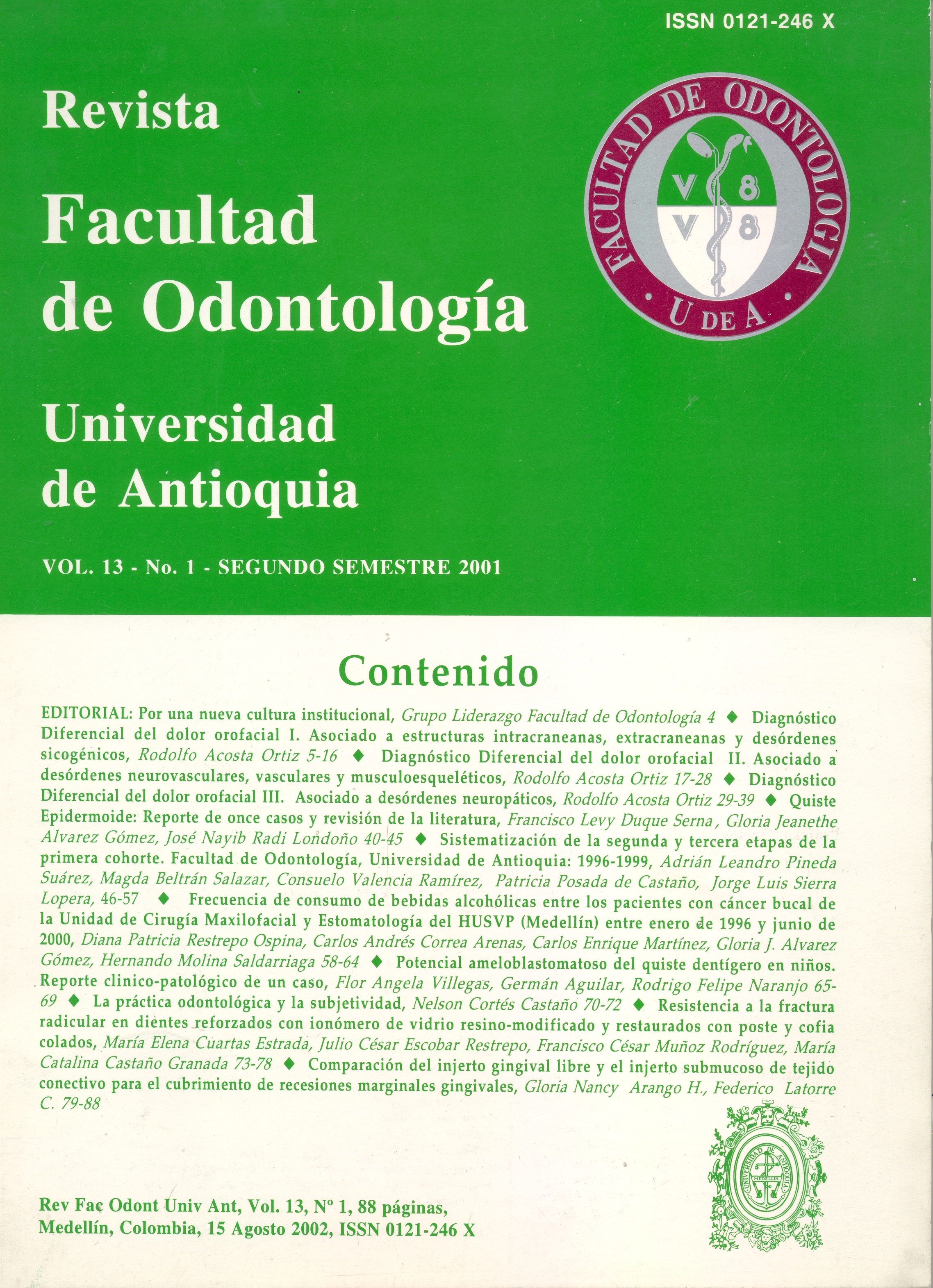
Diagnóstico diferencial del dolor orofacial I: asociado a estructuras intracraneanas, extracraneanas y desórdenes sicogénicos
DOI:
https://doi.org/10.17533/udea.rfo.343847Palabras clave:
Dolor, Dolor orofacial, Dolor facial, Diagnóstico diferencial, Cefaleas, Cefaleas sicogénicas, Cefaleas por tumores cerebralesResumen
El dolor orofacial (DOF) es un problema común en la población y representa una condición potencialmente deteriorante y debilitante. Un diagnóstico correcto es la base principal para un manejo adecuado; en pacientes con DOF esta tarea puede ser pequeña y simple, o bien, convertirse en una experiencia complicada y frustrante para ambos, clínico y paciente. Sin embargo, el conocimiento por parte del clínico de todas las posibles condiciones de dolor que pueden afectar la región orofacial facilitará el proceso diagnóstico. Es importante destacar que es muy difícil diagnosticar algo que no se conoce y aunque "las cosas comunes ocurren comúnmente" no es
extraño encontrar pacientes con patologías "raras", de poca ocurrencia, que el clínico ha olvidado o no conoce. El hecho de que el clínico no considere todos estos aspectos durante la evaluación clínica puede llevarlo fácilmente a confundirse, lo que finalmente terminará en un diagnóstico incorrecto, mal manejo clínico y posiblemente consecuencias devastadoras para los pacientes. Esta es una
serie de tres artículos que tienen como propósito presentar una revisión de la literatura de las condiciones que se han considerado para establecer el diagnóstico diferencial del dolor orofacial. Los dolores asociados a las estructuras intracraneales (cefaleas por tumores cerebrales), extracraneales (dientes, ojos, senos paranasales, entre otros) y el dolor sicogénico serán discutidos en este primer artículo.
Descargas
Citas
Crombie IK, Dvies HTO, Macrae WA. The epidemiology of chronic pain: time for new directions. Pain. 1994; 57(1): 1-3. DOI: https://doi.org/10.1016/0304-3959(94)90102-3
Schiffman EL, Fricton JR, Haley DP, Shapiro Bl. The prevalence and treatment needs of subjects with temporomandibular disorders. J Am Dent Assoc. 1990; 120(3):295-304. DOI: https://doi.org/10.14219/jada.archive.1990.0059
List T, Wahlund K, Wennenberg B, Doworkin SF. TMD in children and adolescents: prevalence of pain, gender differences, and perceived treatment need. J Orofac pain. 1999; 13(1): 9-20.
Von Korff M, Dworkin SF, Le Resche L, Kinger A. An epidemiologic comparison of pain complaints. Pain. 1988; 32(2): 173-83. DOI: https://doi.org/10.1016/0304-3959(88)90066-8
Donaldson D, Kroening R. Recognition and treatment of patients with chronic orofacial pain. J Am Dent Assoc. 1979; 99(6): 961-66. DOI: https://doi.org/10.14219/jada.archive.1979.0421
Dworkin SF. Personal and Societal impact of orofacial pain. In Fricton JR, Dubner R. Advances in pain research and therapy orofacial pain and temporomandibular disorders. New York: Raven Press; 1995.
Turk DC, Rudy TE. Towards a comprehensive assessment of chronic pain patients. Behav Res Ther. 1987; 25(4): 237-49. DOI: https://doi.org/10.1016/0005-7967(87)90002-7
Bush FM, Harkins SW. Pain related limitation in activities of daily living in patients with chronic orofac pain: psychometric properties of a disability index. J Orofacial Pain. 1995. 9(1): 57-63.
Dworkin SF, Massoth DL. Temporomandibular disorders and chronic pain: Disease or illness? J Prosthet Dent. 1994. 72(1): 29-38. DOI: https://doi.org/10.1016/0022-3913(94)90213-5
Dworkin SF. Perspectives on the interaction of biological, psychological and social factors in TMD. J Am Dent Assoc. 1994; 125(7): 856-64. DOI: https://doi.org/10.14219/jada.archive.1994.0212
Vickers ER, Cousins MJ, Woodhouse A. Pain description and severity of chronic orofacial pain conditions. Aust Den J. 1998; 43(6): 403-9. DOI: https://doi.org/10.1111/j.1834-7819.1998.tb00200.x
Gerschman JA, Hall W, Reade PC, Burrows GD, Wright JL, Holwill BJ. Determinants of chronic orofacial Pain. Clin J Pain. 1987; 3(1): 45-53.
Drummond PD. Predisposing, precipitating and relieving factors in different categories of headache. Headache. 1985; 25(1): 16-22. DOI: https://doi.org/10.1111/j.1526-4610.1985.hed2501016.x
Glaros AG, Glass EG, Hayden WJ. History of treatment received by patients with TMD: a preliminary investigation. J Orofac Pain. 1995; 9(2): 147-51.
Miyamoto H, Matsuura H, Wilson DF, Goss AN. Malignancy of the parotid gland with primary symptoms of temporomandibular disorders. J Orofac Pain. 2000; 14(2): 140-6.
Moody DG, Clark GT. Temporomandibular joint derangement with multiple surgical interventions: a case report. J Orofac Pain. 1995; 9(3): 285-92.
Gobetti JP, Turp JC. Fibrosarcoma misdiagnose as a temporomandibular disorder: a cautionary tale. Oral Surg Oral Med Oral Pathol. 1998; 85(4): 404-9. DOI: https://doi.org/10.1016/s1079-2104(98)90065-8
Huntley TA, Wiesenfeld D. Delayed diagnosis of the cause of facial pain with neoplastic disease: a report of eight cases. J Oral
Maxillofac Surg. 1994; 52(1): 81-5. DOI: https://doi.org/10.1016/0278-2391(94)90021-3
Becker N, Thomsen AB, Olsen AK, SjØrgren P, Bech P, Eriksen. Pain epidemiology and health-related quality of life in chronic non-malignant pain patients referred to a Danish multidisciplinary pain center. Pain. 1997; 73(3): 393-400. DOI: https://doi.org/10.1016/s0304-3959(97)00126-7
Lam DK, Lawrence Hp, Tenenbaum HC. Aural symptoms. In temporomandibular patients attending a craniofacial pain unit. J Orofacial Pain. 2001; 15: 146-57.
Mongini F, Ciccone G, Ibertis F, Negro C. Personality characteristics and accompanying symptoms in temporomandibular joint dysfunction, headache, and facial pain. J Orofacial Pain. 2000; 14(1): 52-8.
Kight M, Gatchel RJ, Wesley L. Temporomandibular disorders: evidence for significant overlap with psychopathology. Health Psychol. 1999; 18(2): 177-82. DOI: https://doi.org/10.1037//0278-6133.18.2.177
Acosta-Ortiz R. Historia clínica, examen físico y estrategias adicionales para desórdenes temporomandibulares y dolor orofacial. Rev Estomatología; 2002; 10.
Acosta-Ortiz R, Tallents RH, Macrae D. Introduction to orofacial pain evaluation. Unpublished.
Fricton JR, Kroening R. Practical differential diagnosis of chronic craniofacial pain. Oral Surg Oral Med Oral Pathol. 1982; 54: 628-36.
Graff-Radford SB. Disorders of the mouth and teeth. In Silberstein SD, Lipton RB, Dalessio DJ. Wolff's headache and other head pain. 7 ed. New York: Oxford University Press; 2001.
Macrae D. Intracraneal causes of oral and facial pain. Dent Clin North Am. 1959; 3(2): 529-42. DOI: https://doi.org/10.1016/S0011-8532(22)03327-4
Pfund Z, Szapary L, Jászberenyi O, Nagy F, Czopf J. Headache in intracranial tumors. Cephalalgia. 1999; 19(9): 787-90. DOI: https://doi.org/10.1046/j.1468-2982.1999.1909787.x
The epidemiology of headache among children with brain tumor. Headache in children with brain tumors. The childhood brain tumor consortium. J Neuro-Oncolo. 1991; 10(1): 31-46. DOI: https://doi.org/10.1007/bf00151245
Medina LS, Pinter JD, Zurakowski D, Davis RG, Kuban K, Barnes PD. Children with headache: clinical predictors of surgical space-occupying lesions and the role of neuroimaging. Radiology. 1997; 202(3): 819-24. DOI: https://doi.org/10.1148/radiology.202.3.9051039
Bullitt E, Tew JM, Boyd J. Intracranial tumors in patients with facial pain. J Neurosurg. 1986; 64(6): 865-71. DOI: https://doi.org/10.3171/jns.1986.64.6.0865
Forsyth PA, Posner JB. Headaches in patients with brain tumors: a study of 111 patients. Neurology. 1993; 43(9): 1678-83. DOI: https://doi.org/10.1212/wnl.43.9.1678
Rossi LN, Vassella F. Headache in children with brain tumors. Childs Nerv Syst. 1989; 5(5): 307-09. DOI: https://doi.org/10.1007/bf00274519
Nguyen M, Maciewicz R, Bouckoms A, Poletti C, Ojeman R. Facial pain symptoms in patients with cerebellopontine angle tumors: a report of 44 cases of cerebellopontine angle meningioma and a review of the literature. Clin J Pain. 1986; 2(1): 3-9.
Nemer JA, Tallick SA, O'Connor RE, Reese CL. Emergency medical services transport of patients with headache: mode of arrival may indicate serious etiology. Prehosp Emerg Care. 1998; 2(4): 304-07. DOI: https://doi.org/10.1080/10903129808958885
Monaghan AM, McKinlay KP. An intracranial tumor causing dental pain. Br Dent J. 1991; 171(8): 249-50. DOI: https://doi.org/10.1038/sj.bdj.4807679
Luyk NH, Hammond-Tooke G, Bishara SN, Ferguson MN. Facial pain and muscle atrophy secondary to an intracraneal tumor. Br J Oral & Maxillofac Surg. 1991; 29(3): 204-07. DOI: https://doi.org/10.1016/0266-4356(91)90041-3
Levyman C, Dagua Filho dos S, Volpato MM, Settani FA, De lima WC. Epidermoid tumor of the posterior fossa causing multiple facial pain-a case report. Cephalalgia. 1991; 11(1): 33-6. DOI: https://doi.org/10.1046/j.1468-2982.1991.1101033.x
Couch JR. Headache to worry about. Med Clin North Am. 1993; 77(1): 141-67. DOI: https://doi.org/10.1016/s0025-7125(16)30277-2
Gionnaoni C, Sulek M, Friedman EM. Intracranial complications of sinusitis: a pediatric series. Am J Rhinol. 1998; 12(3): 173-6. DOI: https://doi.org/10.2500/105065898781390127
Lipton JA, Ship JA, Larach-Robinson D. Estimated prevalence and distribution of reported orofacial pain in the United States. J Am Dent Assoc. 1993; 124(10): 115-21. DOI: https://doi.org/10.14219/jada.archive.1993.0200
Ingle JI, Taintor JF. Endodontics. 4 Ed. Chicago: Williams&Wilkins; 1994.
Okeson JP, Falace DA. Nonodontogenic toothache. Dent Clin North Am. 1997; 41(2): 367-83.
Acosta-Ortiz R. Odontalgias de etiología no dental. Rev Fed Odontol Colomb. 2002; (201). 53-62.
Wright EF, Gullickson DC. Identifying acute pulpalgia as a factor in TMD pain. J Am Dent Assoc. 1996; 127(6): 773-80. DOI: https://doi.org/10.14219/jada.archive.1996.0313
Wahl P, Weathers AK Jr. The challenge of the endodontic diagnosis. Oral Health. 1997; 87(6): 45-9.
Homewood CI. Cracked tooth syndrome: incidence, clinical findings and treatment. Aust Dent J. 1998; 43(4): 217-22.
Cameron CE. The cracked tooth syndrome: additional findings. J Am Dent Assoc. 1976; 93(5): 971-5. DOI: https://doi.org/10.14219/jada.archive.1976.0034
Wright EF. Diagnosis, treatment, and prevention of incomplete fractures. General Dent. 1992; 40: 390-9.
Okeson JP. Bell's orofacial pain. Chicago: Quintessense Publishing; 1995.
Batchelder BJ, Krutchkoof DJ, Amara J. Mandibular pain as the initial and sole clinical manifestation of coronary inssufficiency: report of case. J Am Dent Assoc. 1987; 115(5): 710-11. DOI: https://doi.org/10.14219/jada.archive.1987.0291
Chukwuemeka AO, John LC. An unusual case of unilateral facial pain. Inter J Clin Practi. 1999; 53(4): 312.
Natkin E, Harrington GW, Mandel MA. Anginal pain referred to the teeth. Oral Surg. 1975; 40(5): 678-80. DOI: https://doi.org/10.1016/0030-4220(75)90378-3
Kreiner M, Okeson JP. Toothache of cardiac origin. J Orofac Pain. 1999; 13(3): 201-7.
Hans P. The differential diagnosis of eye diseases. Philadelphia: Saunders; 1978.
Rosenblatt MA, Sakol PJ. Ocular and periocular pain. Otorhino Clin North Am. 1989; 22(6): 1173-203.
Tomsak RL. Opthalmologic aspects of headache. Med Clin North Am. 1991; 75(3): 693-706. DOI: https://doi.org/10.1016/s0025-7125(16)30443-6
Hayreh SS, Podhajsky PA, Zimmerman B. Occult giant cell arteritis: ocular manifestations. Am J Ophtalmol. 1998; 125(4): 521-6. DOI: https://doi.org/10.1016/s0002-9394(99)80193-7
Hayreh SS, Podhajsky PA, Zimmerman B. Ocular manifestation of giant cell arteritis. Am J Ophtalmol. 1998; 125(4): 509-20. DOI: https://doi.org/10.1016/s0002-9394(99)80192-5
Vernick DM, Warfield CA. Diagnosis and treatment of otalgia. Hosp pract. 1987; 22(3): 170-8.
Wazen JJ. Referred otalgia. Otolaryngol Clin North Am. 1989; 22(6): 1205-15.
McDonald JS. Otalgia. In Hughes GB, Pensak ML. Clinical otology. 2 ed. New York: Thieme; 1997.
O'Connor AF. Examination of the ear. London: Scott-Brown's otolaryngology; 1987.
Lance JW. Red ear syndrome. Neurology. 1996; 47(3): 617-20. DOI: https://doi.org/10.1212/wnl.47.3.617
Wengraf C, Booth JB. Otalgia. London: Scott-Brown's otolaryngology; 1987.
Yanagisawaka K, Kveton JF. Referred otalgia. Am J Otolaryngol. 1992; 13(6): 323-7. DOI: https://doi.org/10.1016/0196-0709(92)90072-2
Clark JL. Otalgia: identifying the source. Postgrad Med. 1981; 70(4): 99-103. DOI: https://doi.org/10.1080/00325481.1981.11715880
Levine HL. Otorhynolaryngologic causes of headache. Med Clin North Am. 1991; 75(3): 677-92. DOI: https://doi.org/10.1016/s0025-7125(16)30442-4
Ciancaglini R, Loreti P, Radaelli G. Ear, nose, and throat symptoms in patients with TMD: the association of symptoms according to severity of arthropathy. J Orofac Pain. 1994; 8(3): 293-7.
Kreisberg MK, Turner J. Dental causes of referred otalgia. Ear NoseThroat J. 1987; 66(10): 398-408.
Copobianco DJ. Facial pain as a symptom of nonmetastasic lung cancer. Headache. 1995; 35(10): 581-5. DOI: https://doi.org/10.1111/j.1526-4610.1995.hed3510581.x
Close LG, Aviv J. Headaches and disease of the nose and paranasal sinuses. Semin Neurol. 1997; 17(4): 351-4. DOI: https://doi.org/10.1055/s-2008-1040948
SchoØsten-Madsen U, Stoksted P, Christensen PH, Koch-Henriksen N. Chronic headache related to nasal obstruction. J Laryngol Otol. 1986; 100(2): 165-70. DOI: https://doi.org/10.1017/s0022215100098911
Pinto A, De Rossi SS, McQuone S, SollecitoTP. Nasal mucosal headache presenting as orofacial pain: a review of the literature and a case report. Oral Surg Oral Med Oral Pathol. 2001; 92(2): 180-3. DOI: https://doi.org/10.1067/moe.2001.114006
Abu-Bakra M, Jones NS. Prevalence of nasal mucosal contact points in patients with facial pain compared with patients without facial pain. J Laryngol Otolo. 2001; 115(8): 629-32. DOI: https://doi.org/10.1258/0022215011908685
Naumann HH. Differential diagnosis in otorhinolaryngology. New York: Thieme Medical, 1993.
Bruyn GW. Stylohyoid syndrome (Eagle). In Vinken PJ, Bruyn GW, Klawans HL. Handbook of clinical neurology. Vol 4: Headache. New York: Elsevier Sciance; 1986.
Manssey EW, Massey J. Elongated stylohyoid process (Eagle's syndrome) causing hemicrania. Headache. 1979; 19(6): 339-41. DOI: https://doi.org/10.1111/j.1526-4610.1979.hed1906339.x
Mahan PE, Alling CC. Facial Pain. 3 ed. Philadelphia: Lea & febiger; 1991.
Hadley JA, Schaefer SD. Clinical evaluation of rhinosinusitis: history and physical examination. Otolaryngol Head Neck Surg. 1997; 117(3): S2-S11.
Friedman WH, Rosemblum BN. Paranasal sinus etiology of headache and facial pain. Otolaryngol Clin North Am. 1989; 22(6): 1217-28.
Fireman P. Diagnosis of sinusitis in children: emphasis on the history and physical examination. J Allergy Clin Inmunol. 1992; 90(3): 433-6. DOI: https://doi.org/10.1016/0091-6749(92)90164-w
Chow JM. Rhinologic headaches. Otolaryngol Head Neck Surg. 1994; 111(3 pt 1): 211-8. DOI: https://doi.org/10.1177/01945998941113p109
Rosbe KW, Jones KR. Usefulness of patient symptoms and nasal endoscopy in the diagnosis of chronic sinusitis. Am J Rhinol. 1998; 12(3): 167-71. DOI: https://doi.org/10.2500/105065898781390208
Williams JW Jr, Simel DL, Roberts L, Samsa GP. Clinical evaluation for sinusitis: making the diagnosis by history and physical examination. Ann Inter Med. 1992; 117(9): 705-10. DOI: https://doi.org/10.7326/0003-4819-117-9-705
Laine K, Määttä T, Varonen H, Mäkelä M. Diagnosing acute maxillary sinusitis in primary care: a comparison of ultrasound, clinical examination and radiography. Rhinology. 1998; 36(1): 2-10.
Schor D. Headache and facial pain, the role of the paranasal sinues: a literature review. Cranio. 1993; 11(1): 36-47. DOI: https://doi.org/10.1080/08869634.1993.11677939
Truelove E. Management of mucosal pain. In Lund JP, Lavigne GJ, Dubner R, Sessle BJ. Orofacial pain: form basic science to clinical management. Chicago: Quintessence; 2001.
Morrish RB Jr. Differential diagnosis of oral lesions and their relationship to orofacial pain. In Fricton JR, Dubner R. Advances in pain research and therapy orofacial pain and temporomandibular disorders. New York: Raven Press; 1995.
Bergdahl M, Bergdahl J. Burning mouth syndrome: prevalence and associated factors. J Oral Pathol Med. 1999; 28(8): 350-4. DOI: https://doi.org/10.1111/j.1600-0714.1999.tb02052.x
Ship JA, Grushka M, Lipton JA, Mott AE, Sessle BJ, Dionne RA. Burning mouth syndrome: an update. J Am Dent Assoc. 1995; 126(7): 842-53. DOI: https://doi.org/10.14219/jada.archive.1995.0305
Tourne LPM, Fricton JR. Burning mouth syndrome: clinical review and proposed clinical management. Oral surg Oral Pathol Oral Med. 1992; 74(2): 158-67. DOI: https://doi.org/10.1016/0030-4220(92)90376-2
Grushka M. Clinical features of burning mouth syndrome. Oral surg Oral Pathol Oral Med. 1897; 63(1): 30-6. DOI: https://doi.org/10.1016/0030-4220(87)90336-7
Heir GM, Fein LA. Lyme disease: consideration for dentistry. J Orofac Pain. 1996; 10(1): 74-86.
Hathaway KM. Psychiatric and somatoform pain disorders: the less common of the diagnosis. In Fricton JR, Kroening RJ, Hathaway KM. TMJ and craniofacial pain. St. Louis: Inhiyaku Euroamérica; 1988.
Fordyce WE, Steger JC. Chronic pain. In Pomerteau DF, Brady JP (eds). Behavioral medicine theory and practice. Baltimore: Williams & Wilkins; 1978.
Dworkin SF, Burgess JA. Orofacial pain of psychogenic origin: current concepts and classification. J Am Dent Assoc. 1987; 115(4): 565-71. DOI: https://doi.org/10.1016/s0002-8177(87)54009-0
Von Korff M, Le Resche L, Dworkin SF. First onset of common pain symptoms: a prospective study of depression as a risk factor. Pain. 1993; 55 (2): 251-8. DOI: https://doi.org/10.1016/0304-3959(93)90154-h
Adler RH, Zamboni P, Hofer, Hemmeler W, Hürny C, Minder C et al. How not to miss a somatic needle in the haystack of chronic pain. J Psychosom Res. 1997; 42(5): 499-506. DOI: https://doi.org/10.1016/s0022-3999(97)00005-6
Fusco MF, Freedman PD, Black SM, Lumerman H. Münchausen's syndrome: report of case. J Am Dent Assoc. 1986; 112(2): 210-3. DOI: https://doi.org/10.14219/jada.archive.1986.0327
Hackectt TP; Cassem NH. Massachuset General Hospital: handbook of pychiatry. 2 ed. Littleton: Company; 1987.
Blumer D, Heilbronn M. Chronic pain as a variant of depressive disease: the pain-prone disorder. J Nervous Mental Dis. 1982; 170(7): 381-94. DOI: https://doi.org/10.1097/00005053-198207000-00001
Hathaway K. Comunicación personal. 1999.
Descargas
Publicado
Cómo citar
Número
Sección
Categorías
Licencia
Derechos de autor 2001 Revista Facultad de Odontología Universidad de Antioquia

Esta obra está bajo una licencia internacional Creative Commons Atribución-NoComercial-CompartirIgual 4.0.
El Derecho de autor comprende los derechos morales y los derechos patrimoniales.
1. Los derechos morales: nacen en el momento de la creación de la obra, sin necesidad de registro. Corresponden al autor de manera personal e irrenunciable; además, son imprescriptibles, inembargables y no negociables. Son derechos morales el derecho a la paternidad de la obra, el derecho a la integridad de la obra, el derecho a conservar la obra inédita o publicarla bajo seudónimo o anónimamente, el derecho a modificar la obra, el derecho al arrepentimiento, y el derecho a la mención, según definiciones consignadas en el artículo 40 del Estatuto de propiedad intelectual de la Universidad de Antioquia (RESOLUCIÓN RECTORAL 21231 de 2005).
2. Los derechos patrimoniales: consisten en la facultad de disponer y aprovecharse económicamente de la obra por cualquier medio. Además, las facultades patrimoniales son renunciables, embargables, prescriptibles, temporales y transmisibles, y se causan con la publicación, o con la divulgación de la obra. Para el efecto de la publicación de artículos de la Revista de la Facultad de Odontología se entiende que la Universidad de Antioquia es portadora de los derechos patrimoniales del contenido de la publicación.
Yo, el(los) autor(es), y por mi(nuestro) intermedio, la Entidad para la que estoy(estamos) trabajando, transfiero(imos) de manera definitiva, total y sin limitación alguna a la Revista Facultad de Odontología Universidad de Antioquia, los derechos patrimoniales que le corresponden sobre el artículo presentado para ser publicado tanto física como digitalmente. Declaro(amos) además que este artículo ni parte de él ha sido publicado en otra revista.
Política de Acceso Abierto
Esta revista provee acceso libre inmediato a su contenido, bajo el principio de que poner la investigación a disposición del público de manera gratuita contribuye a un mayor intercambio de conocimiento global.
Licencia Creative Commons
La Revista facilita sus contenidos a terceros sin mediar para ello ningún tipo de contraprestación económica o embargo sobre los artículos. Para ello adopta el modelo de contrato de licenciamiento de la organización Creative Commons denominada Atribución – No comercial – Compartir igual (BY-NC-SA). Esta licencia les permite a otras partes distribuir, remezclar, retocar y crear a partir de la obra de modo no comercial, siempre y cuando nos den crédito y licencien sus nuevas creaciones bajo las mismas condiciones.

Esta obra está bajo una Licencia Creative Commons Atribución-NoComercial-CompartirIgual 4.0 Internacional.




